The Givens Castle

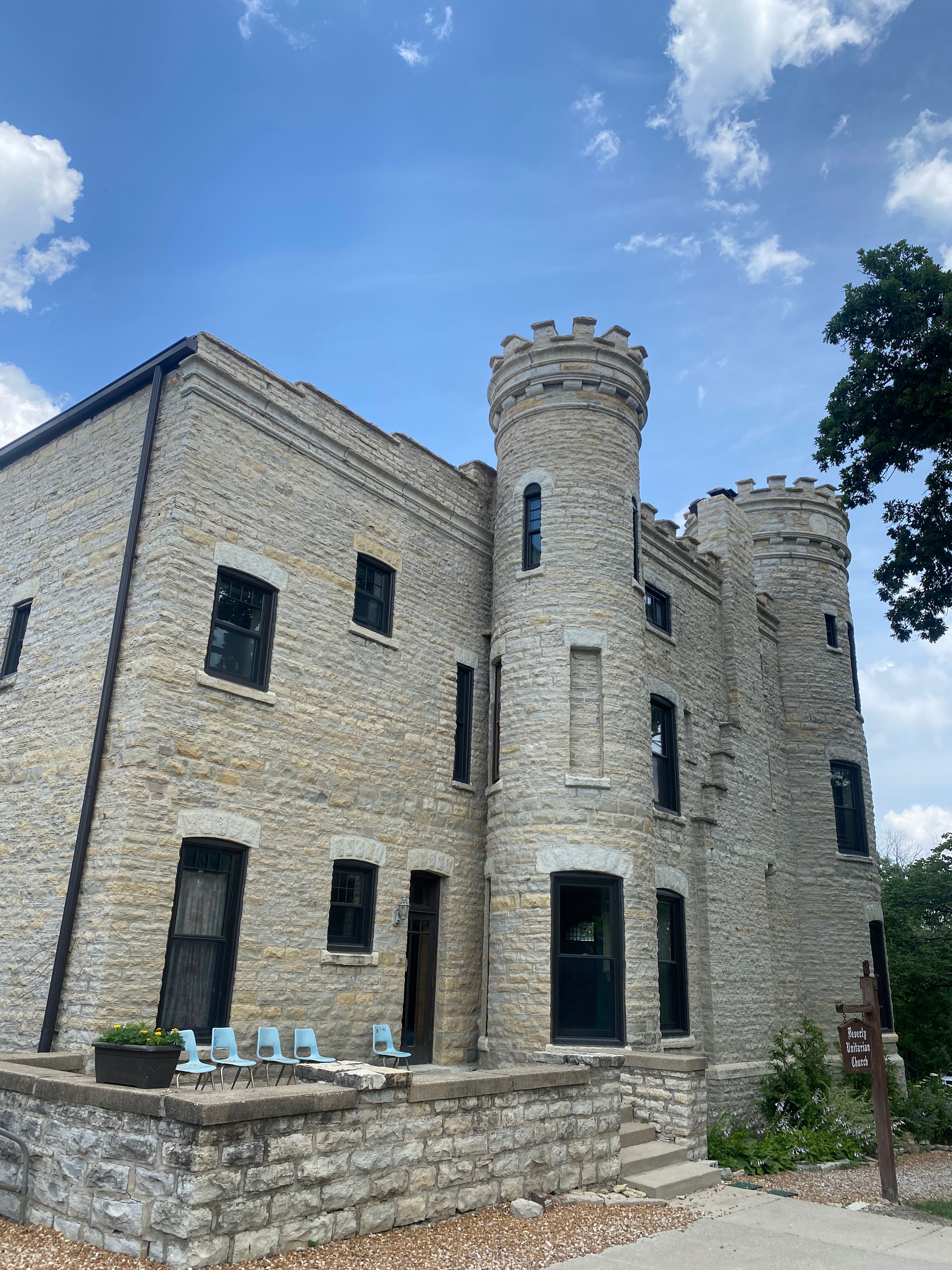
10244 S. Longwood Drive
Chicago, IL 60643
(Beverly)
Nobody is furious. Nobody hates these people.
At least, nobody driving by in this car.
It is only natural, however, that it should occur to us
How much more fortunate they are than we are.
It is only natural that we should look and look
At their wood and brick and stone
And think, while a breath of pine blows,
How different these are from our own.
We do not want them to have less.
But it is only natural that we should think we have not enough.
We drive on, we drive on.
When we speak to each other our voices are a little gruff.
Excerpted from Gwendolyn Brooks’s “Beverly Hills, Chicago”
you must be
made of money.
your parents
must have grown
on trees.
bet you’re black
tinged with green.
bet you sleep
on bags of it.
bet your barbies
climb it.
bet you never
wanted.
bet you never
had to ask.
bet you golf.
bet you tennis.
bet you got
a summer house.
bet you got
a credit card
for your 5th birthday.
bet you played
with bills for toys.
bet you chew
them up
for dinner.
bet you spit
your black out
like tobacco
that’s why you talk so
bet you listen to green day.
bet you ain’t never heard of al.
bet your daddy wears a robe
around the house.
bet his hands are soft as a frog’s belly.
bet your house is on a hill.
bet the grass is freshly cut.
bet you feel like a princess.
bet the police protect your house.
bet you know their first names.
bet your house has a hundred rooms.
bet a black lady comes to clean them.
Jamila Woods’s “beverly, huh.”
Beverly is one of the 77 Community Areas of Chicago. Officially, it is bounded by Western Avenue on the west, the Cook County Forest Preserves’ Dan Ryan Woods on the north, roughly by Beverly Boulevard on the east north of 99th Street, and the Rock Island Metra railroad tracks south of 99th Street, and by 107th Street on the south. Before the turn of the 20th century, Beverly was an elite, rural Chicago suburb, with the Blue Island Ridge as its backbone. Real estate developer Robert Cartwright Givins saw opportunity in the wild, open prairie, and concocted a way to attract buyers to the area. Historian Errol Magidson dubbed Givins the "P.T. Barnum of Chicago developers." Givins started building what would become known as The Givins Castle in 1886, three years before Beverly was folded into Chicago proper as part of a large expansion. It would act as a gigantic billboard hawking the South Side’s charms. Givins sold a bunch of these sub-divided prairie plots to wealthy Chicagoans, though his business (and fortunes) crashed in the Panic of 1893. Five primary residents have inhabited the castle in its almost century-and-a-half existence, including the Beverly Unitarian Church from 1942 until the present.
When Gwendolyn Brooks wrote the poem, “Beverly Hills, Chicago” in 1949, she lived in the overpopulated, predominantly Black Bronzeville neighborhood. The poem studies the exclusively white, affluent Beverly neighborhood, specifically the manicured lawns in the mansions along the ridge, from a perspective of people excluded from that kind of prosperity. The economic disparity Brooks highlights in that poem reflects broader human experiences, particular of ordinary Black Chicagoans.
The intervening 66 years between Brooks’s poem and Jamila Woods’s “beverly, huh. (Poetry magazine, December 2015) changed little, judging by the recurring have-have not theme. Woods, a multidisciplinary artist, spent most of her formative years in Beverly, around West 100th Street and South Western Avenue.
Vast sections of Beverly—especially south of 99th Street and west of Western Avenue--remained completely open prairie until the 1940s and 1950s.
According to historian and local resident Ellen Skerrett’s article about Beverly in the Encyclopedia of Chicago, “Beyond the post– World War II baby boom, Beverly's increase in population between 1940 and 1960, from 15,910 to 24,814, was due in large measure to racial change in such neighborhoods as Englewood, Normal Park, and South Shore.” As whites fled such neighborhoods due in part to the Supreme Court’s decision in Shelley v. Kraemer that outlawed racially restrictive real estate covenants, they found refuge in still-racially-stable Beverly.
According to Chicago writer Edward Robert McClelland in a 2022 article in Chicago magazine, “Whites who were forced to remain in Chicago, to meet municipal job residency requirements, isolated themselves in suburban-style neighborhoods at the city’s fringes: Beverly, Mount Greenwood, Norwood Park, and Edison Park still have white populations between 56 and 82 percent.”
And, according to Alma Campos and Chima Ikoro in South Side Weekly (accessed via an undated online version on WTTW.com), while “[l]ike Hyde Park, Beverly is considered one of Chicago’s most diverse neighborhoods. . . . Beverly was one of the first Chicago neighborhoods to build cul-de-sacs, which very clearly divided it from surrounding Black neighborhoods. In the 1990s, the city built eleven concrete cul-de-sacs and diverters in the area north of 95th Street with restricted car access and only three points of entry: 91st Street and Western Avenue; 95th and Leavitt; and 95th and Damen Avenue.”
Due to economic realities, developers opted away from opulent homes and toward brick bungalows, Georgian-style homes, and ranch houses. Eventually, that’s what filled these empty fields. These smaller homes were considerably more affordable for middle-class buyers. The neighborhood population went from Gilded Age railroad tycoons to Chicago cops, firefighters, and public-school teachers. It became a strong enclave of Union workers. In 1990, it was still around 73 percent white and 24 percent Black; in 2000, it was around 63 percent black and 32 percent Black. In 2026, Beverly counts as one of Chicago’s most integrated neighborhoods, with around 57 percent white, 31 percent Black, and almost seven percent Hispanic. However, the Black population tends to be concentrated on the eastern and northern edges of the neighborhood. Beverly is made up of parts of seven census tracts; as of the 2010 census the two northernmost tracts and two of the easternmost tracts were majority Black; the two southwesternmost tracts were majority white.
Givins wrote several popular fiction books in the late 19th and early 20th centuries, including The Millionaire Tramp (1886) and The Rich Man's Fool (1890). The eclectic writer frequently published his Victorian-era fiction under the backwards pseudonym Snivig C. Trebor. His stories mirrored his real estate background, often focusing on extreme wealth, social class divides, sweeping travel, or eccentric sci-fi inventions. Beyond fiction, Givins was an avid globetrotter who wrote widely read travel reviews and literary columns published in the Chicago Evening Post.
When the Givins family vacated the property due to the economic pressures of the Panic of 1893, the building was leased to the Chicago Female College from 1895 to 1897. The president and head administrator of this elite young women's finishing school was Julia Thayer. Thayer was a widely respected regional educator and a prolific late-Victorian poet. During her two years running the school out of the stone fortress, she actively composed poetry and essays. In her journals, she wrote extensively about how the castle’s majestic interior, glowing copper gaslights, and sweeping views of the ridge served as a massive creative inspiration for both her and her young female students. Though Thayer did not publish any books in her lifetime, The Magazine of Poetry and Literary Review dedicated an 1889 multi-page biographical spread and retrospective to Thayer's poetry, introducing her work to a national audience of literary critics. After the college closed, she remained in the Chicago area and opened the Studio of General Culture and Literary Training. Through this school, she spent years training local Chicagoans in proper public speech, conversational skills, and essay writing, directly shaping the next generation of the city's authors, journalists, and club leaders.
In more recent decades, the poets Nate Marshall and Woods are among the accomplished contemporary authors with connections to Beverly. Marshall used to ride the bus along Longwood Drive enroute to his grade school, the Keller Regional Gifted Center.