Former tavern building

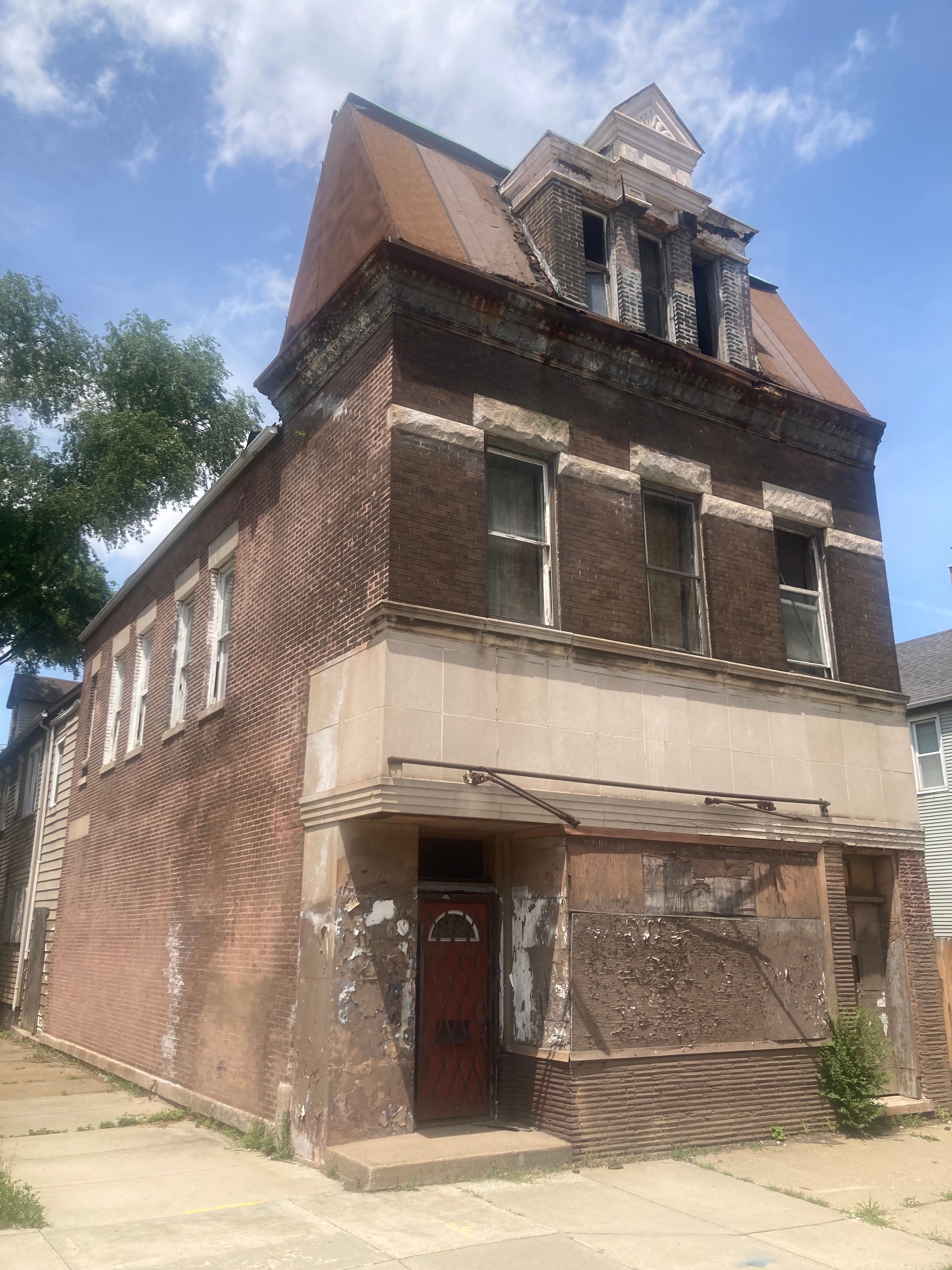
8358 S. Burley Avenue
Chicago, IL 60617
(South Chicago / Bush neighborhood)
From 79th Street
South Works flexed its
muscle of light,
an infinite halo
of orange and white;
like they had captured
the sun
in four steel walls . . .
And they had.
Its mighty slag
filled potholes on
Torrance Avenue clear down
to the Calumet River;
where it lay in heaps
like dirty linen.
Tony Fitzpatrick’s epic book-length, illustrated poem Bum Town (2001)
Bounded roughly by 83rd Street on the north, 86th street on the south, the Metra Electric District Line to the west, and the former U.S. Steel South Works site (now Steelworkers Park and Park No. 566 “USX”) at Green Bay Avenue on the east.
The small Bush neighborhood is part of the South Chicago Community Area. Its boundaries are roughly 83rd Street on the north, 87th street on the south, the Metra Electric District Line to the west, and the former U.S. Steel South Works site (now Steelworkers Park and Park No. 566 “USX”) on the east. The South Works dominated the neighborhood, employing most of its residents and filling its streets with the sounds, smells, and industrial output of the steel production process. The North Chicago Rolling Mills first established a 73-acre steel mill at the South Works site in 1880. Eventually, the facility would expand up to 575 acres by dumping slag into the lake. After years of a dwindling workforce due to production efficiency, foreign competition, and a series of energy crises, South Works closed on April 10th, 1992.
Chicago artist, writer, and actor Tony Fitzpatrick’s epic book-length, illustrated poem Bum Town (2001) opens with a description of the South Works, as seen from 79th Street to the north. According to his Block Club Chicago obituary from October 14, 2025, Tony Fitzpatrick (1958 – 2025) had his artwork “displayed at the Art Institute of Chicago, Philadelphia Museum of Modern Art and New York’s Museum of Modern Art and the Met, among other places. His intricate multimedia collages and paintings weave in images of the city [of Chicago] close to his heart. . . .The born-and-bred Chicago artist also acted, appearing in various stage productions and movies like “Philadelphia,” “Primal Fear,” “U.S. Marshals” and local series like “Chi-Raq” and “ER.” He had a recurring role in the Amazon series “Patriot.””
In addition to Bum Town, his books included The Wonder: Portraits of a Remembered City, volumes 1, 2 & 3, This Train: An Artist's Journal, Dime Stories, The Secret Birds, Max and Gaby's Alphabet, Dirty Boulevard, The Apostles of Humboldt Park, and The Sun at the End of the Road: Dispatches from an American Life.
The Bush neighborhood was one of the “original mill neighborhoods” of the South Chicago community area, according to the Encyclopedia of Chicago. As new ethnic groups arrived to work in the steel mills in the early 20th Century, they settled in the Bush and other neighborhoods close to the mills, while more established ethnic groups “tended to migrate [southeast] across the [Calumet] river to the better neighborhoods on the East Side.” The Bush was “[b]athed in the soot of the steel furnaces [and] became notorious throughout Chicago for its poor environmental and economic conditions.”
In the late 19th Century through much of the 20th, the streetcorner tavern was an important “third place” in Chicago’s working class, immigrant neighborhoods. Taverns were also among the service businesses that augmented neighborhood economies and catered to the workers of Chicago’s industrial neighborhoods.
This is the area of Hugo Martinez-Serros’ childhood and where many of his stories are set. In Martinez-Serros’ story “The Last Laugh,” (see Our Lady of Guadalupe Church for a detailed biography of Martinez-Serros) a Mexican American family lives above a tavern named “Burley Liquors” during the 1930s or 1940s. It is unclear whether Martinez-Serros modeled the fictional tavern on a particular real-life building, but this is one of multiple former tavern buildings in the Bush that could have been his inspiration. In the story, Martinez-Serros’ recurring Mexican immigrant patriarch character Jose Maria makes a deal with the owner of the tavern building, a local doctor. Under the deal, Jose Maria and his family refurbish and move into the “large flat” above the tavern, a “rattrap” previously used by two alcoholic regulars of the tavern for parties. The rent is “a pittance” but the boys – Jaime and Lazaro – must also stoke the basement furnace for the building, providing consistent heat that had been previously lacking. While this arrangement provides the family with a place to live, it incurs the resentment of the two regulars, who resent the boys’ intrusion into their basement crash pad. The two regulars also endure the ridicule of the bartender Morris and the bar patrons because of the Mexican boys’ success in maintaining the same furnace that the two regulars had previously claimed did not work.
The story vividly describes the tavern and its culture: “Burley Liquors was open seven days a week, from early morning until after midnight. Lazaro and Jaime grew accustomed to entering it, yet they never forgot it was a man’s world, a place for adults, for tough women. There, voices were loud, laughter raucous, the air thick with cigarette smoke and the reek of alcohol and the foulest language they have ever heard. It was a place that made them feel like intruders, that admitted them grudgingly. They were quick to spot a hostile eye, to see bodies stiffen at their entry, to detect disapproving silences. But Morris was there – short, thickset, massive, like a bulldog, the bulldog on the nose of a Mack truck, or the truck itself – and they knew they were safe.”