Our Lady of Guadalupe Catholic Church

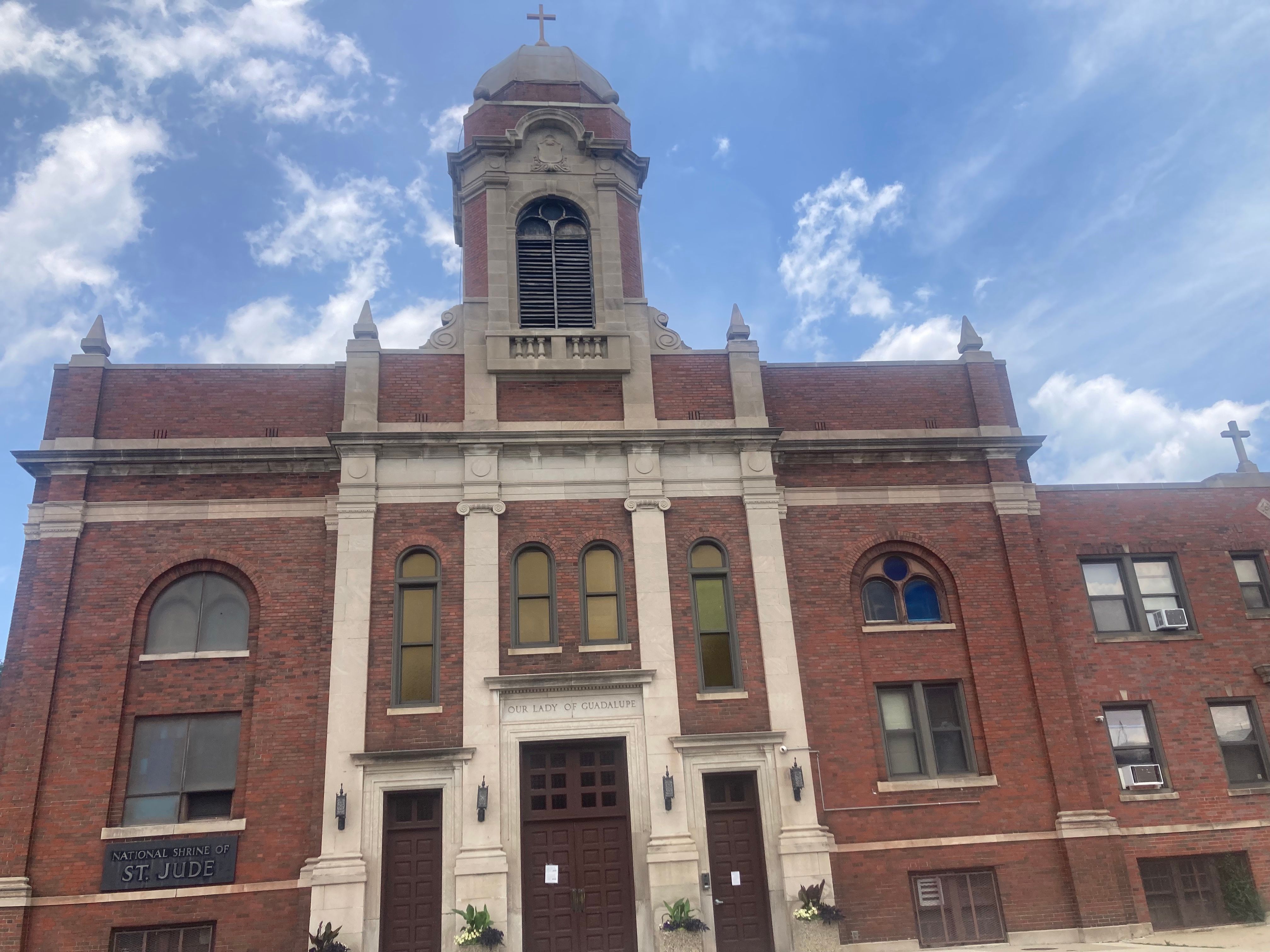
3200 E. 91st Street
Chicago, IL 60617
(South Chicago)
Hugo Martinez-Serros (1930-2026) was a professor of Latin American and Spanish Literature at Lawrence University in Appleton, Wisconsin for 29 years, from 1966-1995. He previously taught at Knox College and the University of Oklahoma. He earned a bachelor’s degree in Spanish from the University of Chicago, and master’s degree and Ph.D. from Northwestern University. His first and most well-known collection of short fiction is The Last Laugh and Other Stories (1988). His other works include the collection Steeling Chicago: South Side Stories and the novels Enamored Dust and The Brothers Duran of Mexican South Chicago.
In a tribute published after his death, Lawrence University recalled Martinez-Serros as “committed to education and social justice. He adored teaching and though he expected much of his students, he was always encouraging and supportive of them.” One former student recalled that Martinez-Serros “was obsessive in his drive to have students not simply read and follow plot, but also to live within the words on the page . . . [and] never let general observations on characters or narrative go unchallenged, always exhorting the student to justify based on text.” Another former student remembered him as encouraging her “to be open, to adapt, and to fully embrace a new culture—even when it meant stepping far outside my comfort zone and learning to accept whatever was placed before me.”
When Martinez-Serros retired from Lawrence, he was awarded an honorary degree and cited for his stories “’rich, blistering indictments of racism’” and for being “a pioneer of the study of Spanish-American literature.”
Most of Martinez-Serros stories depict young Mexican American immigrant boys who live in this area during the 1930s or 1940s. Martinez-Serros variously uses first, second, and third person narration to depict the challenges of the boys’ lives as poor immigrants in this working-class neighborhood in the shadow of steel mills, crisscrossed by railroads and streetcars. While most of his characters are Mexican American, white ethnic and Black residents appear in the stories, with white characters often figures of authority such as teachers, landlords, and streetcar conductors. Often the protagonist boys are the children of Jose Maria Rivera, a hard-working, imposing, sometimes-cruel father who works in a steel mill.
While Our Lady of Guadalupe Church (3200 E. 91st Street) has been a major community institution in South Chicago’s Mexican American community since its’ founding in 1923, Martinez-Serros’ characters do not go to church and attend public school. In one story, “Learn, Learn,” the religious skeptic Jose Maria sends his sons to regularly pick up the church bulletin, so he can identify mistakes in the pastor’s writing and needle him with anonymous letters pointing out his errors. The pastor, Fr. Tortas, may be a fictional depiction of Fr. James Tort, the Claretian priest who oversaw the building of the current church building in 1929.
Another neighborhood institution important to the young boys in several of Martinez-Serros’ stories is the South Chicago YMCA, located just west of Our Lady of Guadalupe at 3039 E. 91st Street. The YMCA closed in 2017 after more than 90 years serving the community. The building was adaptively redeveloped and reopened as senior housing in 2021.