Trumbull Park Homes

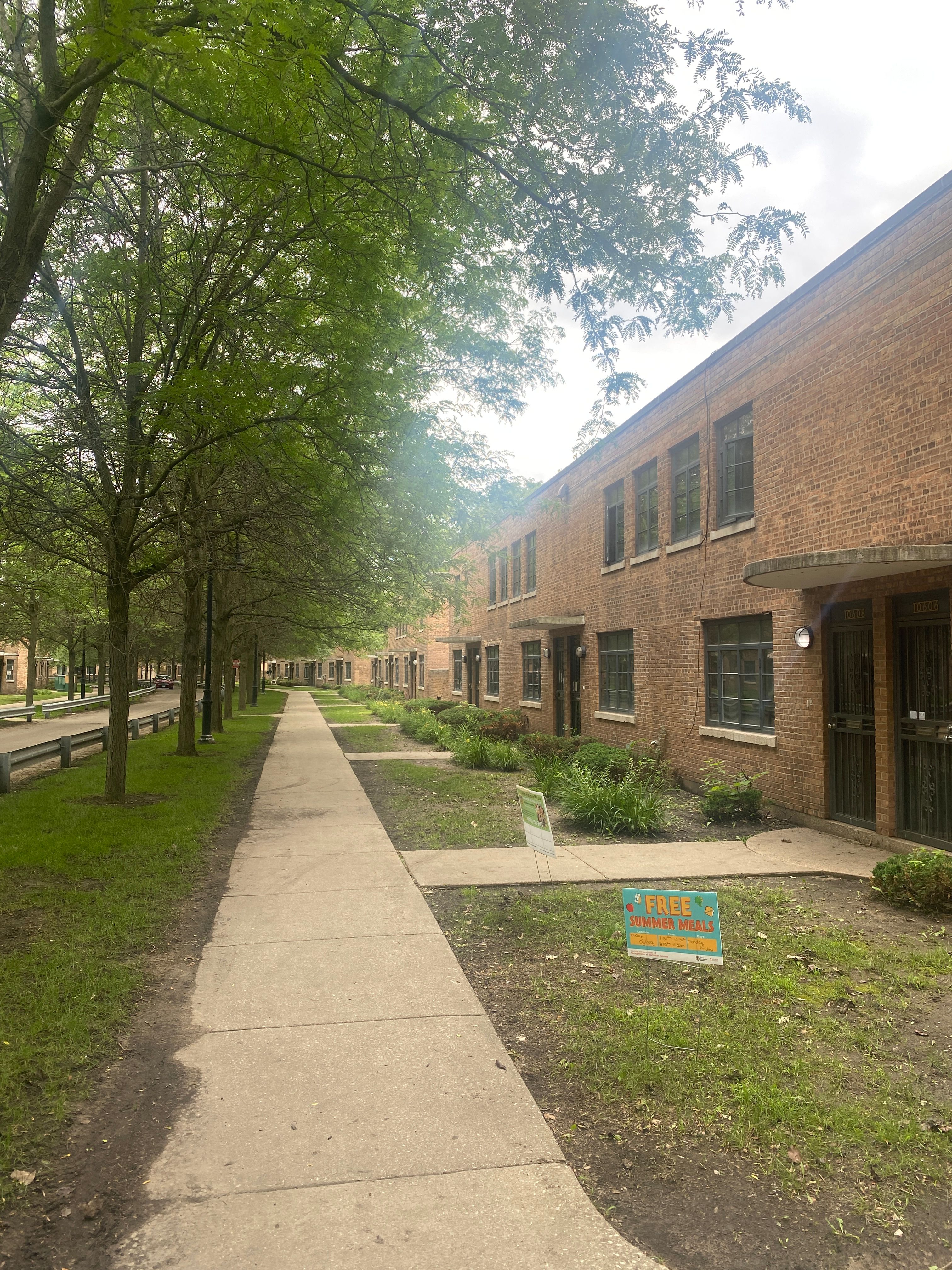
2437 E. 106th St.
Chicago, IL 60617
(South Deering)
And we walked and walked and walked—walking through the great Trumbull Park, Buggy walking to Helen, Harry walking to his wife Margaret, walking to all of our friends there. Walking. Mobs screaming, throwing things, pushing us, pushing the policemen who had orders to take cover or else. Walking past 104th, past 105th, past the alley near 106th, almost there, almost home. Walking.
Frank London Brown’s Trumbull Park
He observed
School and garbage and bright shells,
The molasses stickiness of stupidity,
The ticking of quick Time,
The tender profiles of children,
Unwieldy
Prophecy, political persons
Gone past the place
And point of grace
To slitheriness and slime.
Always
Love and the pledge of the curtain to fall
Erected such reverence of vagabond View after all.
Petitions denied,
We let our spirited and our venturesome go–
Our Liberator and our insevere
Armed arbiter, our scrupulous pioneer–
Out from the lushness of his legacy:
His stars, that stare so certain-silverly;
His trees, that stretch in hard and lofty pride;
His clouds that sail a vair-tempered sea.
We’ve given our Goodbyes.
There are no further choices.
There’s nothing left to know.
But carry back the fact
Of the stone in his Voices.
But carry back the storm
Of the organ in his eyes.
Gwendolyn Brooks’ Of Frank London Brown, a tenant of the world
In 1938, Trumbull Park was constructed in the South Deering neighborhood as part of Franklin Roosevelt’s Public Works Administration project in Chicago. The housing development was named after abolitionist and Illinois Supreme Court Justice Lyman Trumbull, who, as a political ally of Abraham Lincoln, authored the Thirteenth Amendment to the Constitution, which abolished chattel slavery. A year after the amendment’s ratification, Trumbull authored the Civil Rights Act of 1866, an act intending to protect the civil rights of persons of African descent born in the United States.
In spite of its namesake’s legacy, or perhaps in continuance of it, Trumbull Park is most famous for the race riots that marked resistance to white supremacist discrimination and violence. During the 1950s, the development housed mainly persons from Slavic, Italian, and Mexican backgrounds, and due to an unofficial Chicago Housing Authority policy, Black residents were not placed into predominately white neighborhoods. In 1953, fair-skinned Betty Howard and her family were assigned to the neighborhood because the CHA did not perceive Howard as a Black woman. As other Black families moved in, white residents rioted, throwing bricks through windows, setting off explosive devices and doing anything in their power to make life unbearable for their Black neighbors. White mob violence necessitated the involvement of local police to escort Black residents and set up checkpoints for Black residents to get in and out of their apartments.
Although Frank London Brown’s novel, Trumbull Park, is a work of fiction, it is largely based on Brown’s own experience living in the housing development during the 1950s and fighting against racial violence and intimidation. Brown’s leadership among the Black families in the neighborhood was anchored in a life dedicated to radical resistance. At Roosevelt College, along with future mayor Harold Washington, Brown founded the Chicago League of Negro Voters. In Mississippi, Brown covered the Emmett Till trial and fictionalized his account in his short story, “In the Shadow of a Dying Soldier.”
Literary scholar Mary Helen Washington emphasizes the importance of the collective nature of the novel, which follows each of the six Black couples that move into Trumbull Park. For Washington, Trumbull Park is a break from the pattern of Black novels of the time– Ralph Ellison’s Invisible Man, James Baldwin’s Go Tell it on the Mountain, for instance— to focus on the attainment of individual consciousness. Brown’s novel, instead, portrays the growth of a community to overcome an insurmountable obstacle.
Frank London Brown died of leukemia in March of 1962 at the age of 34, and his friend Gwendolyn Brooks eulogized him at his funeral and in a September of 1962 edition of Negro Digest. For Brooks, his neighbors of Trumbull Park, and many others, Brown will always be "Our Liberator and our insevere armed arbiter, our scrupulous pioneer." In lieu of already given goodbyes, Brooks calls on listeners and readers to live Brown’s legacy and “carry back the storm of the organ in his eyes.”
Reading, Viewing and Listening List
An Autobiography of Black Chicago