Third World Press

7822 S. Dobson
Chicago, IL 60619
(Grand Crossing)
Everyone who’s black ought to have a black publisher.
Gwendolyn Brooks
My sanctuaries are liberated lighthouses of shelved books,
featuring forgotten poets, unread anthropologists of tenure-
seeking assistant professors, self-published geniuses, remaindered
first novelists, highlighting speed-written bestsellers,
wise historians & theologians, nobel, pulitzer prize, and american book
award winners, poets & fiction writers, overcertain political commentators,
small press wunderkinds & learned academics.
All are vitamins for my slow brain & sidetracked spirit in this
winter of creating.
Haki Madhubuti’s “So Many Books, So Little Time”
Third World Press (TWP) has been publishing African-American literature under the supervision of founder Dr. Haki Madhubuti for nearly 60 years. That makes it the United States’ oldest independent, Black-owned press. The building was once a church and school but was transformed into the TWP headquarters. Madhubuti would often run past the property on his way to Grand Crossing Park while doing weekly exercises and wonder what he would do if he had the property. Eventually, the parish became empty, and Madhubuti contacted his friend Cardinal Wilton Gregory, at the time a bishop, to inquire about purchasing the building. It took multiple calls under the name Professor Madhubuti, but once he called under his previous name, Don L. Lee, he got a call back the same day from Cardinal Gregory’s secretary.
Madhubuti was supposed to meet with Cardinal Gregory for 15 minutes, but the meeting went on for three hours. When he left, Cardinal Gregory not only wrote him a letter of recommendation but also said TWP should be placed at the top of the list of buyers for the building. It was bought for close to a million dollars, and the only way they got the money was through selling the church.
TWP began in 1967 in Madhubuti’s basement apartment at 6220 S. Ada Street in Englewood. With a $400 poetry reading honorarium, he was able to buy a mimeograph machine and began publishing. After that, they moved to two storefronts and then eventually settled in the current headquarters. Now, more than a half-century later, TWP continues to remain a strong force in Black publishing.
Over the years, they have published notable authors of national and international acclaim. Some of these people include playwright and producer Woody King, poet and publisher Dudley Randall, and Illinois Poet Laureate and Pulitzer Prize winner Gwendolyn Brooks. Madhubuti explained that TWP nurtures the careers of writers by giving them opportunities that some might not have had.
They’ve published a long list of influential poets, including Amiri Baraka, Sonia Sanchez, Mari Evans, Margaret Walker, Sterling Plumpp, and Dr. Haki R. Madhubuti himself. Madhubuti is the author of several books and poetry collections. Despite his success, it was never about fame for him. Random House contacted him after his third book, Don’t Cry Scream, sold 75,000 copies in one year, but he refused to sell out. As a poet, Madhubuti is committed to telling the truth and not disappointing his inspirations like Gwendolyn Brooks.
“See, it’s when you’ve been enslaved, and your people have been enslaved all of our lives, and have been basically incorrectly taught and raised on lies for the most part, part of the responsibility of any artist is to tell the truth,” he explained.
For Madhubuti, writing and publishing have never been about the money but about ensuring that Black authors are given a platform to continue to publish. Madhubuti has never taken a salary. He has used money from teaching, poetry readings, and even working on the docks to contribute to TWP. Many famous poets like Baraka, Sanchez and Brooks chose to continue publishing with the press out of loyalty and because they trusted TWP to preserve their stories.
TWP isn’t only limited to creative writers, having published psychiatrists Frances Cress Welsing and Carl C. Bell, editor Hoyt W. Fuller and historians John Henrik Clarke, Jacob Carruthers and Chancellor Williams.
They decided to change their business model in 2015 and converted to a nonprofit under the umbrella of the Third World Press Foundation. Madhubuti stated that the change was necessary to create a “new, more realistic business model for our authors.” Following the Bush economy, TWP was almost put out of business, so they made the decision to make everything non-profit.
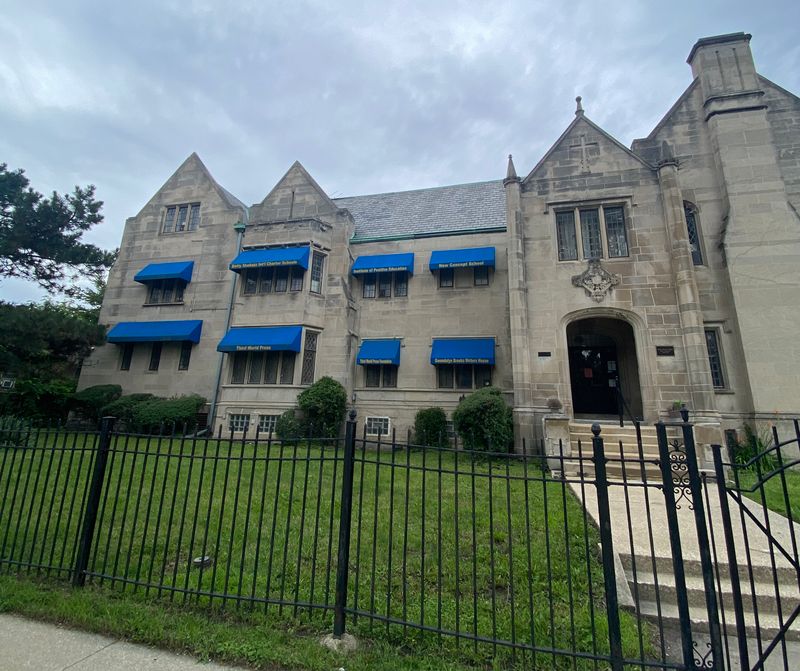
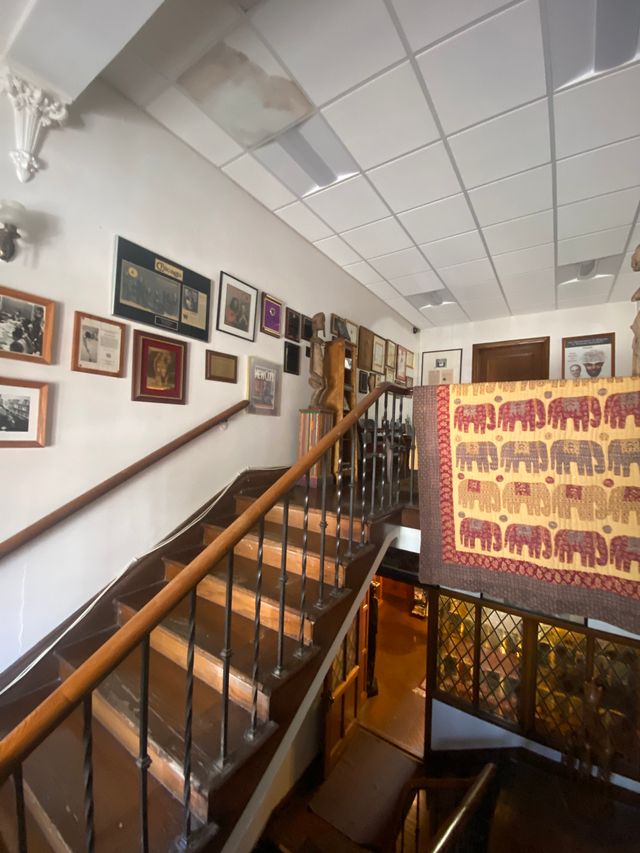
The location of TWP, as well as the Institute of Positive Education, is a beautiful campus featuring two buildings resting back-to-back. The outside of the greystone building reflects the rich history that lies within. There are bright blue canopies on the window with the words “Betty Shabazz Int’l’ Charter Schools, Institute of Positive Education, New Concept School, Third World Press, Third World Press Foundation, and Gwendolyn Brooks Writer’s House.” These canopies show the multiple different organizations that are home to this property, including three charter schools. The inside still resembles that of a church with its wood interior and beige walls, but the walls are covered with art, including photographs of Third World Press in its early days, awards Madhubuti has won over the years and beautiful paintings. Bookcases line the walls.
The publishing process at Third World Press is incredibly thorough. Authors are expected to send in their original work, artwork, photographs, layout boards, and all other related materials. Within four to six weeks, they are contacted regarding the submitted material. As an independent publisher, it has always been Third World Press’s mission to publish and add to a thriving, conscious tradition of Black literature, Black education excellence and Black institutional development. Third World Press endures support from long-time authors like Illinois Poet Laureate Angela Jackson and poet Useni Eugene Perkins.
Brooks’s decision, around 1967, to eschew mainstream publishers in favor of Black presses speaks to the mission of Third World Press. In Report from Part One, published in 1972, Brooks says that her inspiration was to “write poems that will somehow successfully ‘call’ … all black people: black people in taverns, black people in alleys, black people in gutters, schools, offices, factories, prisons, the consulate; I wish to reach black people in pulpits, black people in mines, on farms, on thrones.” From that point on, Third World Press put out many of the Illinois Poet Laureate’s books, ensuring that she would reach a Black audience as well as her white readers. This includes her 1987 comprehensive omnibus collection, Blacks, which includes parts or all of Annie Allen, A Street in Bronzeville, The Bean Eaters, In the Mecca, and Maud Martha.
Brooks' own modest home is a few blocks north of here, at 7428 S. Evans. During her 32 years as Illinois Poet Laureate, beginning in 1968, Brooks invited young Illinois poets to send their work to her home as part of the Youth Poetry Awards contest that she created. The house was designated an official Chicago Landmark in 2010.
Reading, Viewing and Listening List
Explosion of Chicago’s Black Street Gangs: 1900 to Present