Theater Row

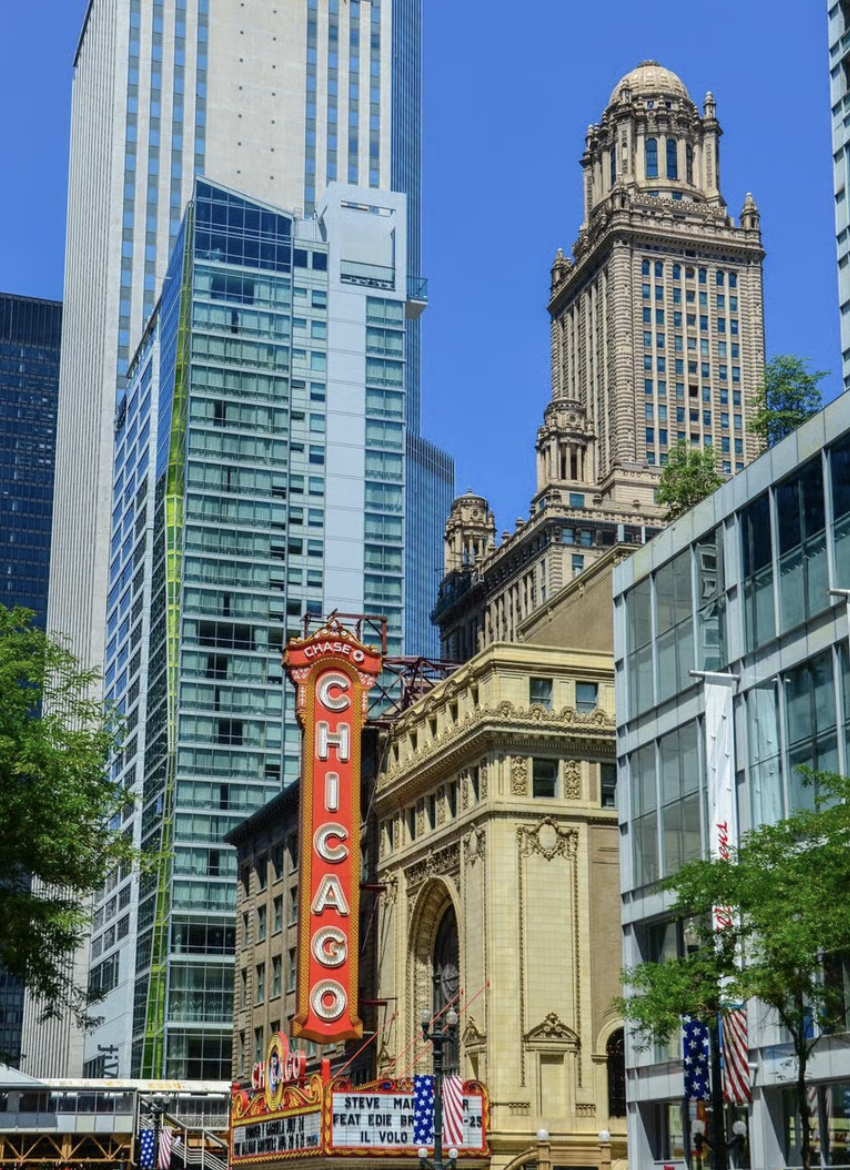
The Chicago Theater, Eric Allix Rogers
Randolph Street (between State Street and Dearborn Street)
Chicago, IL 60601
Chicago theatre rivals that of nearly every major American city, except, perhaps, New York. The rich and varied theatre scene creates opportunity for contemporary local playwrights, such as Pulitzer Prize winners Tracy Letts, Branden Jacobs-Jenkins, David Mamet, and Bruce Norris, as well as MacArthur Foundation recipients like Mary Zimmerman and many Jeff Award winners.
The Theater Row venues were hugely successful during the1920s-50s, but demand declined starting in the 1960s and by the 80s this stretch of Randolph mostly trafficked in X-rated movies. Some of the great theatres shuttered, but in the 1990s and 2000s, many that were not demolished re-opened under new names.
Movie palace architects the Rapp brothers designed three grand theaters in the 1920s, basing the designs on luxurious French and Indian monuments. The oldest is the Chicago Theatre, near Randolph at 175 North State Street, which was designed in 1921 as a movie palace for Balaban and Katz, a national theater chain based in Chicago. Robert Loerzel, Chicago historian, wrote that “The Rapps clearly had France on their mind when they drew up the blueprints. The building’s terra-cotta front looks like the Arc de Triomphe, while the lobby resembles the Royal Chapel of Versailles, with the Paris Opera House’s grand staircase thrown in for good measure.”
In 1926, the Rapp brothers, again working for Balaban and Katz, unveiled the Oriental Theatre at 4 West Randolph Street. The Indian themes included elephant throne chairs and Buddhas, with turban-wearing ushers and opening night jazz tunes like “Insultin’ the Sultan.” Later that same year, the Rapps used the palaces of Fontainebleau and Versailles as their model for the 2,500-seat New Palace Theatre, a vaudeville house run by the Orpheum Circuit at 151 West Randolph.
According to Loerzel, “The decades that followed were the heyday for entertainment along Randolph Street. Duke Ellington, Jack Benny, Benny Goodman and Danny Kaye performed at the Chicago Theatre. The Three Stooges, Bing Crosby, Al Jolson, Cab Calloway, Ella Fitzgerald and Billie Holiday appeared at the Oriental. Jimmy Durante, Mae West and Bob Hope played the New Palace. And just off Randolph on Dearborn, the Harris and Selwyn Theaters (designed by C. Howard Crane and H. Kenneth Franzheim) produced shows with Helen Hayes, Charles Laughton, Boris Karloff, Audrey Hepburn and Noel Coward.”
In 2000, The Goodman, on Dearborn just off this stretch, moved from behind the Art Institute into the space previously occupied by the Harris and Selwyn Theaters. The Goodman enjoys national, even global, respect for its serious work, whereas a lot of the other Theatre Row venues traffic in large-scale, commercial productions. Wicked, for example, ran from June 2005-January 2009 at the Oriental Theatre (now the James M. Nederlander Theatre). Moulin Rouge! The Musical, Les Misérables, and The Great Gatsby have all been at the Cadillac Palace Theatre this year. To get a sense of the many lives and deaths inherent in Theater Row, the Cadillac Palace Theatre originally opened in 1926 as the New Palace Theatre; in the 1960s, the venue became a rock hall known as the Bismarck Theatre; after a 1999 renovation, Cadillac bought the naming rights and thus the current name of the space. While the Cadillac Palace Theatre thrives on popular offerings such as Shrek the Musical, it does mix in more meaningful literary productions, such as longtime Chicago resident Oprah Winfrey’s adaptation of Alice Walker’s The Color Purple, which ran from April-September of 2007.
Even in the midst of the glitzy, high-priced Theater Row district, Chicago’s dynamic, gutsy storefront scene manages to wiggle its way inside. Drunk Shakespeare is hidden in the Chicago Theatre; during each show, one of several performers in the Drunk Shakespeare Society take five shots of whiskey and tries to perform their part. The entryway can be seen on Wabash Avenue.
The Goodman supports playwrights with their Playwrights Unit, “a program in which local writers meet twice per month to discuss their plays-in-process” and are showcased in the summer after 10 months. Many of Mamet’s early successes premiered at the Goodman, including Chicago-set stories Glengarry Glen Ross and American Buffalo. Born in Chicago, Mamet returned after college; he worked at factories, real estate agencies, and as a taxi driver.
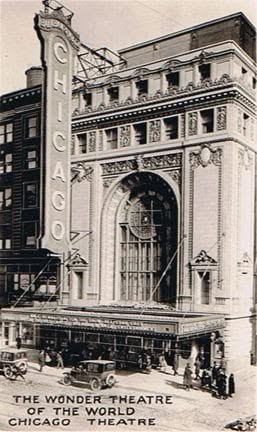
The Chicago Theater in the 1920s