The Berghoff Restaurant

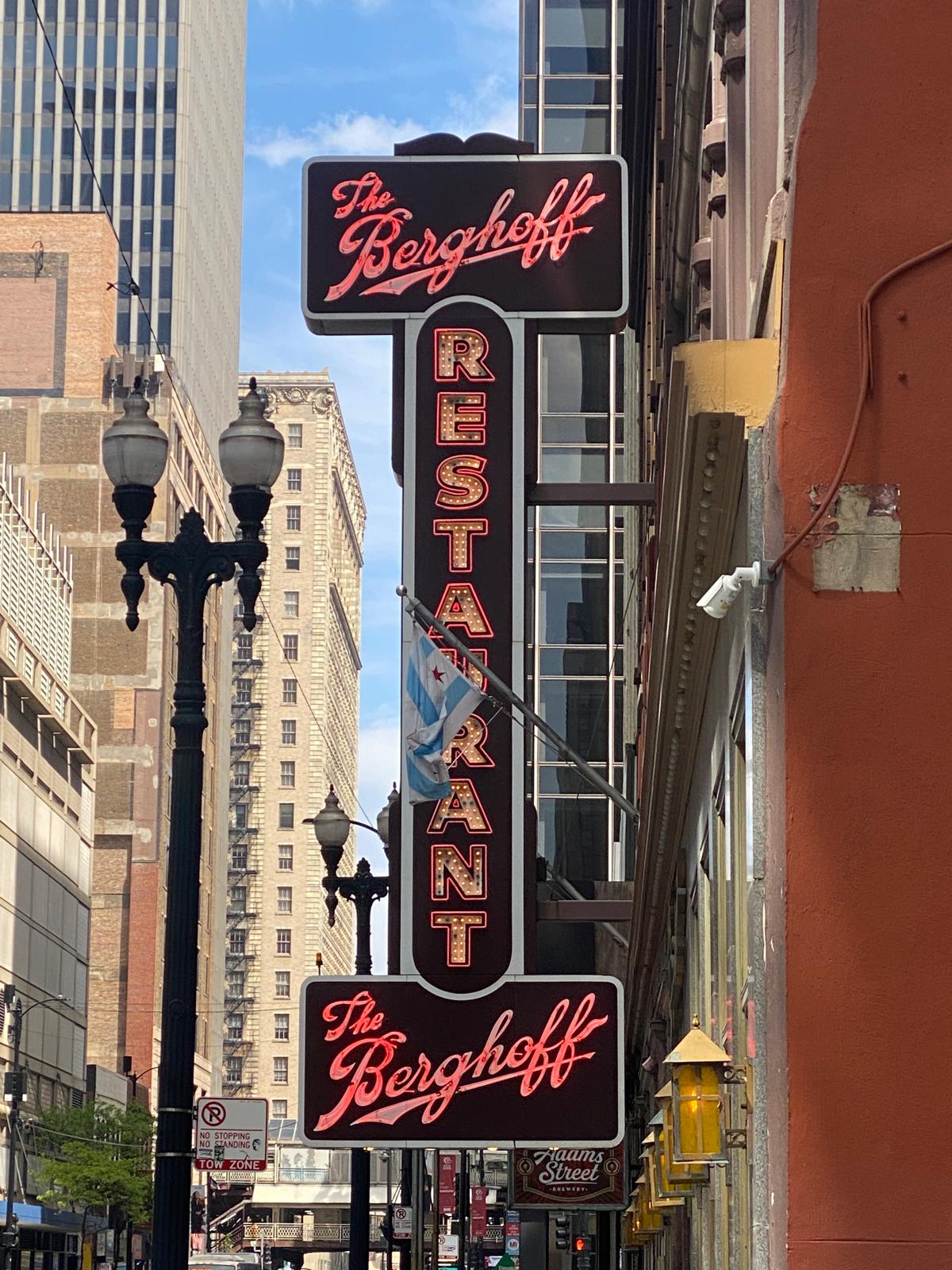
The Berghoff's stately sign on Adams Street, Gus Boyer
17 W. Adams Street
Chicago, IL 60603
The Berghoff is warm, and noisy. There are quite a few people, eating and standing around. The legendary Berghoff waiters are bustling importantly from kitchen to table. I stand in line, thawing out, amidst chattering families and couples. Eventually I am led to a small table in the main dining room, toward the back. I order a dark beer and a plate of duck wursts with spaetzle. When the food comes, I eat slowly. I polish off all the bread, too, and realize that I can’t remember eating lunch. This is good, I’m taking care of myself, I’m not being an idiot, I’m remembering to eat dinner. I lean back in my chair and survey the room. Under the high ceilings, dark paneling, and mural of boats, middle-aged couples eat their dinners. They have spent the afternoon shopping, or at the symphony, and they talk pleasantly of the presents they have bought, their grandchildren, plane tickets and arrival times, Mozart. I have an urge to go to the symphony now…
Audrey Niffenegger: The Time Traveler’s Wife
His preference for Fitzgerald and Moy’s Adams Street place was another yard off the same cloth. This was really a gorgeous saloon from a Chicago standpoint. Like Rector’s, it was also ornamented with a blaze of incandescent lights, held in handsome chandeliers. The floors were of brightly coloured tiles, the walls a composition of rich, dark, polished wood, which reflected the light, and coloured stucco-work, which gave the place a very sumptuous appearance. The long bar was a blaze of lights, polished woodwork, coloured and cut glassware, and many fancy bottles. It was a truly swell saloon, with rich screens, fancy wines, and a line of bar goods unsurpassed in the country.
...Then began one of those pointless social conversations so common in American resorts where the would-be gilded attempt to rub off gilt from those who have it in abundance.
Theodore Dreiser, Sister Carrie
The Berghoff traces its roots to one of Chicago’s most enjoyed cornerstones: beer. In 1870, Herman Berghoff emigrated from Germany to America and opened a brewery in Indiana. The prospect of the World’s Fair in Chicago in 1893 led Herman to set up a stand in the Midway Plaisance, selling beers to some of the 27 million people who attended the fair for the five months of its showing. Building off of the success of his stand, Herman Berghoff opened a permanent place on Adams Street in 1898, where beers were sold for a nickel and came with a free side sandwich.
Despite the threat to business with the start of Prohibition in 1920, Herman Berghoff pivoted, selling a “Near Beer,” which contained less than 0.5% alcohol, and expanding the restaurant menu. Thirteen years later, The Berghoff obtained Chicago’s first post-prohibition liquor license. This honor has been cemented in tradition: Chicago grants the first license of the year to The Berghoff every January.
The Berghoff became a site of political activism when, in 1969, Gloria Steinem and other members of the National Organization for women demanded to be served at the then men-only bar. This was not an isolated event. In Steinem’s own words, “The Berghoff is a restaurant which women have been breaking the barriers in, is to us what the lunch counters were to the black movement. That's very serious and important.”
Underneath the red neon bulbs of the street sign, The Berghoff continues to be a site of reunion and respite. Its inclusion in literary works traces the character arc of the great Chicago third space for over a century. Theodore Dreiser's fictional bar in Sister Carrie, Fitzgerald and Moy’s, is likely inspired by The Berghoff, which matches the description and location of Adam Street near the old Federal Building. For Charles Drouet, the titular character’s first lover, the bar “represented in part high life—a fair sample of what the whole must be.” In Audrey Niffenegger's The Time Traveler’s Wife, The Berghoff is no longer a gilded resort for the elite, now a destination for the busy families and couples visiting downtown Chicago. In both though, the restaurant exudes a lifeforce that provides a nourishment greater than what can be reaped from its food and drink.
In literature, restaurants like The Berghoff exude a timeless nostalgia. Marrian Boruch’s “Once at Berghoff’s” reminisces on the narrator's trip to the restaurant 40 years ago.
that window, Chicago's old downtown, a girl
and her mother at lunch in that understated
stately place. Which is to say, cloth napkins.
Which is to say, the sky darkened, made
lamplight by buildings. Exactly
as my mother dreamed.
Chicago native Boruch recently received the 2026 $100,000 Jackson Poetry Prize, which recognizes an American poet of exceptional talent. Boruch is the twentieth recipient of the prize.
The Berghoff can be visited 7 days a week from 11:30 to 8:00 pm. The Adams Street Brewery, opened in 2018 by the Berghoff family, crafts a wide variety of beers.
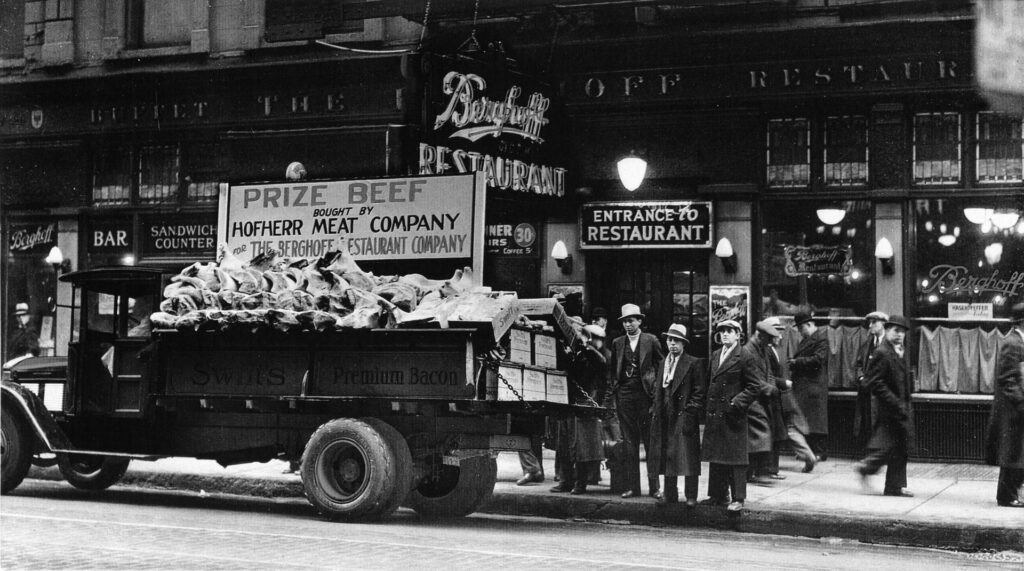
The Berghoff, 1898