South Shore Cultural Center

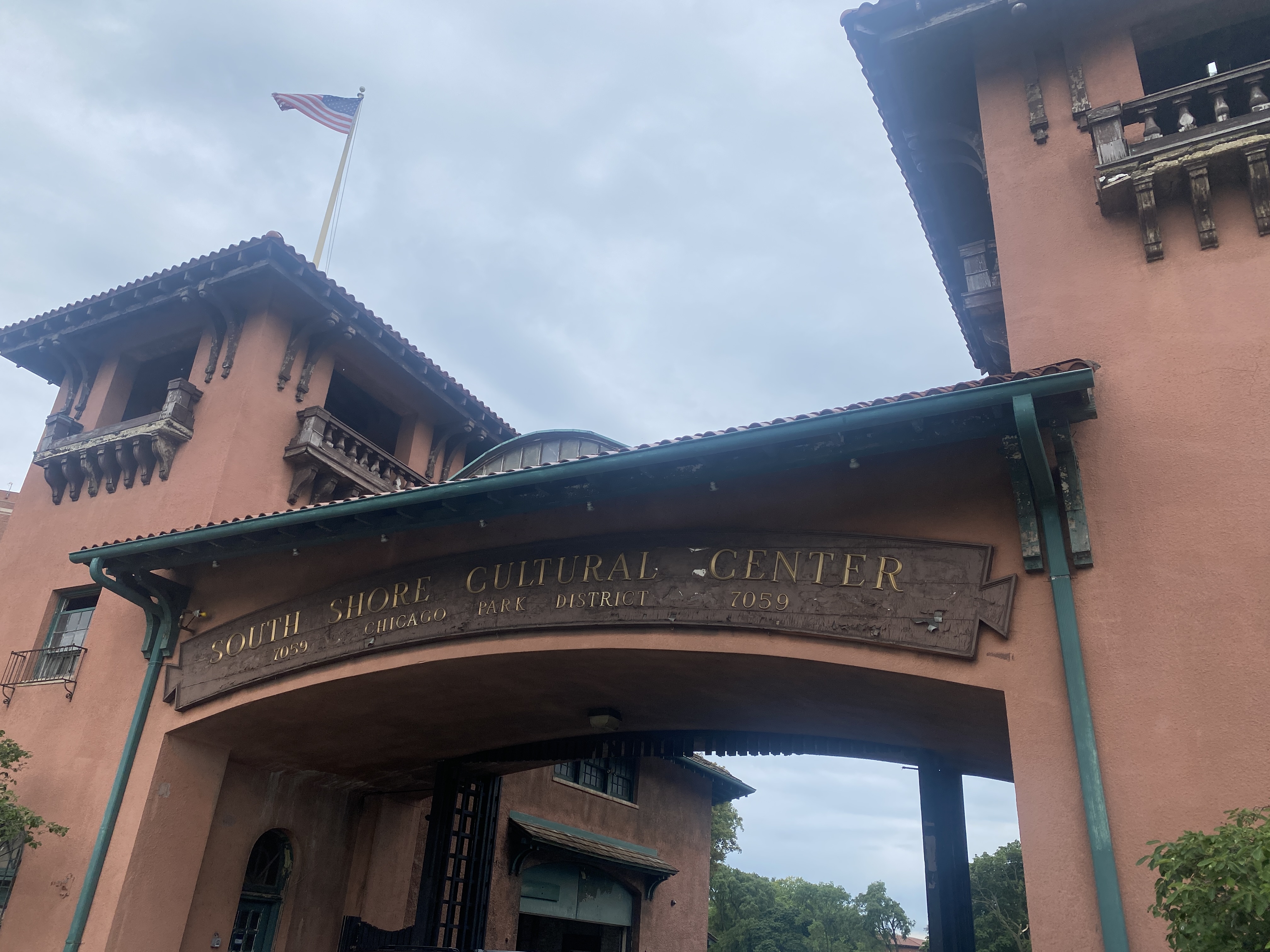
7059 South Shore Dr.
Chicago, IL 60649
(South Shore)
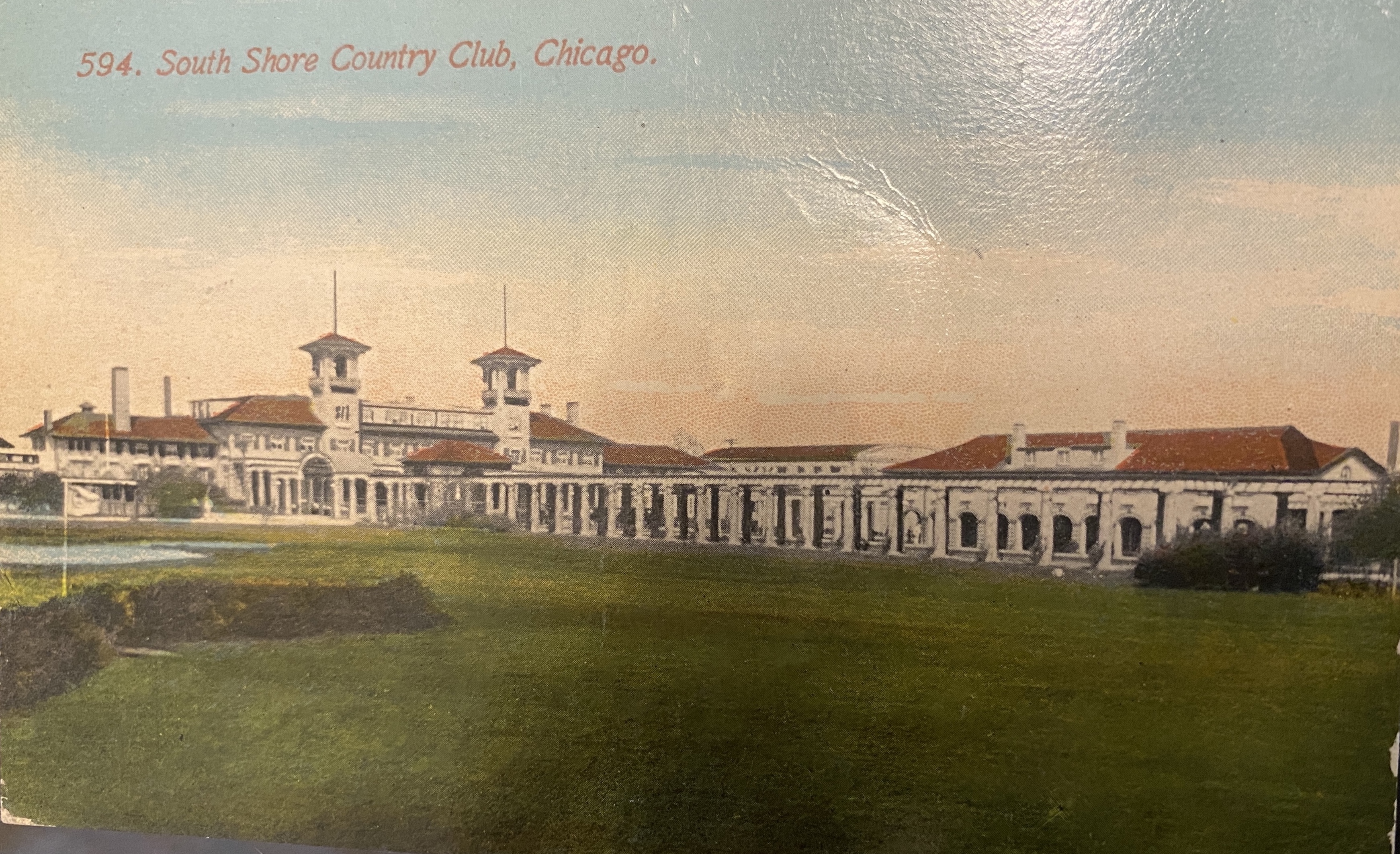
When South Shore Country Club opened in 1906, it adopted a consciously elitist and exclusionary operating policy. No Blacks. No Jews (well, there were a couple in the early years, but none thereafter). No women members (though they were permitted on the grounds as guests). Built by and for Chicago’s wealthy white elite, the sprawling estate included gardens, polo grounds, lawn bowling, a trap-shooting range, tennis courts, a golf course, equestrian stables, a private beach, and a Benjamin Marshall-designed clubhouse. Mutual Bank President Lawrence Heyworth, who also ran a large construction company, garnered the support (material and otherwise) of prominent businessmen like Marshall Fields, J. Ogden Armour and Charles A. Stevens to build what he envisioned as a summer resort. He bought the large, marshy lakefront property in an undeveloped area that had been used primarily for duck hunting and fishing. The Encyclopedia of Chicago called the club “posh.” According to Sarah Downey, writing in the August 15, 2007 issue of Chicago magazine, “Mingling with the city’s merchant princes were politicians, surgeons, and brewers-folks who could clear the membership hurdles. A gunpowder manufacturer was accepted; a butter merchant was not. Eligibility rested largely on personal recommendations and on meeting stringent economic, social, and ethnic qualifications.” Downey points out in that article that the club hosted luminaries such as John Cardinal Cody and a Romanian queen. There were nearly a hundred upper-floor guest rooms. In 1920, the club built a band shell on the lawn overlooking Lake Michigan. Ron Grossman, writing for the Chicago Tribune on October 21, 2016, noted, “Among the orchestras that played for cotillions and dress balls was one led by Paul Whiteman, who blended jazz and symphonic music, bridging black and white musical forms. Other name performers stayed in the club’s luxurious guest rooms while playing Chicago area theaters and ballrooms. Bing Crosby brought his family there during an appearance at the Drury Lane theater. Hollywood’s Dick Powell and Joan Blondell honeymooned at the South Shore Country Club. Jean Harlow, a superstar of the silent film era, was a guest, as were the cowboy philosopher Will Rogers and Amelia Earhart, a pioneering aviator.”
The 1948 Supreme Court ruling in Shelley v. Kraemer, which declared racially restrictive housing covenants unenforceable, ushered change in the community, with some middle-class Black families moving into the neighborhood. South Shore’s white population was still 90 percent in 1960, but in the next decade would drop to 28 percent. Still, the South Shore Country Club’s bigoted rules stayed in place. In fact, the club closed permanently in 1974 rather than integrate. The Chicago Park District purchased the property in June, 1974, with the intention to raze the old structure. The Coalition to Save South Shore Country Club Park, which was praised by author Sara Paretsky, were among the community activists and preservations who protected the space from demolition. (Paretsky’s V.I. Warshawski drives along South Shore Drive in Guardian Angel, noticing the greenery of Jackson Park and the beautiful South Shore homes.) Once the property was listed on the National Register of Historic Places in 1975, the process of transforming the space into a public cultural facility started in earnest. Today, SSCC consists of 70 lakefront acres. It’s devoted to “equitable recreational opportunities,” though it rents out its facilities, for occasions such as the Obama wedding reception, at relatively high rates. Inside, there is the Paul Robeson Theatre, two dance studios, and a Fine Art Gallery, with a wing dedicated to Margaret Burroughs. The venue hosts a variety of programs, theatrical productions, and civic events, as well as the annual South Shore Summer Fest.
Studs Lonigan walks the perimeter of the country club in Judgement Day, the final installment of the trilogy. It’s a grueling hot Chicago afternoon, with the shabby surrounding streets in contrast to the club’s exclusive loveliness. While walking, Studs imagines himself as a rich, beloved golf pro attaining heroic feats on the course before him. But Studs, unlike in Young Lonigan, no longer possesses a youthful imagination. His shattered finances and bleak future make him feel mentally defeated, while the walk itself causes physical--shortness of breath and chest pains--suffering. This scene foreshadowed the novel’s tragic ending.
Michelle Obama, who grew up at 7436 S. Euclid Avenue, launched her memoir, Becoming, on Tuesday, November 13, 2018, at the venue. ABC transformed the former ballroom now known as the Paul Robeson Theater (as well as the foyer leading up to it) into a custom television studio space, with a specially built central riser on which Good Morning America’s Robin Roberts interviewed Obama. An audience of civic leaders, neighborhood people, friends and family filled the room. In her memoir, Obama writes about the country club’s exclusionary practices, and how the neighborhood shifted in three decades from nearly all white to nearly all Black, "a ghosting of sorts, a collective, silent packing of boxes and moving of families." More than a quarter century earlier, on October 3, 1992, Michelle and Barack hosted their wedding reception in the center.
The cultural center’s splendor has attracted several film projects to the location. The SSCC served as the exterior shot of the fictional Palace Hotel Ballroom in The Blues Brothers’ climactic concert scene. In A League of Their Own, its solarium room became a charm school in which the raggedy, rough female ball players received a crash course in etiquette and lady-like skills.
Kayne West lived with his mother, longtime Chicago State University professor and department chair Dr. Donda West, in a home located at 7815 S. South Shore Drive, just a bit more than a mile from SSCC. In her 2007 memoir, Donda, writes, “I didn’t know it, but South Shore, and especially South Shore Drive, where we lived, was considered ‘the shit,’ a prestigious area in a coveted part of town. We were within walking distance of Lake Michigan and our backyard backed up to Rainbow Park.” In 2021, Kayne built a full-scale replica of this exact South Shore house inside Soldier Field for his Donda album listening event. Nearly a century before Kayne West’s time, nature writer Donald Culross Peattie lived at 76th and South Shore Drive. He describes an unspoiled prairie landscape filled with natural beauty and life, in the years before the invasion of people and industrial machinery would stamp the neighborhood with a much more urban sensibility. Contemporary poets Nate Marshall and José Olivarez shared an apartment at 7715 S. Paxton Drive during the time when the acclaimed collection Citizen Illegal launched, in 2018; their neighbor was Gwendolyn Brooks’s daughter, Nora Brooks Blakely.
Rev. Jesse Jackson, Carol Moseley Braun (first African American woman elected to the U.S. Senate), Larry Ellison (founder of Oracle), Mandy Patinkin, Bo Diddley, and Enrico Fermi were all South Shore residents.
South Shore Cultural Center was designated a Chicago Landmark on May 26, 2004.
Reading, Viewing and Listening List
“South Shore Country Club’s Last, Lingering Summer”
Chicago’s South Shore Country Club
The Heart of Chicago’s South Shore: A Neighborhood Coming Full Circle
Raising Kanye: Life Lessons from the Mother of a Hip-Hop Superstar
South Shore Days 1940’s and ‘50s
You Can Take the Girl Out of Chicago: Tales of My Wayward Youth