Randolph/Wabash El

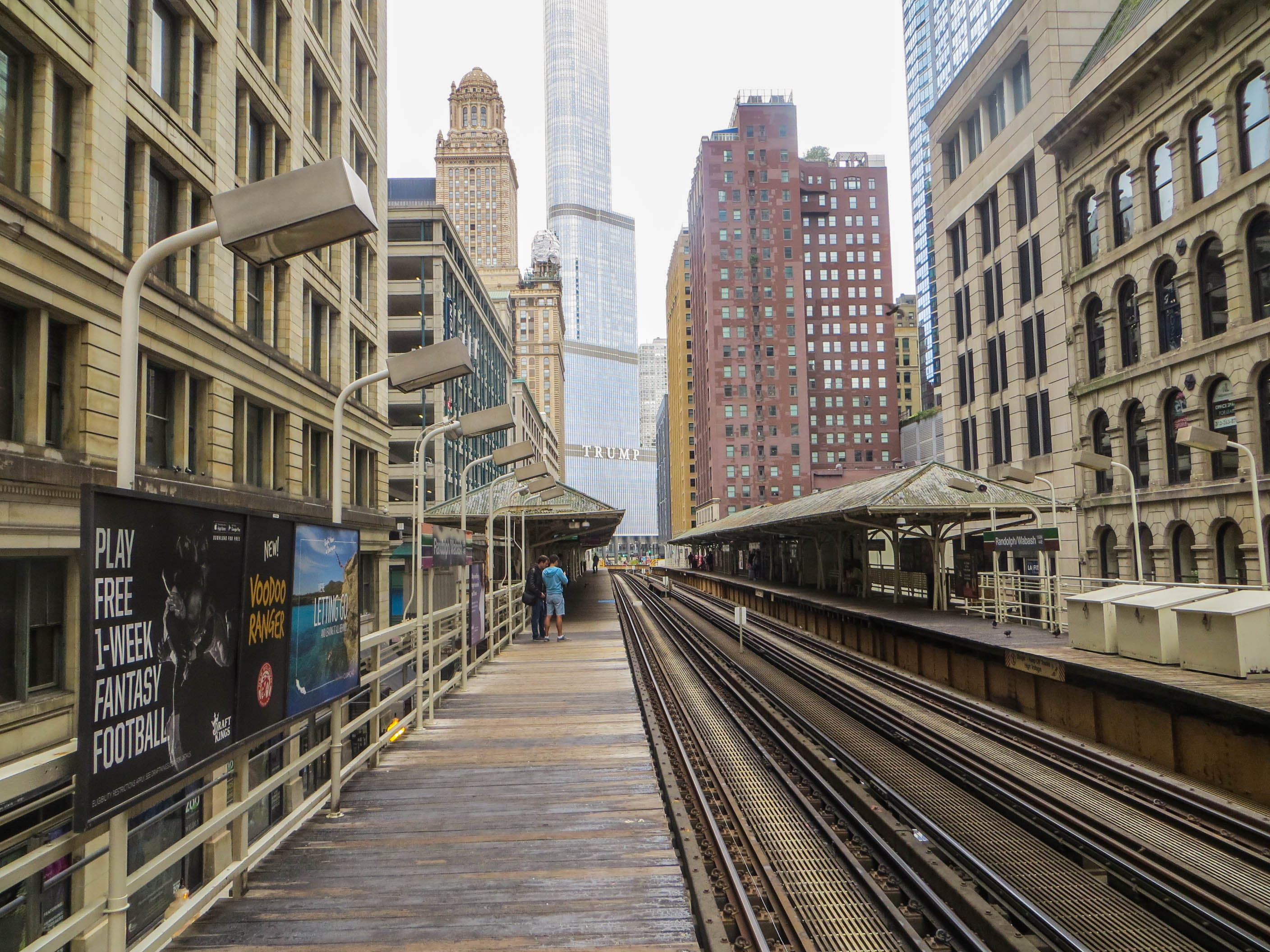
David Wilson, 2017
151 N. Wabash Avenue
Chicago, IL 60601
I came down on the El, getting off at the Randolph and Wabash station. There were crooked streaks of red at one end of the street and, at the other, a band of black, soft as a stroke of charcoal; into it were hooked the tiny lights of the lake front. On the platform the rush-hour crowds were melting under the beams of oncoming trains. Each train was followed by an interval of darkness, when the twin colored lamps of the rear car hobbled around the curve. Sparks from the street below were caught and blanked in the heavy, flat ladder of ties. The pigeons under the sooty, sheet-iron eaves were already asleep; their waddled shadows fell on the billboards and, with every train, fluttered as though a prowler had sprung from the roof into their roost.
I walked along East Randolph Street, stopping to look at the rich cakes and the tropical fruits. When I came to the smoky alley alongside the library where the south-bound cars emerge, I saw a man sprawl out in front of me, and at once I was in the center of a large crowd and, from a distance that could have been as great as it seemed, a mounted policeman standing before a Cottage Grove car was gazing down.” Saul Bellows’s Dangling Man, 1944, novel
I walked around every block in the Loop, watched the frameworks of the Elevated lines shake and tremble and half expected a train to tumble down to the street. Carl Sandburg’s Always the Young Strangers, 1952
One of my most astute Chicago friends…loves that grim rectangle, bounded in its iron crown of elevated-railroad tracks, and says that during the war, when he was overseas and he thought of Chicago, it was always of the Loop in the rain, with the sound of the low-pitched, bisyllabic police whistles, like sea birds’ cries. A.J. Liebling’s Chicago: The Second City
The El, and more broadly the vast train system, is an ingrained part of Chicago life—and literature. The omnipresent Chicago Transit Authority blasts and shrieks throughout the city, all day and night, sometimes passing within inches of apartment windows. The metal shrieks, blast-level roars, the smell of creosote—it’s all a kind of background noise against which everyday life plays out, especially downtown. And since the El permeates the average citizen’s existence, it must also, in a city whose most celebrated authors practiced naturalism and realism, show up time and again in Chicago stories.
Mass transit baron Charles Tyson Yerkes, along with bridge builder John Waddell Low, built the el in 1897. It physically forms a rectangular loop around the central business district. Yerkes, who also was responsible for London’s The Tube system, was somewhat of a villain in Chicago, despite his incredible feat of consolidating all the independent railway lines. Yerkes bullied, bribed, manipulated, cheated; he also accomplished what perhaps nobody else could before it became too late to make a reality. Yerkes was Dreiser’s model for Frank Algernon Cowperwood in his Trilogy of Desire, which included The Financier (1912), The Titan (1914), and The Stoic (1947). Yerkes and his plans for the El are also discussed in detail in Saul Bellow's story, "Looking For Mr. Green." The protagonist of the story thinks of Yerkes and his creation of the El as symbolic of the human capacity to conceive of audacious plans and realize them.
Chicago author and historian Patrick T. Reardon writes, “[The El] is arguably the most distinctive visual element in the city’s downtown—and in any city’s central business district. With its airy steel framework and its looming presence over the cityscape and its trains rumbling twenty feet overhead, the elevated loop says ‘Chicago’ in a most physical and visceral way.”
There are eight El stops in the Loop. The Randolph/Wabash station permanently closed on September 3, 2017, and was subsequently demolished. It was replaced by the modern Washington/Wabash station, located one block south, which serves the Brown, Green, Orange, Pink, and Purple lines. It was at the original station that Bellow’s Dangling Man narrator, Joseph, shared his observations about the El—in that scene, the author gives a master class on atmosphere. He uses the setting to define the character, physically and emotionally, and makes vivid details, like the sparks, work on literal and figurative levels.
Nelson Algren frequently used the El in his writing, describing the system as "the city's rusty heart." Movies habitually use the El for establishing shots of Chicago—there are well-known scenes in The Blues Brothers, The Untouchables, Risky Business, and Public Enemies, among others. Over the decades, there have been many artistic projects on or about the El, including Get On Board! A Brown Line Musical, created by Henry Golden-Starr and produced by Chicago Children's Theatre. In Octobers from 1998-2003, The Hypocrites, a storefront theatre, performed ghost stories called The Haunted “L” on decorated trains. From 2011-2016, The Waltzing Mechanics, another storefront theatre group, did a late-night, documentary style show at City Lit Theatre—the first version if El Stories mapped out a ride from Jackson to Howard and subsequent shows worked off different themes. Chicago Tap Theatre also did a show called CTA. During avery r. young’s time as Chicago’s inaugural Poet Laureate, he launched a project called, “A City That Writes Together.” In April 2026, a month-long exhibit launched on the city’s Blue Line trains: exterior artwork and interior poetry were featured as part of an interactive, moving celebration of Chicago’s poetry community. The featured work used young’s own invented poetic form, the nine-line, five-stanza “Soloem.” Among those aboard the train for the launch, or contributors to the exhibit, were past and present Illinois Poet Laureates Angela Jackson and Mark Turcotte, as well young’s Chicago Poet Laureate successor, Mayda del Valle. A YouTube playlist of readings is available through the Department of Cultural Affairs and Special Events.
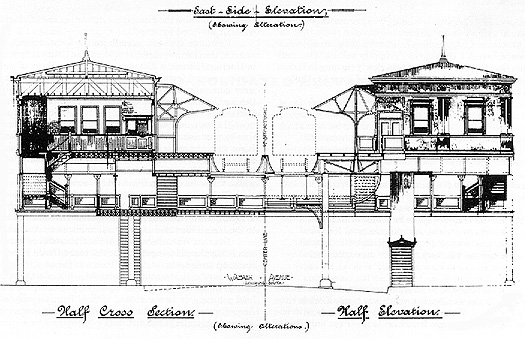
Plans for the Randolph/Wabash El's construction. CTA collection, 1886.