Pullman National Historic Park Visitor’s Center

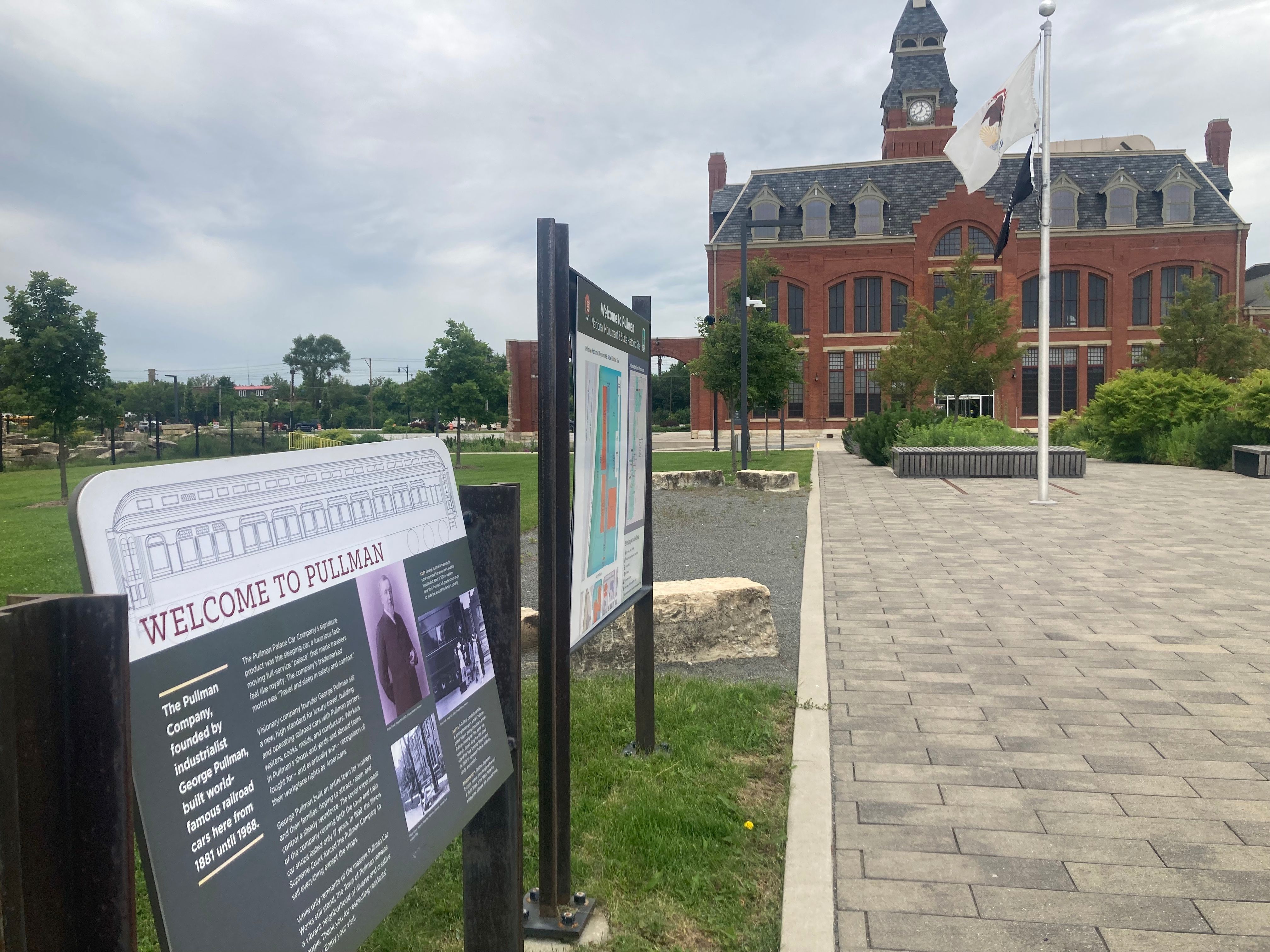
610 E. 111th Street
Chicago, IL 60628
(Pullman)
Only half a car, possibly not that much, was given over to the use of the colored passengers. It was as comfortable as the other part of the train, however, so no discrimination was evident. The portion given to them was, of course, next to the baggage car; while far to the rear, as he observed when the train rounded a curve, fully eight or ten cars were more or less filled with white passengers. About half the number were Pullmans.
Oscar Micheaux's The Forged Note
We labor, we labor, our white rag wet
With formaldehyde, our knees deep in shag
Carpet pressing a stain as commanded
By a mastering manual kept in a slim slash
Pocket, our white charges sleeping their way
Across cud-chewing to Chicago
Roger Reeves’ “Tag at Pullman National Monument”
The Pullman neighborhood in Chicago, located west of Lake Calumet, is most famously associated with the housing development built by the Pullman Palace Car Company in 1884. Situated between 103rd and 115th Streets to the north and south, the railroad tracks to the east and Cottage Grove to the west, the town of Pullman was constructed out of a growing demand for Pullman train cars near the end of the 19th century and George Pullman’s desire to introduce a “new era in the history of labor,” as declared in the Hour Week Journal of New York in 1882. Pullman hired architects to design his utopian worker town with Queen Anne style homes, town shops, a sewer system and the Hotel Florence to accommodate largely skilled workers and their families so they could live near the factories producing the Pullman cars.
In 1893, Pullman attracted tourists during the World’s Fair Columbian Exhibition, who praised the town for its sanitation and order. Despite its appearance, however, workers felt unfairly charged for utilities and rent. “Pullman may appear all glitter and glow, all gladness and glory to the casual visitor, but there is the deep, dark background of discontent which it would be idle to deny,” wrote the Chicago Tribune in 1888. Unrest led the workers to strike in May of 1894, although the company was largely unaffected financially, due to the reliance on existing leases. The Pullman workers and the American Railway Union, led by Eugene V. Debs, called upon ARU workers to boycott work on all Pullman cars nationwide. Debs criticized the hypocrisy of the Pullman utopia in juxtaposition to the treatment of their workers in a 1894 speech, declaring “the paternalism of the Pullman is the same as the interest of a slaveholder in his human chattels. You are striking to avert slavery and degradation."
Social activist Jane Addams, inducted into the Chicago Literary Hall of Fame in 2012, visited the Pullman workers and families during the strike. Like Debs, Addams denounced the authoritarianism of the Pullman Company, comparing George Pullman’s relationship with his workers to King Lear’s relationship with his daughter Cordelia. “The president of the Pullman company thought out within his own mind a beautiful town. He had the power with which to rebuild this town, but he did not appeal to nor obtain the consent of the men who were living in it.” For Addams, the Pullman strike, like the tragedy of Shakespeare, tells a moral cautionary tale about the social and economic relations between a leader and his constituents.
The nation-wide Pullman strike was ultimately unsuccessful, squashed by an injunction of the federal government which brought armed forces to Pullman and other South Side neighborhoods. Dozens were killed in fights between workers and the military, and key organizing leaders, including Eugene V. Debs, were jailed. The Pullman strike affirmed the power of the federal government to ensure the free flow of interstate commerce, indicating movements interrupting this flow as illegal.
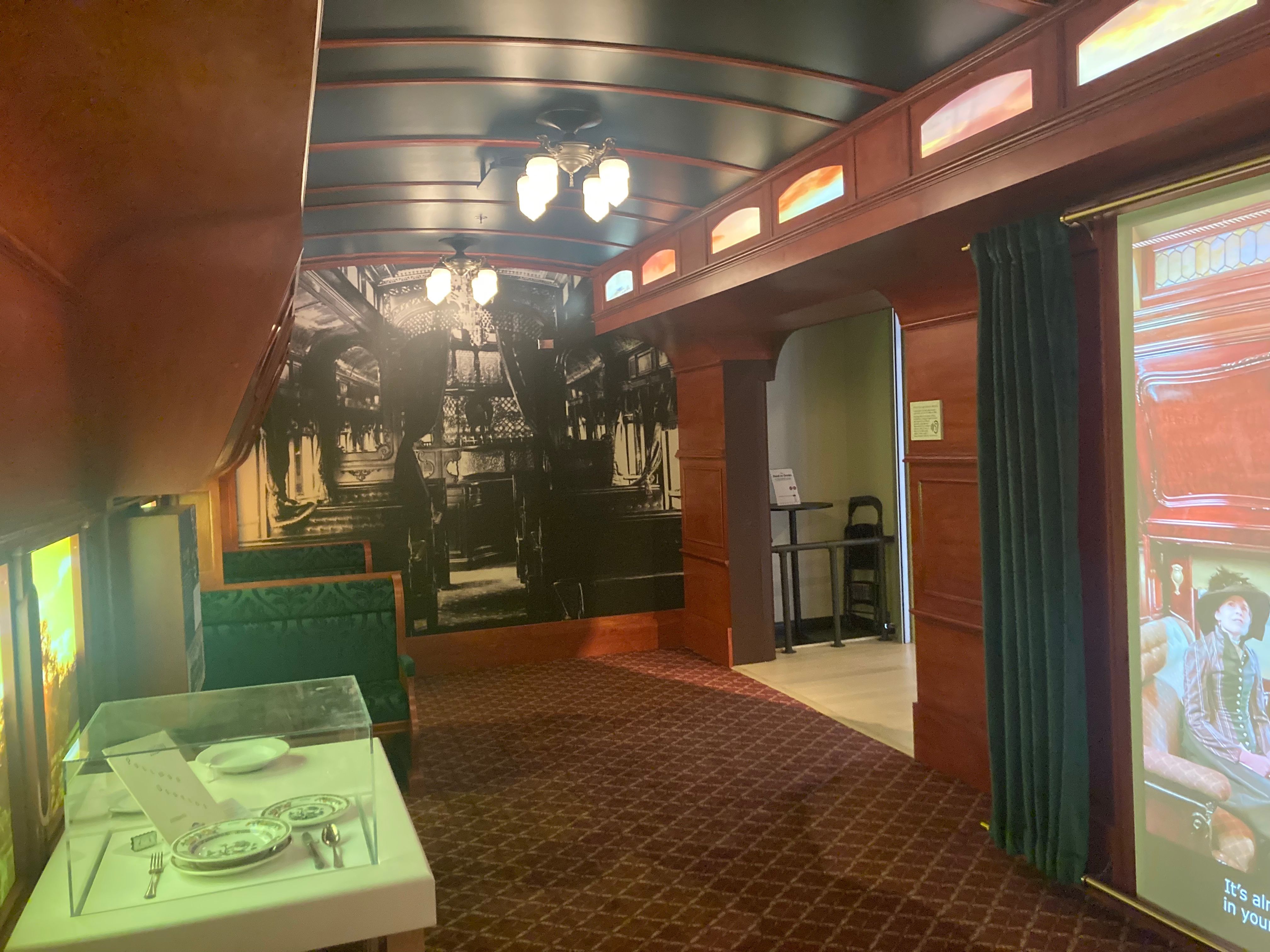
Oscar Micheaux, born in 1884, is one of the most significant artists in the 20th century, despite his absence in the popular eye. Micheaux’s films were of the first to depict Black life in America through the lens of a Black creator, with movies such as Within Our Gates challenging the stereotypes of African Americans seen in pictures of the time like the immensely popular Birth of a Nation by director D. W. Griffith. Although raised in Metropolis, Illinois near the Ohio River, Micheaux moved to Chicago at the age of 17 to make a living. He started working in the meatpacking industry in the stockyards before becoming a Pullman Porter, one of the sleeping car attendants assisting the wealthy customers of the Pullman train cars. George Pullman often hired former slaves and children of slaves, as was the case of Oscar Micheaux, whose father was born into slavery in Kentucky. Micheaux’s 1915 novel, The Forged Note, follows a black bookseller attempting to sell his anonymous novel, The Tempest, employing a series of individuals to help him on his journey, including Pullman porters. The Forged Note depicts the under-documented lives of Black readers and writers of early 20th century America.
In a celebration of the centennial of the park service on August 25th, 2016, the National Park Service and the Academy of American Poets commissioned poet Roger Reeves to commemorate the Pullman neighborhood and monument, which was declared a National Monument in 2015 and upgraded to a National Historical Park in 2022. Reeves’ poem, “Tag at Pullman National Monument,” paints the past and present of Pullman. Reflecting on the poem, Reeves writes, “Utopias don’t last long if they last at all. The poem begins with a building that can do nothing but burn throughout the twentieth century in a utopic community built by the railroad magnate, George Pullman, for his workers, a community that very few people of color lived in until recently.”
The Pullman neighborhood is also home to writer, journalist, and photographer Lee Bey, who investigates and documents how political and social forces penetrate architecture and urban planning. His 2019 book Southern Exposure: The Overlooked Architecture of Chicago’s South Side includes photographs and commentary on the infrastructure and art found in Chicago’s southern neighborhoods, including Pullman. “This is a book Chicago needs—an overdue public embrace of the South Side for those who know it, and an introduction for those who don't,” says Chicago author Thomas Dyja.
Nate Marshall, winner of the Agnes Lynch Starrett Prize for his poetry collection, Wild Hundreds, was raised in West Pullman, the neighborhood adjacent to the George Pullman’s town. In the late 19th century, many Pullman workers, looking to escape the grip of the company housing, populated the village of Gano in West Pullman. Marshall’s Wild Hundreds depicts life in the South Side half a century after the Pullman company shut down in 1968. His poem, “when it comes back,” depicts an encounter of youth and masculinity in Pullman Park. Place is important to Nate Marshall. In an interview with South Side Weekly, Marshall mentions Gwendolyn Brook’s poem, “Beverly Hills, Chicago” as an influential piece in his own exploration of location and the juxtaposition between wealth and poverty in the South Side. Pullman’s rich history and dramatic changes in the past century make the neighborhood a ripe muse for artists and writers like Reeves, Bey and Marshall.
Reading, Viewing and Listening List
Southern Exposure: The Overlooked Architecture of Chicago’s South Side