Oak Woods Cemetery Gate

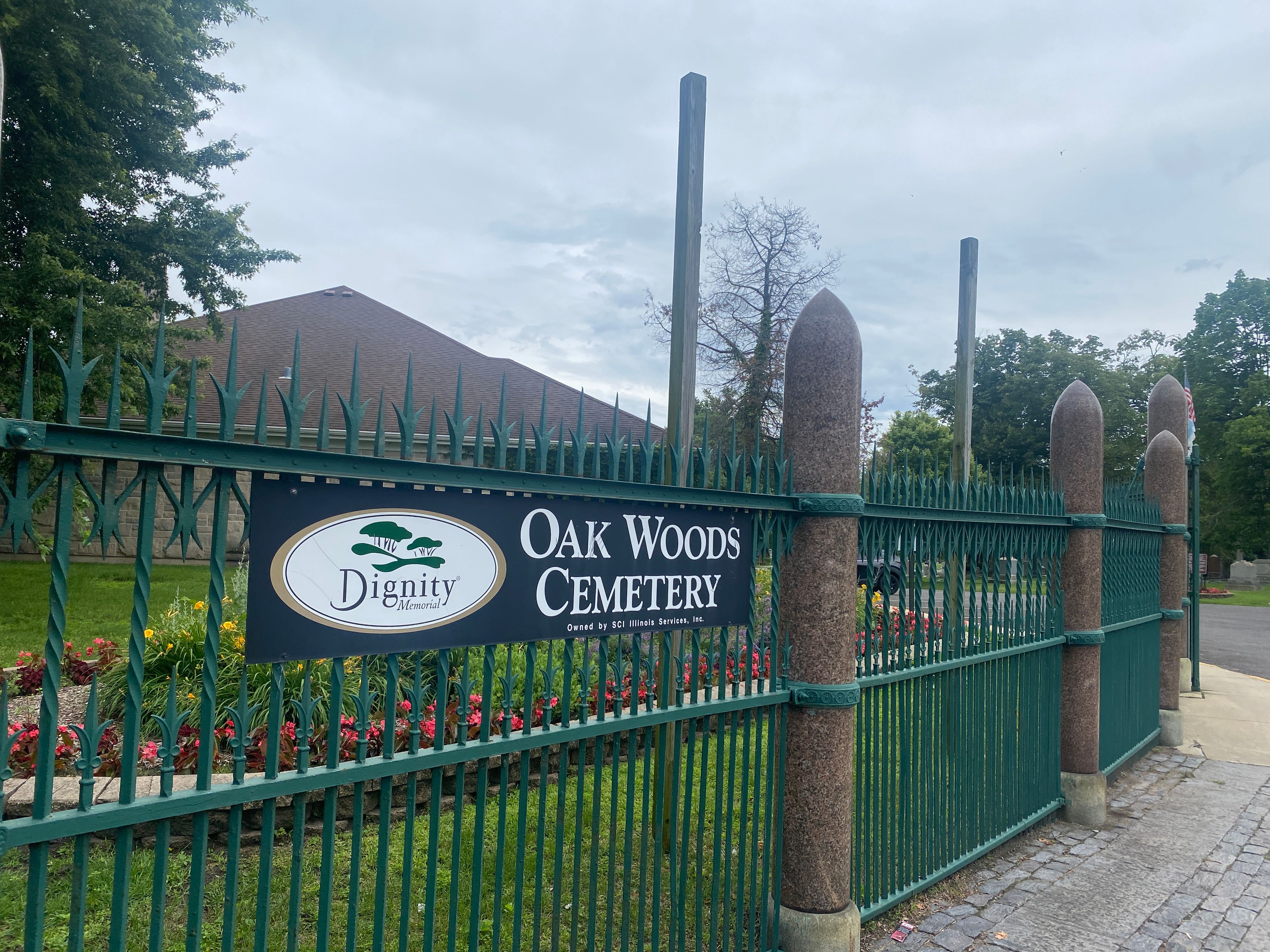
1035 E. 67th Street (at the front of Greenwood Avenue)
Chicago, IL 60637
(Woodlawn)
Oak Woods Cemetery was established in 1853. According to the Hyde Park Historical Society’s Oak Woods Cemetery project, “The cemetery has been the final resting place for a vast array of individuals who have shaped the history of the City of Chicago, and even the world. Five Chicago Mayors, including the 1st and 2nd Black Mayors, as well as 2 Nobel Prize winners, and a gold medal Olympian are among those buried at Oak Woods.”
Notably, the cemetery includes “The Confederate Mound,” a memorial to more than 4,000 Confederate soldiers who died at Camp Douglass, the Civil War prison camp located in what is now the Bronzeville neighborhood. In Sara Paretsky’s 2003 novel Blacklist, private investigator V.I. Warshawski visits this monument searching for clues to the murder of Black journalist Marcus Fremont, whose research into local history might have led to his death.
In the 20th Century, Oak Woods was largely segregated, refusing to bury Black people with few exceptions until yielding to protests in 1963. Ida B. Wells was an exception. She passed away on March 25, 1931, but her family had purchased their burial plot before the segregation policies took full effect. The granite headstone (Plot Section I, Lot 1, Grave 212) includes the inscription, “Crusaders for Justice,” an homage to Ida’s legacy as an anti-lynching, anti-segregation activist.
Another gate to Oak Woods used to exist at the southwest corner of the cemetery, at the busy, three-way intersection of 71st Street, Cottage Grove Avenue, and South Chicago Avenue, four blocks east of Algren’s childhood home on King Drive. This non-extant gate is central to Algren’s childhood memories of the neighborhood, as recounted in City on the Make. In “The Silver-Colored Yesterday,” the most autobiographical section of the book, Algren describes several features of the intersection, including the “wrought-iron gate” of the cemetery, a tavern, and a place where he sold newspapers. None of these features are extant. A modern concrete wall stands in place of the non-extant southwest cemetery gate.
In City on the Make, Algren recounts that in 1919, during the White Sox World Series season, “every Saturday evening the kid called Nephew and I hauled a little red wagon load of something called the Saturday Evening Blade, a rag if there ever was one, down Cottage Grove to the wrought-iron Oakwoods Cemetery gate. There to hawk it past the long-moldering graves of Confederate prisoners who had died at Camp Douglas in some long-ago wrought-iron war.” Afterwards, “[w]hen we sold out we’d just hang around the gate waiting for Nephew’s Uncle Johnson to break out of the saloon directly across the way.”
Algren does not identify the tavern, but he could be referring to the Terminal Inn, which stood “directly across the way” from the former Oak Woods gate later, about 1939 – at roughly 7100 S. South Chicago Avenue, about where the J&J Fish & Chicken parking lot is today.
In “The Silver-Colored Yesterday,” Algren describes an August sunset looking west from roughly that southwest corner of Oak Woods: “All that long-ago August day the sun lay like shellac on the streets, but toward evening a weary small breeze wandered out of some saloon or other, toured Cottage Grove idly awhile, then turned, aimlessly as ever, west down Seventy-First.”
But that intersection is symbolically important to Algren in “The Silver-Colored Yesterday” because it is here – even before his move north, even before the revelation that his White Sox had thrown the Series – that he witnessed what he seems to regard as his first loss of innocence. In Algren’s telling, after Nephew’s uncle emerged from the tavern, he was invariably goaded to drunkenly “fight” another patron who inevitably beat him senseless and humiliated him in the process: “I remember that poor hatless holy Johnson yet, lurching upon some unsaved little tough with a face shadowed by a cap and a lit cigarette on his lip—the cigarette bobbles and Uncle reels back, blood from his nose coming into his mouth. . . . Uncle had never learned to fall down. He’d reel, lurch, bleed, bellow and bawl until the bartender would break the thing up at last, wiping Uncle’s ashen face with a bar towel in the arc-lamp’s ashen light. Till the others came crowding with congratulations right out of the bottle, pouring both into Uncle right there on the street.”
The young Algren “used to hang open-mouthed around that sort of thing, coming away at last feeling nothing save some sort of city-wide sorrow. Like something had finally gone terribly wrong between the cross atop St. Columbanus and that wrought-iron gate, out of an old wrought-iron war, forever guarding the doubly-dead behind us.”
Algren’s mapping of the poles between which “something” went “terribly wrong” are his place of innocence – the St. Columbanus cross near his childhood home – and that busy corner of three intersecting city streets, where iron gates held back the dead and where he saw the drunken Uncle Johnson beaten and humiliated. Algren would have walked the four-block route along 71st Street – the same route Algren’s sunset follows in reverse – to get to the Oak Woods gate to sell his newspapers.
Algren would go on to dedicate his career to depicting the lives of people like Uncle Johnson – the marginalized, the losers, the alcoholics, the down-and-out. In his work, readers see the dignity and humanity of these characters, even as others – like Uncle Johnson’s tormentors – attempt to deny them the same.