Mt. Greenwood Cemetery

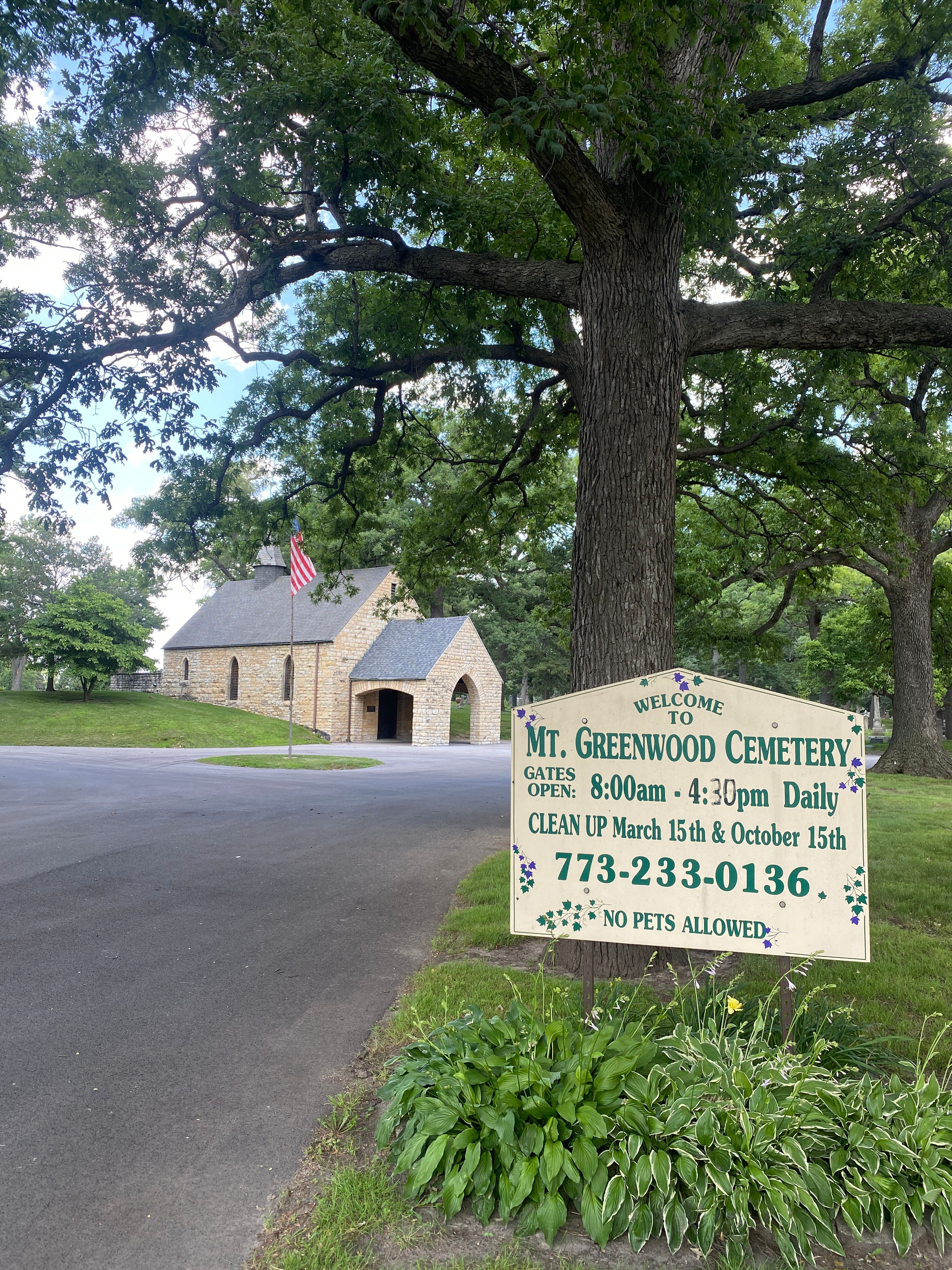
2900 W. 111th Street
Chicago, IL 60655
(Mount Greenwood)
It’s a different neighborhood than most, if for no other reason than the fact that more than half of its inhabitants are dead and have been for years. Although the neighborhood is legally part of Chicago, it is isolated from the rest of the city by grave markers and evergreens. The area is entirely surrounded by cemeteries, seven of them to be exact. The neighborhood is named after the largest of these cemeteries. Seven Holy Tombs.
Although most of the men of Seven Holy Tombs worked in other parts of Chicago, the vast majority of residents thought you needed a visa in order to get out of the neighborhood for more than one day at a time. It was customary for the natives, upon reaching puberty, to marry the girl next door and then move two blocks away. We children of Seven Holy Tombs believed that the edge of the earth lay two blocks beyond the cemeteries. Most of the adults felt that it was somewhat farther than that. – John R. Powers’ The Last Catholic in America
Mt. Greenwood was full of the homes and families of white Chicago firemen and Chicago cops, who always had a real bad reputation for being racist. But it wasn’t just a reputation, it was the fucking truth. And that wasn’t in 1919 and shit. It wasn’t even the ‘40s. It was fucking 1990…the White Power kids were tolerated—not only tolerated but fostered, looked past, ignored completely, even when they put some black kid in the hospital for walking past the imaginary racial dividing line that ran along Western Ave.
Joe Meno’s Hairstyles of the Damned
Mount Greenwood, now geographically integrated into the City of Chicago as one of its 77 Community Areas, began as several cemeteries and a handful of shops to cater to the mourners. It was known as Seven Holy Tombs until surveyor George Waite visited in 1879 and renamed it Mount Greenwood for its trees and elevation. First fueled by the business of funerals, a number of bars and restaurants developed to serve the friends and family of the deceased. During the Prohibition era, some residents campaigned to make the small town a “dry area” like nearby Morgan Park and Beverly, but opposing citizens had Mount Greenwood officially incorporated as a village to keep the saloons running. The village was annexed into Chicago in 1927, though the improved infrastructure the residents hoped for was delayed for decades due to the Great Depression.
According to Christine Schmidt in a 2016 article in South Side Weekly, “Mount Greenwood is eighty-nine percent white and eight percent black. More than ninety-five percent of residents at least graduate from high school, and the median household income is nearly double the city average, according to 2012 census data. The neighborhood also bleeds Chicago Police Department (CPD) blue and Chicago Fire Department (CFD) red: because Chicago law dictates that city workers must live within city limits, Mt. Greenwood, which is the city’s southwestern-most community area, is full of police officers and firefighters. Their families line its suburb-like streets, and have done so for decades. Many of those families take pride in the “quietness” of the neighborhood; crime in Mt. Greenwood is nearly nonexistent, but the area is also frequently described as unfriendly to racial minorities”. Indeed, Schmidt’s article covered a series of 2016 protests in the neighborhood that were greeted with hostility from Mount Greenwood residents after the Chicago police shot a Black man who had come to Mount Greenwood for a funeral in one of the neighborhood cemeteries. Additionally, in 2018, racist fliers were distributed on neighborhood cars, according to a July 27, 2018 story by Kelly Bauer in Block Club Chicago.
Mount Greenwood had a sudden surge in population after World War II as returning soldiers moved there and started families. With the residential population skyrocketing, the town grew with it, establishing homes, schools, and businesses to keep up. It was in this post-war boom that author John R. Powers was born.
John Powers was best known for his novel Do Black Patent Leather Shoes Really Reflect Up?, a fictionalized memoir he later turned into a musical with music by James Quinn and Alaric Jans. The musical was short-lived on Broadway but is beloved by local audiences; Powers’ elder daughter performed in one production. Patent Leather Shoes was the most popular of Powers’ Eddie Ryan trilogy, books detailing a fictionalized account of his life growing up in a Catholic community in the South Side of Chicago. The first of the trilogy, The Last Catholic in America, recounts Eddie Ryan’s elementary school years, based on Powers’ early education at St. Christina Elementary School (3333 W. 111th Street); Patent Leather Shoes focuses on the trials and tribulations of high school, and The Unoriginal Sinner and the Ice-Cream God reflects on later life. Powers’s satirical accounts of growing up Catholic drew in many readers, both on and off the page; later in life, Powers became a motivational speaker and continued to write plays.
Powers spent his childhood and teen years living at 11005 S. Drake Avenue, a mile west of the cemetery. Born in 1945, Powers’s often nostalgic account of the neighborhood lacks the critical awareness that Joe Meno, born almost 30 years later, brings to his fictional exploration. In Hairstyles of the Damned, Meno fictionalizes the real-life controversy that happened his junior year at Brother Rice High School, at which the senior prom was segregated. Narrator Brian Oswald views his high school and community experiences with skepticism and eventually a semi-evolved attitude toward race, or at least a distain for his white racist peers. Both authors feature local cemetery scenes in their fiction, though not specifically Mt. Greenwood Cemetery.
Powers (Class of 1963) and Meno (Class of 1992) both graduated from Brother Rice, as did actor and playwright John C. Reilly (Class of 1983).
Also buried in Mt. Greenwood are victims of the 1903 Iroquois Theater Fire, the 1909 Crib Fire, and the 1915 Eastland Disaster. Graves of victims from the Iroquois Theatre Fire, the 1909 Chicago Crib Fire, and the 1915 SS Eastland tragedy.