Marshall Fields/Macy's

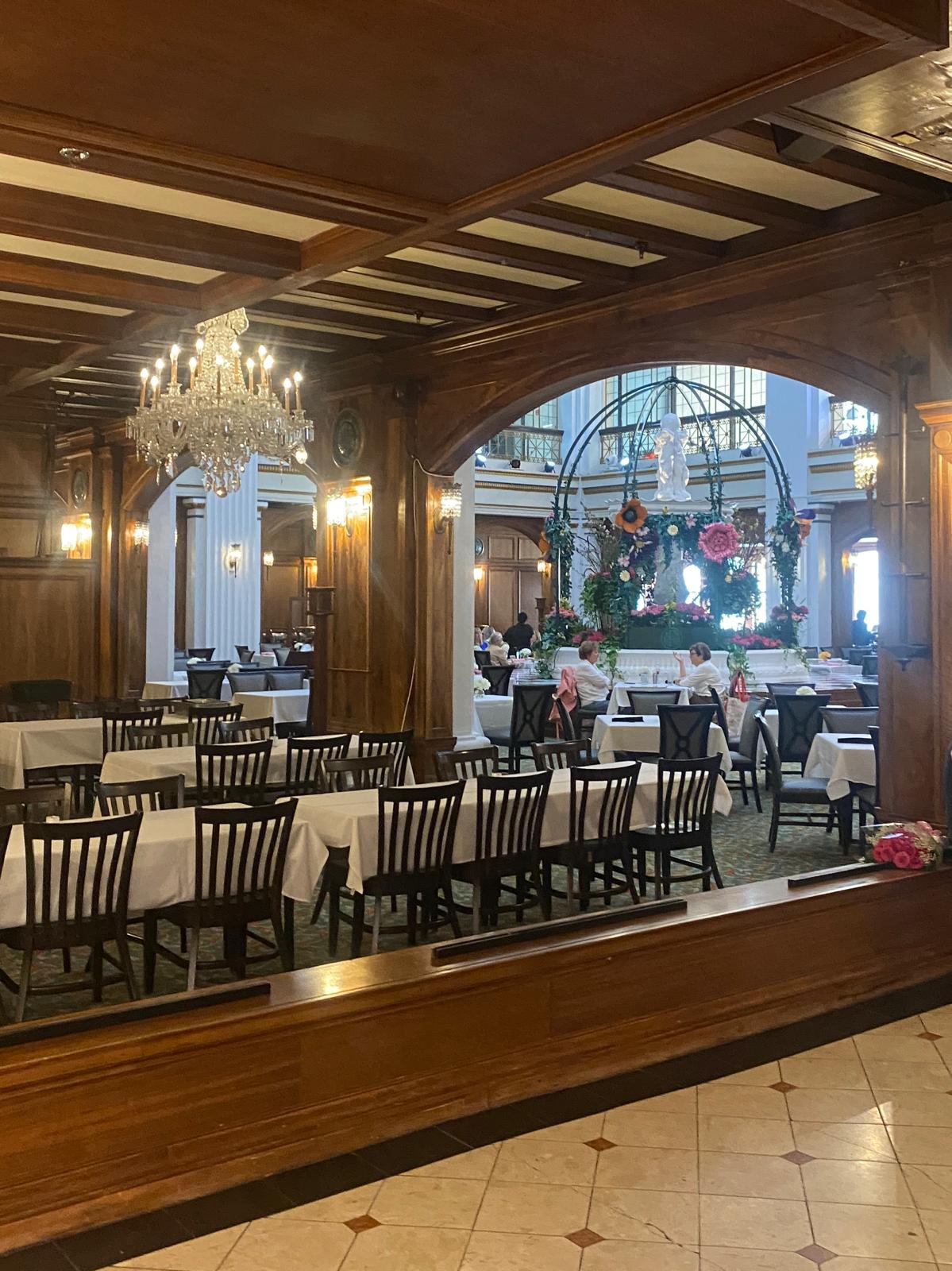
The Walnut Room on the 7th floor of Macy's. (Photo by Gus Boyer)
111 N. State Street
Chicago, IL, 60602
Chicagoans called the store Field’s. Many referred to the book section as Marcella Hahner’s Bookstore. Marcella Burns Hahner was the buyer, manger, and face of the book department for twenty-seven years, becoming “the most conspicuous single figure in American bookselling.” Others called her “the Czarina.”…Americans still buy a large percentage of books outside traditional bookstores. The same was true a century ago, when readers patronized drugstores, cigar shops, newsstands, gift shops, and department stores. Typically the publishers’ largest account, Field’s ordered books by the thousands. As an English essayist touring America in 1920 put it, the Marshall Field & Company book department “is to ordinary English bookshops like a liner to a houseboat.” The book section was said to be the largest bookstore in the world.
Its size didn’t diminish its reputation. It felt like a standalone shop. It dealt in bestsellers and fine bindings and was known more for service than for discounts. Hahner was a bookseller’s bookseller, lauded as a tastemaker for her personal touch and her “highly intelligent staff of book lovers.”
Marshall Field’s represents a critical moment in American bookselling history. For while department stores and their book sections would eventually fall out of favor, the book business—especially the biggest publishers, the biggest booksellers, the biggest authors—kept on biggering. In essence, Field’s was the first book superstore.
Evan Friss’s The Bookshop
While the others stood around discussing an upcoming charity ball, Delia drafted down the center aisle, pausing over a display of delicate handkerchiefs from France. At the next counter, she picked up a bar of Tonquin musk soap and inhaled deeply, relishing the subtle spicy fragrance. As she set the soap down, another display captured her attention, an array of beautiful silk shawls with crystal beading.
Renée Rosen’s What the Lady Wants
Jane rose from her seat abruptly. She had promised to meet Cicily at Marshall Field’s at noon. They were going to look for a new evening gown.
Margaret Ayer Barnes' Years of Grace
In 1856, Marshall Field moved to Chicago from Massachusetts when he was 21 years old. As a young man, he was a partner in many companies, working his way up in the business world. His last partnership with Levi Leiter ended in 1881 when Leiter retired. It was at this point that what was previously Field, Leiter & Co became the iconic Marshall Field & Co. By 1907, the updated Marshall Field’s on State Street was one of the largest retail stores in the world. It was a dazzling Chicago shopping center, with extravagant fashion, fabrics, decor, fragrances, toys, and more. They were also unique in their food and beverage options, with dining spots such as their elegant Walnut Room, their ice cream parlor, and their signature production of Frango Mint candies.
In the midst of these twelve floors of shopping was the book department. It had a kind of magic to it and was home to some of the most successful campaigns in the store. According to Herman Kogan & Lloyd Wendt, the special promotions done in the book department alone boosted annual sales from $235,000 in 1915 to $1,500,000 in 1951 (Give the Lady What She Wants!). In its prime, the book department resided on the third floor of Marshall Field’s. It was a bustling hub for readers and shoppers. Field’s sold countless best sellers, special collectable items, and more variety than any other store. In the 1940s, it was known as “the largest book seller in this hemisphere” according to Leslie Goddard (Remembering Marshall Field’s). The store even had a designated reading and writing room at the end of the third floor where shoppers could pause with a book during their busy days.
Fields was the center for literary events, book signings, live readings, and gatherings in Chicago. It was there during the 1920s that the two writers G.K. Chesterton and Sinclair Lewis met and first started brainstorming a play, Mary Queen of Scotch. Their collaboration was never published, but their meeting marked a significant crossover in the literary world. They were not the only big names to appear at Field’s. Throughout the store’s extraordinary run during the 1920s-1950s, people like Carl Sandburg, Aldous Huxley, Amelia Earhart, Admiral Richard E. Byrd, Bing Crosby, Norman Rockwell, Shirley Temple, and Dear Abby (Abigail Van Buren) came to read and mingle in the book department (via Donald Barliant, “Barbara’s Bookstore Blog”). In September 1986, to promote a British goods display called “Eagle and the Crown,” even Charles Dickens’ great-grandson visited the store.
One of the most memorable literary events at Field’s, though, was in 1944 when a live elephant, Judy, was brought to the book department. She had come from a Wisconsin circus and was there to promote Russell McCracken’s children’s book The Elegant Elephant, which featured a loveable elephant character, Eddie. At the store, Judy the elephant signed and stamped books for kids and drew in a massive audience due to the spectacle. While Judy, who was seven feet tall and 3,000 pounds, had been able to get to the third floor via the freight elevator, it wasn’t as easy to get her out. After the event was over, Judy refused to get back into the elevator, despite her trainers and handlers’ desperate attempts. They even contacted the Brookfield Zoo for advice. It was only after they had scrambled to build a wooden ramp down the three stories that Judy finally walked out onto the main level (via Erica Gunderson, WTTW). Judy’s wild adventure was the inspiration for another book by Rose Oller Harbaugh, Eddie Elephant Has a Party– a story that detailed Eddie during a day at Marshall Field’s.
These children’s books are not the only books with strong ties to Field’s. The store features prominent roles in many Chicago centered novels. The 42nd Parallel by John Dos Passos has a character Eric Egstrom who gets a job in the interior decorating department at Field’s. The store is featured as a Chicago staple of the World's Fair in The Devil in the White City. And of course, Give the Lady What She Wants! is the ultimate collection of insider stories about the retail giant.
Marshall Fields also incorporated literary themes into its famous annual holiday window displays, including the 1944 inaugural display depicting scenes from the poem The Night Before Christmas and the 1986 Boxing Day Theater display that included classic fairytale and folklore stories. The window scenes are sequential, with the proper way to view the stories being to walk along State Street from Randolph to Washington.
Despite the store’s rich literary history, by the 70s or 80s, Marshall Field’s book department was moved drastically. Instead of its large and dedicated space on the third floor, it was lowered to a small corner of the basement level. Though it was still a popular shopping spot, Field’s had lost its title of largest book seller due to the growth of chain bookstores across the country. Then, in 1990, Marshall Field’s was purchased by Target Corporation. In the early 2000s, as the newly bought store was changing, the Target Corporation V-P asked that Barbara’s Bookstore take over the Field’s book department. Barbara’s had been a local bookstore, with a few locations in Chicago, the first opening in 1963. In September 2003, the new Barbara’s Bookstore opened on the lower level. Just a few years later, the company was bought again by the May Company, and all Marshall Field’s stores were officially rebranded to Macy’s in 2006. On State Street, Barbara’s Bookstore remained throughout these changes and still stands as the Macy’s bookstore today.
The store is still the home to readings, release parties, and themed literary events, such as the Harry Potter Christmas window displays in 2000. On the seventh floor, right outside the Walnut Room, a permanent history exhibit features photographs and narratives of the store’s history, along with vintage holiday memorabilia and animatronics of the Snow White display (the last commissioned by Marshall Field’s).