Margaret Anderson’s House/Apartment

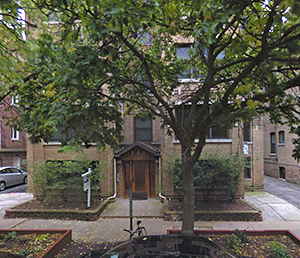
Google Maps image, 2017
837 West Ainslie Street, Chicago
Margaret Caroline Anderson was one of the most influential figures in Chicago’s literary Renaissance of the early 19th century. She arrived in Chicago in 1908, giving up her previous brief career as a pianist to review books for a religious weekly called The Continent. Shortly thereafter, she began working on a rebirth of The Dial as founded by Francis Fisher Brown. The Dial originally began publication in summer of 1840, spearheaded by members of the Transcendentalist Hedge Club, specifically Ralph Waldo Emerson and Margaret Fuller. After working on this offspring of the original publication, and as a book critic for Chicago Evening Post, Anderson began working on her own publication, The Little Review.
As stated by the organization behind the Chicago Tribute Markers of Distinction, it was while living and working in this apartment that Margaret Anderson grew bored and uninspired with her life. It was this moment of depression that supposedly inspired her to start The Little Review, an avant-garde literature and art magazine that would introduce American readers to the works of Ezra Pound, T.S.Eliot, Emma Goldman, and infamously James Joyce’s then-unpublished Ulysses.
While living here, Anderson would also meet her partner and collaborator Jane Heap, an artist, School of the Art Institute of Chicago alumni, and former lover of Djuna Barnes. By the time they met in 1916, The Little Review was already a growing success in Chicago’s literary scene. Their collaboration and partnership over the following 15 years of the magazine’s run would finalize their places as respected figures in literary circles in both America and Europe.
Anderson would leave this apartment for a brief stint living on the beach at Braeside, near Lake Bluff, before heading off to New York with Jane Heap in 1917. Anderson’s six months living in a posh tent (there were wooden floors, and expensive art in the tent) brought a lot of attention to her and her magazine. According to Liesl Olsen, writing for The Newberry, “Writers Ben Hecht and Maxwell Bodenheim walked miles up from the city to reach her on the beach, and then pinned poems to her tent. Sherwood Anderson came out and told stories around the campfire. (Never mind that Margaret Anderson, statuesque and beautiful, was only attracted to women.)”
Anderson was inducted into the Chicago LGBT Hall of Fame in 2006 and the Chicago Literary Hall of Fame in 2014. A Tribute Markers of Distinction stands in front of her old apartment house.