Lorraine Hansberry House

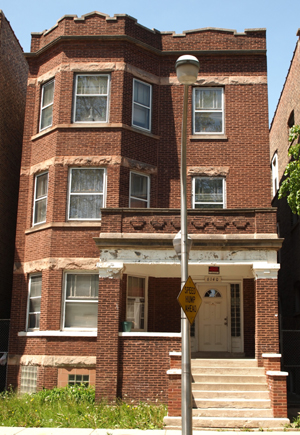
Frederick J. Nachman, 2017
Lorraine Hansberry drew from this building her inspiration for the widely acclaimed A Raisin in the Sun, which would become the first Broadway production of an African American playwright. Hansberry’s father, Carl, was a real estate developer, and he purchased the building in 1937, against threats of violence, in part to challenge the racially discriminatory housing covenant that precluded his African American family from moving into this neighborhood. The Hansberry family lived in this building from May 26, 1937-40, the whole time pursuing a legal challenge that ultimately was decided in a favorable Supreme Court decision. Lorraine Hansberry depicted life in the house in a 1964 letter to the New York Times, in which she described bricks being thrown through the windows, her mother keeping a gun for protection (in contrast to her father, who was the public face of the fight, her mother bore the unreported burden of protecting the family too) and being beaten on the way to school. The building was designated Chicago Landmark on Feb. 10, 2010. Hansberry lived in the Rhodes Avenue place from the ages of seven to 10, approximately. She lived many years at 5936 S. Parkway (now Dr. Martin Luther King Drive), only about a half mile away from what is now Lorraine Hanbserry Park (5635 S. Indiana Avenue, Chicago, IL 60637).The Chicago Park District park renamed Indiana & 56th Park after the great Chicago playwright in 2004 as part of an initiative to recognize the contributions of Chicago women. Hansberry went to Englewood High School, where she became president of the debating club in 1947.
Lorraine Hansberry drew from this building her inspiration for the widely acclaimed A Raisin in the Sun, which would become the first Broadway production of an African American playwright. Hansberry’s father, Carl, was a real estate developer, and he purchased the building in 1937, against threats of violence, in part to challenge the racially discriminatory housing covenant that precluded his African American family from moving into this neighborhood. The Hansberry family lived in this building from May 26, 1937-40, the whole time pursuing a legal challenge that ultimately was decided in a favorable Supreme Court decision. Lorraine Hansberry depicted life in the house in a 1964 letter to the New York Times, in which she described bricks being thrown through the windows, her mother keeping a gun for protection (in contrast to her father, who was the public face of the fight, her mother bore the unreported burden of protecting the family too) and being beaten on the way to school. The building was designated Chicago Landmark on Feb. 10, 2010. Hansberry lived in the Rhodes Avenue place from the ages of seven to 10, approximately. She lived many years at 5936 S. Parkway (now Dr. Martin Luther King Drive), only about a half mile away from what is now Lorraine Hanbserry Park (5635 S. Indiana Avenue, Chicago, IL 60637).The Chicago Park District park renamed Indiana & 56th Park after the great Chicago playwright in 2004 as part of an initiative to recognize the contributions of Chicago women. Hansberry went to Englewood High School, where she became president of the debating club in 1947.