James Farrell’s Home

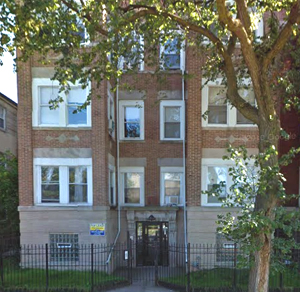
Google Map image, 2017
James T. Farrell wrote more than 100 books in his lifetime, but gained his highest distinction for the Studs Lonigan trilogy, in which he drew on his own experiences to document the lives of first and second-generation Irish Americans. In 1929, he began writing Young Lonigan, the first part of the trilogy, while living at this home. A Chicago Tribute Marker of Distinction has been erected at the site.
Farrell lived at this address during the period 1915-1917, when he was 11 to 13. Farrell then lived at 5816 S. South Parkway (which is demolished) during 1917-1923, when he was 13-19. This move indicated a modest rise in the family's fortunes, as houses "on the park" were in demand and reflected increased wealth. For example, pioneer Black banker Jesse Binga also lived along the park at 5922 S. Parkway, which was bombed several times because it was still a "white" area.
In 1954, Farrell published a short story in Commentary in which his protagonist and somewhat alter ego, Danny O'Neill, goes back to the neighborhood after it has resegregated into a Black neighborhood and visits a Black friend who lived near 57th and South Parkway
James T. Farrell wrote more than 100 books in his lifetime, but gained his highest distinction for the Studs Lonigan trilogy, in which he drew on his own experiences to document the lives of first and second-generation Irish Americans. In 1929, he began writing Young Lonigan, the first part of the trilogy, while living at this home. A Chicago Tribute Marker of Distinction has been erected at the site.
Farrell lived at this address during the period 1915-1917, when he was 11 to 13. Farrell then lived at 5816 S. South Parkway (which is demolished) during 1917-1923, when he was 13-19. This move indicated a modest rise in the family's fortunes, as houses "on the park" were in demand and reflected increased wealth. For example, pioneer Black banker Jesse Binga also lived along the park at 5922 S. Parkway, which was bombed several times because it was still a "white" area.
In 1954, Farrell published a short story in Commentary in which his protagonist and somewhat alter ego, Danny O'Neill, goes back to the neighborhood after it has resegregated into a Black neighborhood and visits a Black friend who lived near 57th and South Parkway