Harold Washington Library Center

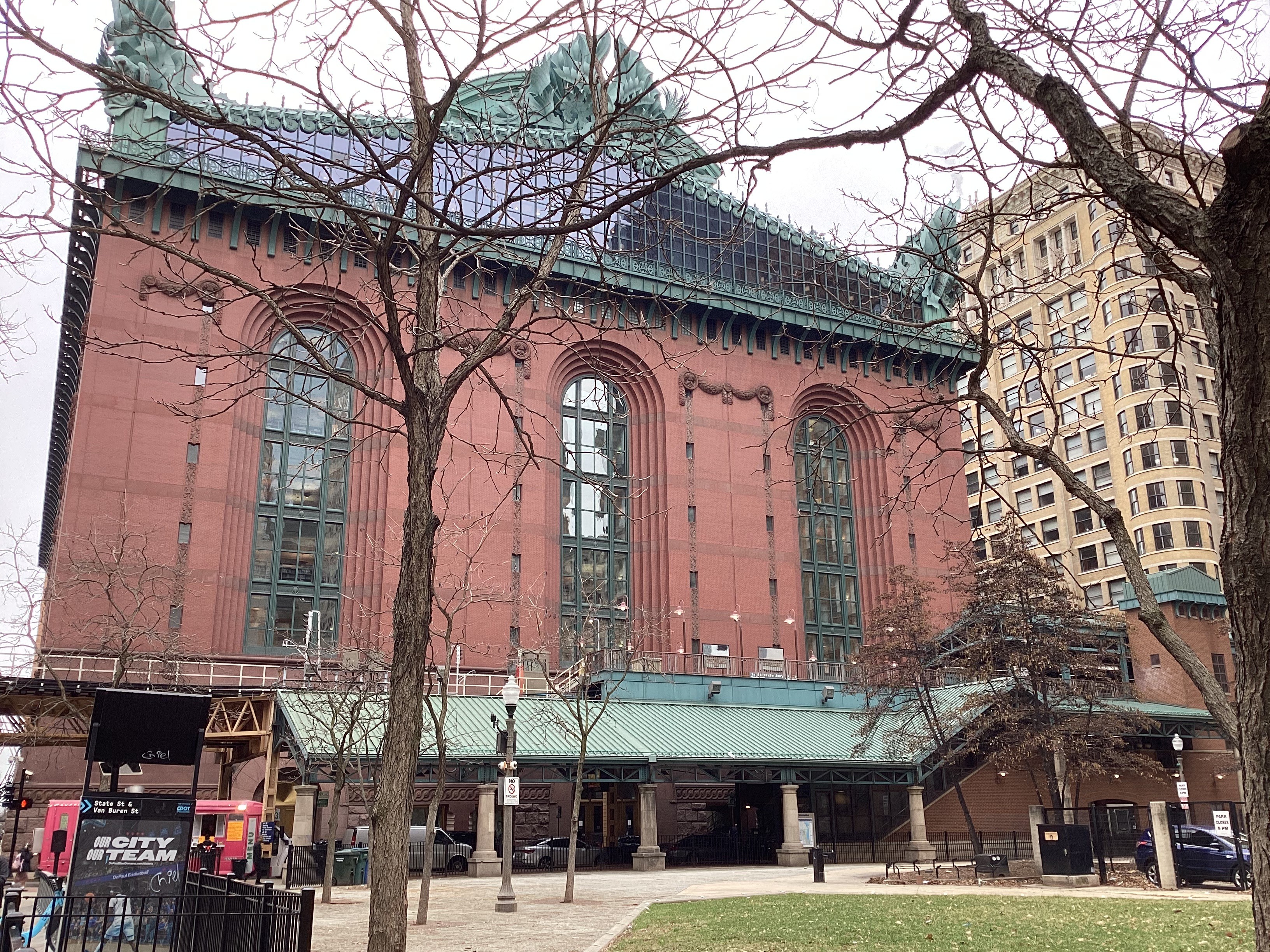
410 S. State Street
At the time of opening in 1991, this was the largest municipal public library in the world (according to The Guinness Book of Records). This neo-classical building holds nearly two million books, or about forty percent of the total shelved throughout the system’s 81 libraries. This includes the Queen Victoria Collection that inspired Chicago’s free library system; Special Collections (ninth floor) of rare and historical manuscripts; the Municipal Reference Collection (fourth floor) containing governmental and community-related titles; and The Literature and Language Department, (seventh floor), which houses an impressive fiction collection.
Not only does the library have over 1,500 books written by Chicago authors about Chicago, it has been described in many novels and short stories, such as “Killing time” by Stuart Dybek.
From top-to-bottom, the Harold Washington Library reflects Chicago literature—literally.
Du Sable’s Journey, the circular mosaic, or cosmogram, viewed from the first floor, acts as a tribute to Chicago’s history, connecting its first settler with its first African American mayor. The center, which traces Jean Baptiste Point Du Sable’s path from Haiti through various waterways to the Great Lakes, is ringed by Harold Washington quotes taken from his first and second inaugurations.
Also on the lower level, in the hallway leading to Reception Hall, is the Writers Portrait Gallery. Beginning in 2000, the CPL established its Foundation Awards. In the beginning, this consisted of two distinct awards. The Carl Sandburg Literary Award honors an author whose significant body of work has enhanced the public's awareness of the written word. The 21st Century Award honors an early-career author with ties to Chicago. Eventually, this expanded to include The Arts Award and The Civic Award. The Cindy Pritzker Auditorium, also on the lower level, is frequent host to readings and author discussions, and usually is the site where the Harold Washington Literary Award winner appears to open the annual Printers Row Lit Festival.
The Winter Garden, on the ninth floor, is a bright, beautiful public space rising 100 feet through the tenth floor to a glass roof. The planters hold olive trees. While most major authors appear on the lower level, at the Cindy Pritzker Auditorium, the Winter Garden has hosted many, many luminaries, such as on May 25, 2016, when Alice Walker received the Carl Sandburg Award. The Special Collections and Preservation Division, located on the north side of this floor, houses books, photographs, artifacts, archival material on the Civil War, Chicago Theater, the 1893 and 1933 World’s Fairs. These resources have been and continue to be instrumental for authors retelling stories of the two Chicago world fairs. There is a whole sub-library of fictional and non-fictional accounts of these two fairs, starting with Samantha at the World’s Fair (1893) by Marietta Holley. The most successful title is Erik Larson’s The Devil in the White City: Murder, Magic, and Madness at the Fair That Changed America. That 2003 account tells the dueling stories of the men who built the World’s Fair in Chicago, the man who would assassinate Chicago’s mayor at the end of it, and the serial killer, H.H. Holmes, who killed women during it. Robert Block novelized the Holmes story in his thriller American Gothic (1974).
Throughout the library you one can find various wall art and sculptures, such as a model of the Chicago Cloud Gate. The tradition of the public art had been started by the first Mayor Richard Daley. The City of Chicago’s Public Art Collection at the Harold Washington Library Center was funded through the City’s Percent-for-Art Program. The Percent-for-Art program allocates 1.33% of all public building project costs to the procurement of art.
Some Chicago literary themes are reflected in the public projects. War, for one. The “Above and beyond” installation on the ceiling above the escalator to the third floor features over 58,000 hand-stamped replicated dog tags representing U.S. soldiers who lost their lives in the Vietnam War. Philip Caputo, a Westchester native who graduated from Fenwick High School and Loyola University, wrote an acclaimed memoir, A Rumor of War (1977), based on his experiences as a platoon commander. After he left the Marine Corps, he was part of a Chicago Tribune writing team that won a Pulitzer Prize for its exposes on election fraud in Chicago. Larry Heinemann, who earned a B.A. from Columbia College Chicago before teaching creative writing there for 15 years, won a National Book Award for his novel, Paco’s Story, in 1987. In that novel, Paco Sullivan is the only survivor of a unit attacked by the Viet Cong. He drew even more directly on his wartime experiences in his first novel, Close Quarters, 1977. Norman Mailer, while not a Chicagoan, did camp out here for his 1968 New Journalism essay on the Republican and Democratic Conventions, Miami and the Siege of Chicago. While that book, including coverage of the convention at the Hilton and protests in Grant Park, dealt tangentially with the movement against American involvement in Vietnam, Mailer more thoroughly captured the spirit and times of the anti-war protests in his, The Armies of the Night. Published that same year, Armies is a third-person account, with Mailer as the protagonist, of protesters marching on the Pentagon in Washington D.C.
More recently, Chicago author and CLHOF member, Rita Dragonette novelized the experiences of a woman in the Viet Nam era, The Fourteenth of September (2018).
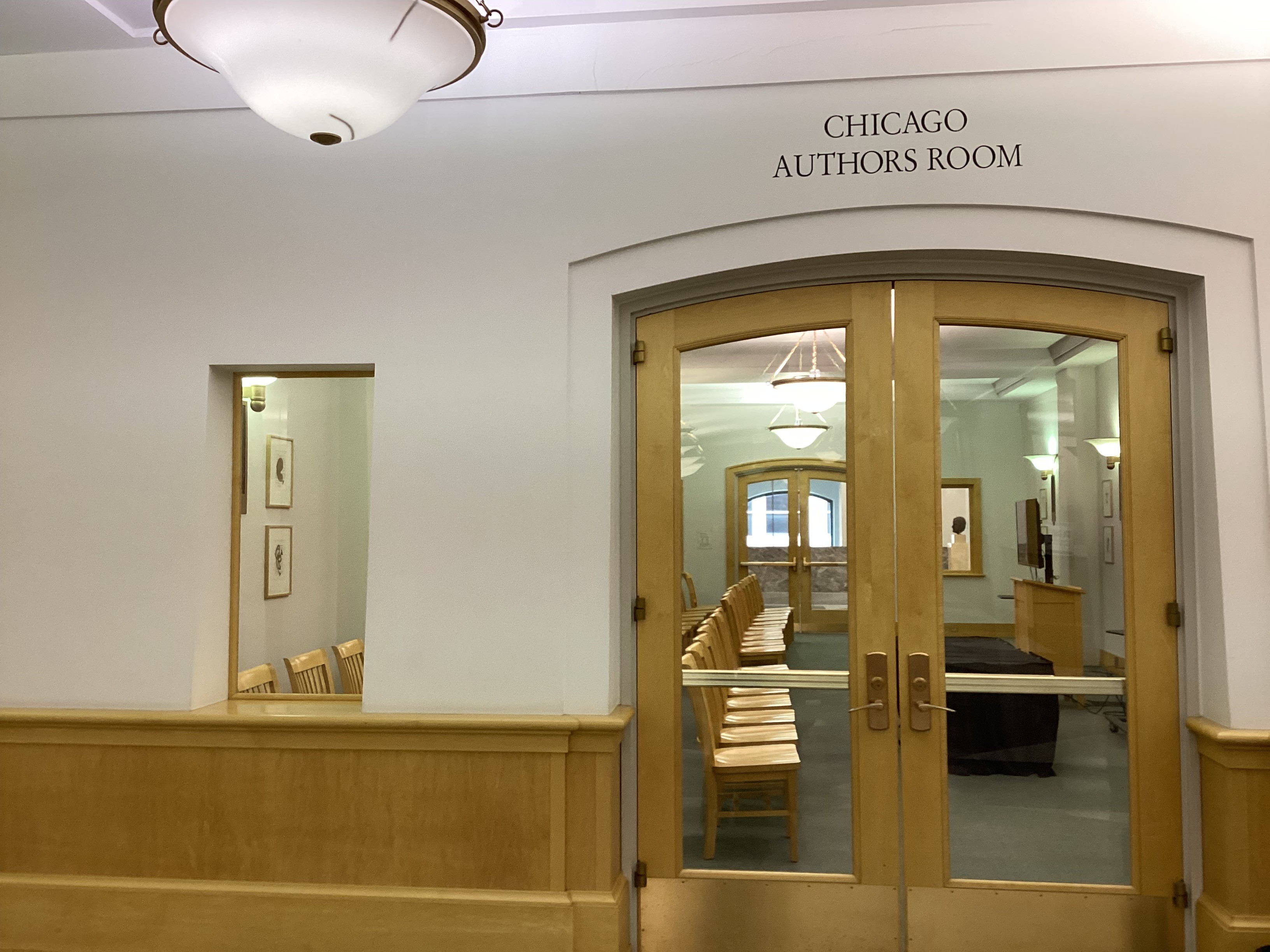
The Chicago Author's Room, on the seventh floor, displays busts of Gwendolyn Brooks (created 1994), Ernest Hemingway (created 1994), and Saul Bellow (created 1993). These are arguably Chicago’s most decorated authors. Brooks was the first woman to win a Pulitzer Prize (in 1950, for her poetry collection, Annie Allen); she also won a Robert Frost Medal, an Anisfield-Wolf Book Award for Fiction, a Medal for Distinguished Contribution to American Letters, a Guggenheim, and was U.S. Poet Laureate. Bellow won a Nobel Prize, a Pulitzer Prize, two National Book Awards, and a National Medal of Arts. Hemingway won Nobel and Pulitzer Prizes. Both Brooks and Bellow wrote extensively about Chicago. Sara Shapiro Miller (July 8, 1924 – October 29, 2016) was an American real estate executive and mother of three before she turned to art. She began studying ceramics and sculpture in her retirement years, at Truman College and the School of the Art Institute. Replicas of her three Chicago authors busts are owned by the National Portrait Gallery. At the bust’s unveiling in June 1994, Brooks dedicated the poem, “For Sara Miller, Sculptor,” in which she ruminates on gaining immortality through the artistic rendering. The Chicago Authors Room provides a setting for many writers’ events.
In addition to the Harold Washington Library Center, the Chicago Public Library system boasts three regional and 77 neighborhood branches. William Miller’s 1977 novel, Richard Wright and the Library Card, dramatizes the true story of the importance of the library system to the future author of Black Boy and Native Son, among others. Wright himself made reference to Bronzeville’s Hall Branch, whose mission is partly to promote African American history and culture. Arna Bontemps, Margaret Walker, Horace Clayton, Gwendolyn Brooks and other prominent writer were associated with that branch.
The Plymouth Hotel, 22 W. Van Buren, was the filming site of Jake and Elroy’s “Hotel For Men Only. Transients Welcome” that Carrie Fisher blew up in The Blues Brothers. It no longer exists. It’s now a grassy plot beneath the el – though the revamped entrance to Library station has obscured the view somewhat.
Reading, Viewing and Listening List
Miami and the Siege of Chicago
Climbing a Great Mountain: Selected Speeches of Mayor Harold Washington
Harold, the People’s Mayor: An Authorized Biography of Mayor Harold Washington
Richard Wright and the Library Card
Mayor Harold Washington: Champion of Race and Reform in Chicago