Federal Plaza

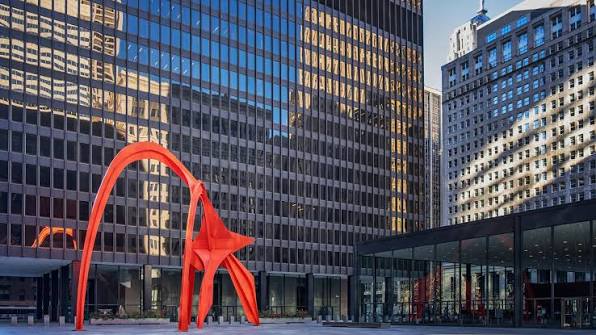
219 S. Dearborn Street
Chicago, IL 60604
The protest was part of the growing "anti-war" movement, and this specific gathering was a critical moment for local opposition to the impending Bush administration actions.
We walked east on Adams, chants from the protesters ricocheting off the glass and steel of the towering buildings. Trudging down the plowed streets, squinting into the biting wind, hunched against it, it felt as if the tall towers surrounding us hemmed us in, their dark mass crowding out the light. And then the buildings above us suddenly stopped, and the street opened to the gray width of Federal Plaza, the center of the protest, total madness, the courtyard crammed like a train car after a baseball game. People screamed through megaphones, others tried to climb the sculpture at the plaza’s center, children swayed on their fathers’ shoulders, the gray sky was suddenly visible and low, a square of it cut out from the crowd of surrounding buildings, like a mirror reflection of the plaza beneath it. We had arrived. Grady Chambers’s Great Disasters (2025), novel.
The Chicago Federal Plaza, which includes the John C. Kluczynski Federal Building and Loop Station Post Office, marks a transition to modernism heralded by its designer, Ludwig Mies van der Rohe. In the 1930s, Mies was the last director of the Bauhaus school in Germany. The rise of Nazism, and its vehement opposition to modernist art and design, led Mies to immigrate to the United States in 1937. Along with the Federal Plaza, Mies’ works in Chicago include the Illinois Institute of Technology campus, 860-880 Lake Shore Drive Apartments and Promontory Apartments in Hyde Park.
Across the street lies the Everett McKinley Dirksen Building, a replacement of the neo-classical Federal Building that once overlooked the Chicago Board of Trade. Mies abandoned the Beaux-Arts style of granite arches and an immense octagonal dome for glass paneling and steel beams where “every column, light fixture, bench, door and paver lines up on the grid,” according to the Chicago Architecture Center.
Since its construction, the plaza has been a site for protest demonstrations, and the Dirksen Federal Courthouse has a rich political history. The courtroom is notable for its lack of bar that typically divides spectators from trial participants, which, according to Syracuse University architecture professor David Shanks, produced an immersive theatrical effect in the famous trial of the Chicago 7/Conspiracy 8. In the 1969-70 trial, eight protesters at the 1968 Democratic National Convention were tried for conspiracy with intent to incite a riot and other charges related to anti-Vietnam War protests. Defendant Abbie Hoffman especially played into the theatrical nature of resistance, cartwheeling outside the plaza before the trial and performing handstands on the court table. All defendants were acquitted for charges of conspiracy by the jury.
Franz Kafka’s novel, The Trial, evokes the challenges of a complicated, opaque bureaucracy that Abbie Hoffman confronted in the Dirksen Federal Courthouse. In the novel, protagonist Josef K. is summoned to an unknown but omnipotent court to be tried for an unspecified crime.
“He had thought that he would recognize the building from a distance by some kind of sign, without knowing exactly what the sign would look like, or from some particular kind of activity outside the entrance. K. had been told that the building was in Juliusstrasse, but when he stood at the street’s entrance it consisted on each side of almost nothing but monotonous, grey constructions.”
The Dirksen Federal Building, David Shanks argues, lacks the signifiers that identify it as a federal courthouse. It is important to note, however, that the Bauhaus movement which inspired architect Mies intended to provide the opposite effect of the buildings in Kafka’s novel. The minimalist design of steel and glass faces reflects an ideal of democratizing access to both art and function, not of intentional misdirection.
Two years before the Chicago 7 trial, defendant Abbie Hoffman protested at the Pentagon with poet Allen Ginsberg, who together led Tibetan chants. Ginsberg’s confessional poem, “Howl,” serves as a lament for great minds destroyed by the soulless and conformist society of mid-century America, which has been protested in Chicago’s Federal Plaza in several contexts.
The only Chicago native of the Chicago 7 trial, Lee Weiner, published a memoir about the trial in 2020. Weiner worked as a social worker before the trial. He writes, “every day... the work drove punishing truths into my head about what was wrong in America.”
Grady Chambers’ Great Disasters is set in Chicago amidst the backdrop of 9/11, the Iraq and Afghanistan wars, and the protests surrounding them. The included excerpt visits a protest in the Federal Plaza. As the protagonist marches to the site, “the buildings grew dark and taller, the crowd thickened around us, and there were wide blue barricades blocking cars from the street..Above us, in the bright windows of the long corridor of office buildings, people crowded at the windows to watch our procession.” Decades after the Chicago 7 trial, modernist architecture of downtown Chicago continues to make an impact on protests.
In 2002, then Illinois State Senator Barack Obama delivered an anti-war speech in the Federal Plaza, marking an early moment in his eventual 2008 presidential campaign.
The Federal Plaza houses Alexander Calder’s bright red, 53-foot-tall statue, which was unveiled in 1974. The American sculptor is something of an obsession for Blue Balliet’s character, Calder, in her young adult series following a trio of Chicago kids who solve art-related mysteries. Set in Chicago’s Hyde Park, three children attempt to locate a missing Vermeer painting in the first novel, Chasing Vermeer. In the second, The Wright 3, the group attempts to stop the demolition of Frank Lloyd Wright’s Robie House. In Calder’s Game, protagonist Calder disappears the same night as an Alexander Calder statue goes missing in England, and the other two friends are recruited to crack the case.
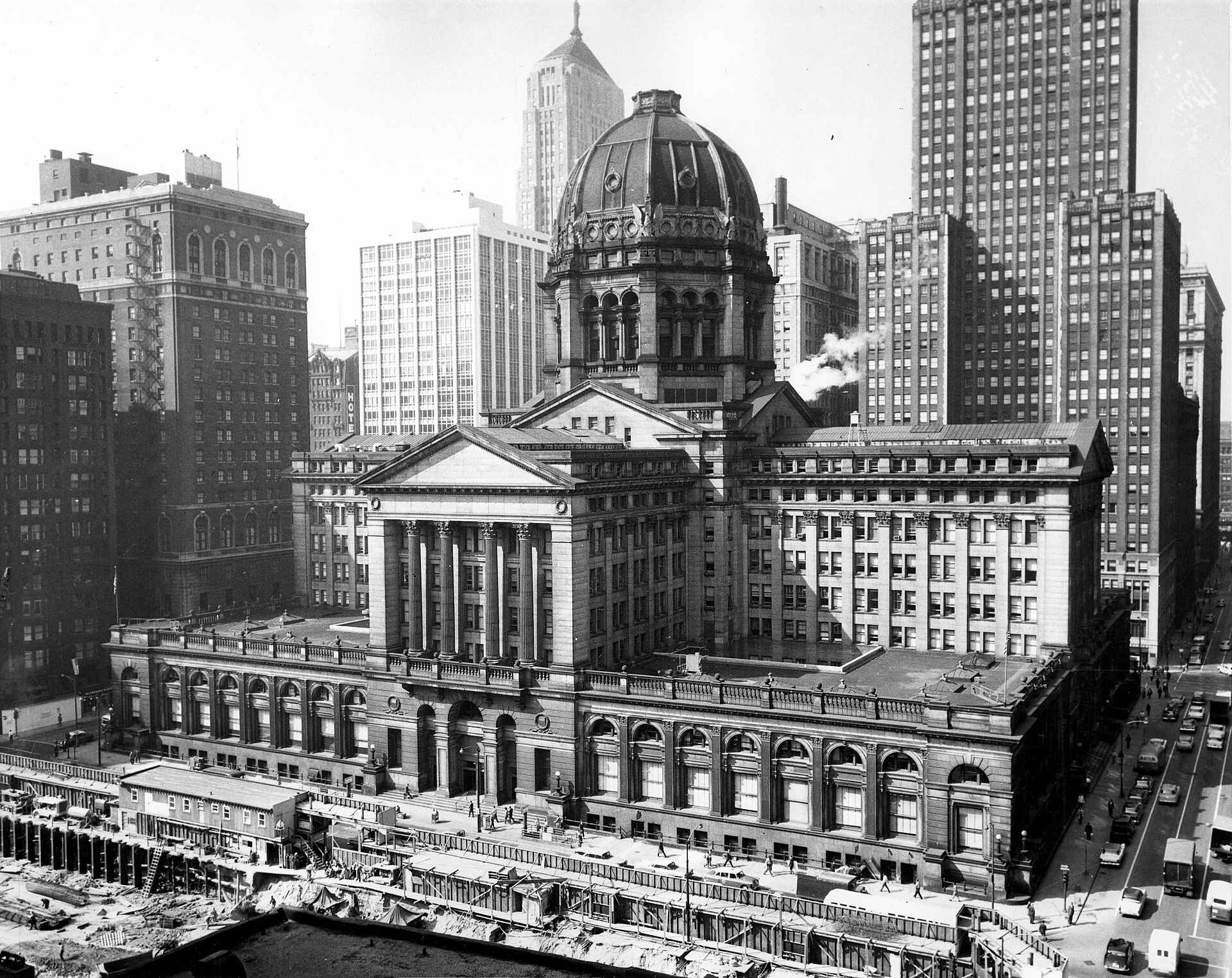
Federal Plaza, 1961
Reading, Viewing and Listening List
Conspiracy to Riot: The Life and Times of One of the Chicago 7