Daley Plaza

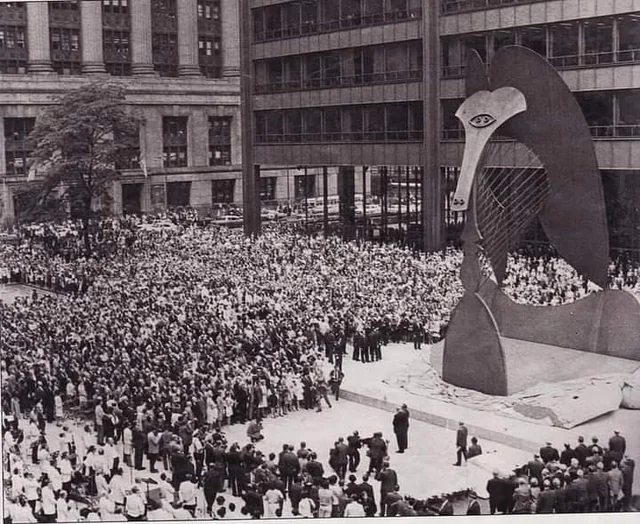
The Picasso being unveiled in the Daley Plaza, 1967
50 W. Washington Street
Chicago, IL 60602
Does man love Art? Man visits Art, but squirms.
Art hurts. Art urges voyages--
and it is easier to stay at home,
the nice beer ready.
In commonrooms
we belch, or sniff, or scratch.
Are raw.
But we must cook ourselves and style ourselves for Art, who
is a requiring courtesan.
We squirm.
We do not hug the Mona Lisa.
We
may touch or tolerate
an astounding fountain, or a horse-and-rider.
At most, another Lion.
Observe the tall cold of a Flower
which is as innocent and as guilty,
as meaningful and as meaningless as any
other flower in the western field.
Gwendolyn Brooks’s “The Chicago Picasso”
Richard J. Daley Center and its adjacent Plaza stands between Washington and Randolph Street and has historically been the host of countless civic functions, from protests to farmers markets to the city’s annual Christkrindlmarket. The building itself primarily houses offices and courtrooms for the Cook County Circuit Courts and the Cook County State’s Attorney.
This March, hundreds of protesters gathered at Daley Plaza before marching to Trump Tower in protest of restrictions on reproductive care and immigration rights, as well as gender-based violence. Thousands of protesters made their way to Trump Tower holding signs focusing on women’s rights and bodily autonomy. Similarly, last June, hundreds and thousands of protesters filled the Plaza as part of a nationwide “No Kings” protest in response to the Trump administration’s immigration policies and perceived authoritarianism. In August 1968, at the height of anti-Vietnam War protests during the Democratic National Convention, the Yippies (a counterculture group led by Abbie Hoffman and Jerry Rubin of the Chicago Seven) attempted to formally nominate a pig for president and set one loose on Daley (then named Civic Center) Plaza.
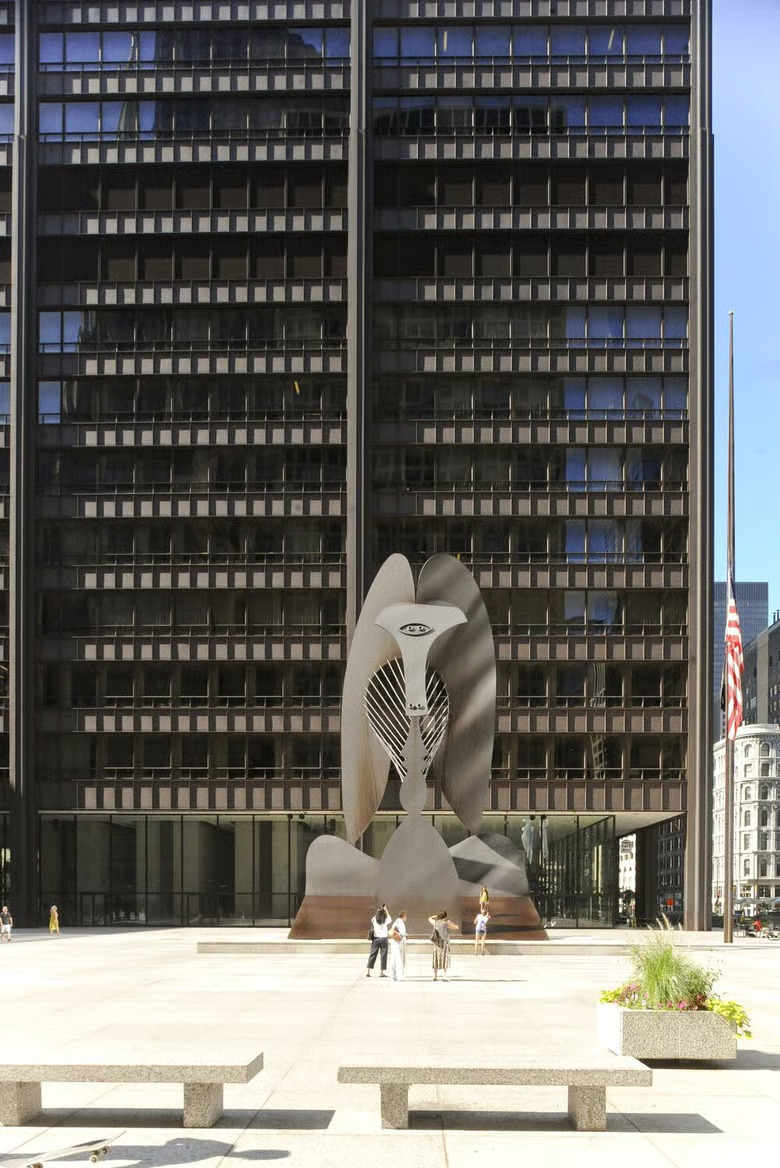
The Picasso sculpture on the Plaza was installed in 1967, just a year before the DNC protests, and has been an artistic fixture of the Loop ever since. Upon its installation, the sculpture was met with controversy, as much of the public was unsure of the meaning to its abstract form, as well as what said form was meant to depict. At the unveiling of a different public sculpture in New York City, Picasso revealed to psychologist Stanley Coren that the Chicago structure was an abstract representation of his Afghan Hound.
For the dedication ceremony of the Chicago Picasso, Mayor Richard J. Daley commissioned Gwendolyn Books to write a poem commemorating the sculpture. Years later, Brooks told a reporter that she “really didn’t feel qualified to discuss what Picasso was doing or had intended to do. So I decided to handle the situation from the standpoint of how most of us who are not art fanciers or well educated in things artistic respond to just the word art,” and on August 15, 1967, she read her poem, “The Chicago Picasso” at the dedication ceremony. ] The next day, Mike Royko wrote a famous Chicago Daily News column, in which he said the statue “has a long stupid face and looks like some giant insect that is about to eat a smaller, weaker insect.”
The city incurred massive lawsuits and legal action during Daley’s tenure regarding police brutality under Jon Burge on the South and Far South Sides, which led to numerous convictions, trials, and overturned sentences, including that of Andrew Wilson, notes the People's Law Office. John Conroy wrote about it for The Reader. His play is called “My Kind of Town,” was at the Timeline. The Chicago Torture Justice Memorials (CTJM), held a press conference in May 2015, where Conroy and others celebrated the passage of the reparations ordinance for Burge torture survivors. The Chicago courts in this era saw several cases related to political maneuvering and corruption within the Cook County structure, including investigations into the state's attorney's office, as discussed in a New York Times article.
Larry Speck