Colfax Avenue viaduct under the Belt Railway Company and Chicago Rail Link (formerly the Chicago, Rock Island, and Pacific) tracks

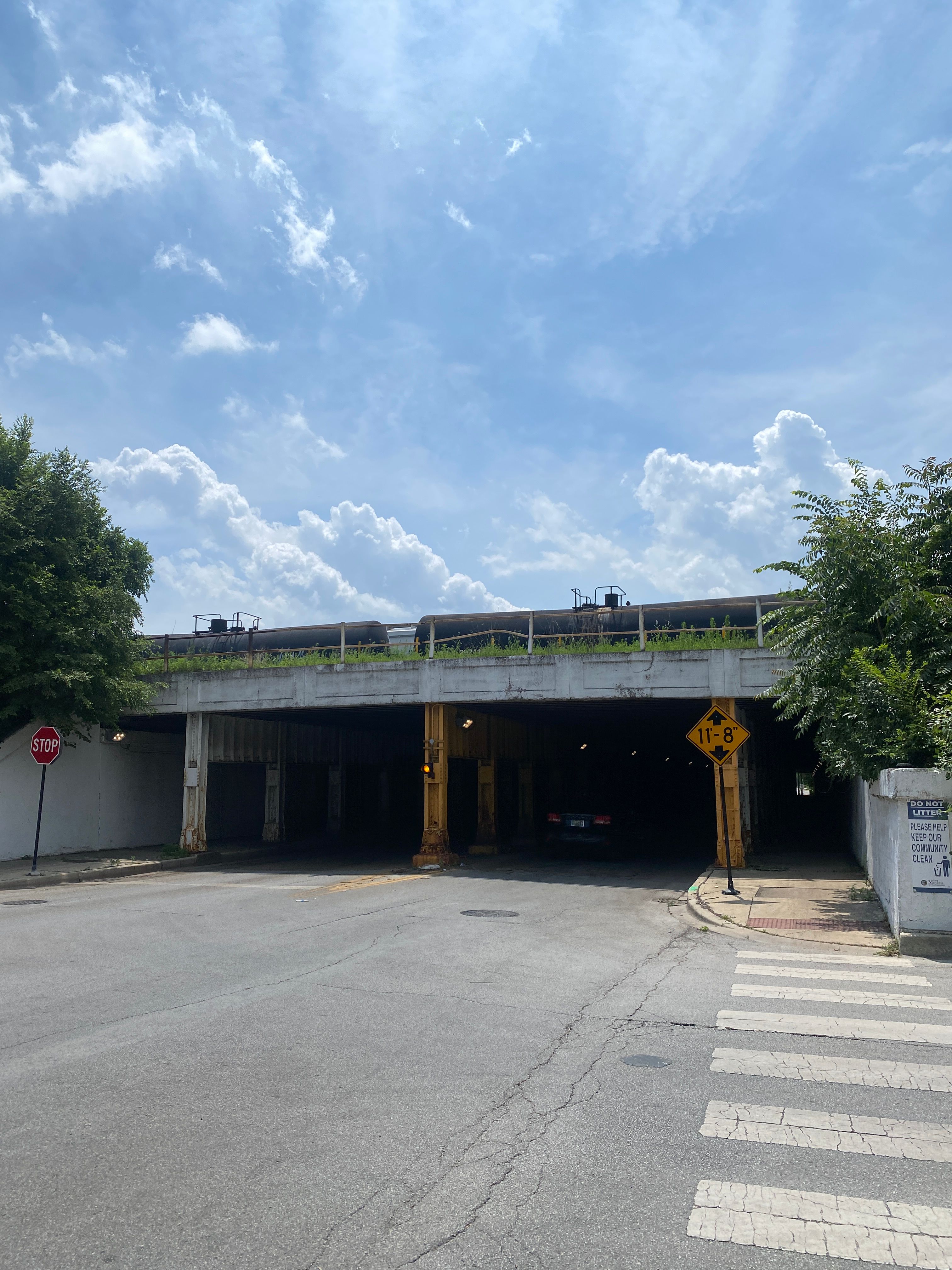
Colfax Avenue between 94th and 95th Streets
Chicago, IL 60617
(South Deering)
At the end of a street that advanced between rows of brick bungalows stood the tunnel. We entered it and I tensed, at once exhilarated and alarmed by the wagon’s din, frightened by the sudden darkness yet braving it because my father was there. A long time passed before we reached midpoint, where I feared everything would cave in on us. Then slowly my father’s silhouette, pillarlike, filled the space ahead of me, growing larger and larger as we approached the light. Beyond the tunnel there were no houses, and we emerged into the radiance of 95th Street and Torrence Avenue.
Hugo Martinez-Serros' “Distillation,”
As the railroad capital of the Unted States, Chicago is crisscrossed by railroad tracks. Originally, many tracks were at grade level; eventually, for safety purposes, many tracks were elevated and run via viaducts over neighborhood streets. Viaducts thus both are markers of transport from one place to another and markers of division between one place and another. In a highly segregated city such as Chicago, such division markers often carry with them notions of divisions between class and race. This distinctive physical feature of Chicago’s landscape is often reflected in Chicago literature. For example, in Stuart Dybek’s short story “Blight,” set on the southwest side, a viaduct becomes a barrier between a white and a black neighborhood, but early 1960s neighborhood vocal groups from either side harmonize and appreciate each other’s music from the safe distance of their respective ends of the viaduct.
In Hugo Martinez-Serros' story, “Distillation,” a crucial moment in the journey to the Chicago city dump occurs at this viaduct, described by the narrator in a manner that illustrates that the journey from their Bush neighborhood, with its frame houses and pollution is also a journey into new and unfamiliar landscapes.
In another Martinez-Serros story, “Kildeer,” the narrator describes how the land south and west of this spot – now built up with mid-20th-Century homes – was farmed by Mexican American immigrants in the 1930s: “acres of land with few trees reached south as far as the 103rd Street bridge and west to the highway – railroad land fallen into disuse. It hid old wells and scant remains of structures razed long ago. Their milpa was off Torrence Avenue, just west of where the long curve ended. Jose Maria, like other Mexican immigrants, had found his way there some years earlier, had cleared several acres, had turned them over with a hoe and worked the simple magic that gave corn, tomatoes, potatoes, squash, coriander and much more. It was more land and richer than any his father had cultivated in Mexico.”