Board of Trade Building

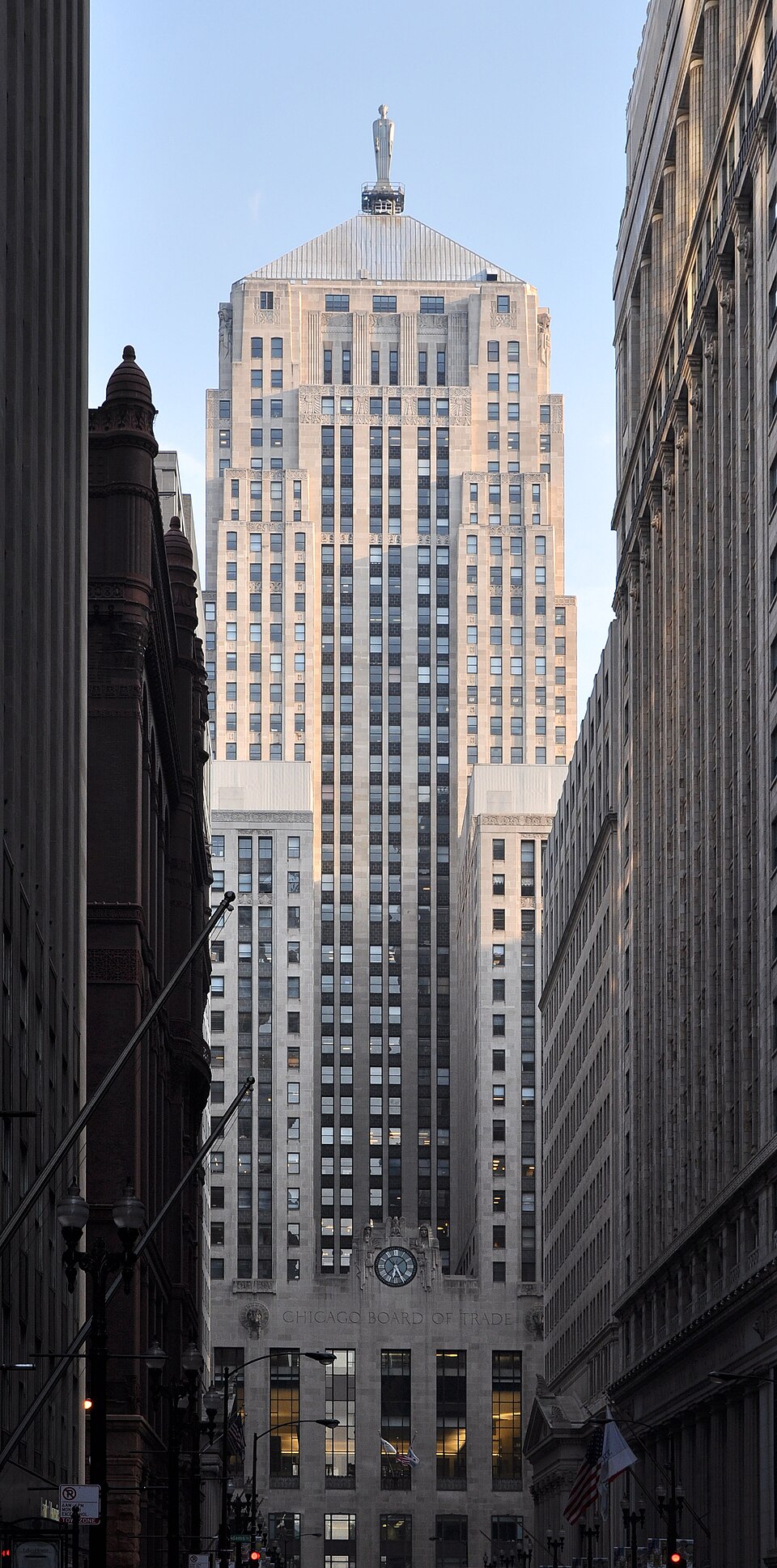
Joe Ravi, 2011
141 W. Jackson Street
Chicago, IL 60604
“Yes, yes, that’s just what it is,” continued Page. “See, there’s the Rookery, and there’s the Constable Building, where Mr. Helmick has his offices. Landry showed me it all one day. And, look back.” She raised the flap that covered the little window at the back of the carriage. “See, down there, at the end of the street. There’s the Board of Trade Building, where the grain speculating is done,--where the wheat pits and corn pits are.”
Laura turned and looked back. On either side of the vista in converging lines stretched the blazing office buildings. But over the end of the street the lead-coloured sky was rifted a little. A long, faint bar of light stretched across the prospect, and silhouetted against this rose a sombre mass, unbroken by any lights, rearing a black and formidable façade against the blur of light behind it.
And this was her last impression of the evening. The lighted office buildings, the murk of rain, the haze of light in the heavens, and raised against it the pile of the Board of Trade Building, black grave, monolithic, crouching on its foundations, like a monstrous sphinx with blind eyes, silent, grave,--crouching there without a sound, without sign of life under the night and the drifting veil of rain.
Frank Norris’s The Pit: A Story of Chicago
In the old days, when I was first starting out, back when ours was the only option exchange, when you literally could not trade options except through one of the brokers at CBOE, like myself, who owned a seat, or several seats, the trading floor was a stocked pond: you just cast your line in the water and caught something, no skill required, and you motored away feeling like you had the biggest cock on the lake. You’d go upstairs to the third floor and find half the Executive staff passed out at their desks, drunk from lunch.
Now that things are going electronic, customers no longer need to trade through a broker—they don’t even need a seat on the Exchange. Yet those of us who own seats still wade into our pits every day, thrashing our arms and crying out until the veins in our neck bulge, knowing that not only are we expendable as human capital, but that the very trading pit we occupy is obsolete in today’s fiber-optic world. Ignoring the empty pits around us, the void encroaching like an unknowable darkness; ceding more and more of our real estate each day to puissant tech-nerds programming tangles of circuitry and wires meant to do one thing only: outperform us.
It's me against the machines. Fucking John Henry and his silver fucking hammer.
L.C. Fiore’s Coyote Loop
Chicago’s reputation, prodded on by the likes of Carl Sandburg, might be as “Stacker of Wheat”—it’s also speculator of wheat. Chicagoans like to think of their city as one in which we get our hands dirty, work up a sweat, and make useful things. All of that is or has been true. Also, true, though, is that Chicago is a white-collar city, amassing wealth and impacting the economy not through production but speculation. Chicago houses several dozen billionaires, making it a city with one of the greatest concentrations of the ultra-wealthy. The city is home to 15 Fortune 500 companies, double that if you expand the boundaries to the greater metropolitan area.
Established in 1848, the same year the first railroads arrived in Chicago and the Illinois and Michigan Canal opened, the Chicago Board of Trade started above the Gage and Haines Flour Store on 101 South Water Street. Chicago, then situated at the edge of the prairie, made sense as a central location for negotiating and transacting future prices of commodities. Railroads and the I&M Canal both made distribution of raw materials more efficient. As a city with agricultural roots and surrounding agricultural interests, grain distribution and trading was a natural fit. CBOT moved several times, staying the longest at LaSalle and Jackson Streets (from 1885-1930). The current Board of Trade Building was built in 1930 and is the site of the world’s oldest futures and options exchange.
Roman agricultural goddess Ceres sits atop the building’s pyramidal roof, or at least a 31-foot, 6,500-pound sculpture of her does. Chicago artist John Storrs chose to leave Ceres faceless, with straight-line garments and a robotic demeanor. The stylized sculpture is in keeping with the massively popular Art Deco movement of the time, and also with the rest of Holabird and Roche’s building design. The Ceres Cafe in the lobby takes its name from the statue; it is open to the public Mondays through Fridays, from 7 a.m. until 8 p.m.
According to the Chicago Architecture Center website, “The building’s ornamentation cleverly communicates the activity happening inside. A Mesopotamian farmer holding grain and a Native American holding corn make several appearances around the building and represent some of the options traded on the building’s multiple trading floors.” Those options include gold and silver, interest rate futures, U.S. Treasury bonds, wheat, soybeans, oats, and ethanol.
The vertical building, which is more than 600 feet tall, uses gray Indiana limestone piers, dark widows, and deeply recessed spandrels. Its streamlined, geometric and abstract exterior ornamentation, and the building’s throne-shaped massing are also in line with the period’s Art Deco trend. For 35 years after its construction, the building was Chicago’s tallest. The 44th-floor observatory was an immensely popular tourist attraction, but after the arrival of much taller buildings such as the John Hancock Center (1969) and Sears Tower (1972), public access was eliminated. Just last year, in July of 2025, The Chicago Board of Trade Building Museum opened—it is a free, 2,000-square-foot exhibit located in the north lobby of 141 W. Jackson Blvd., to “showcase the city's financial history and Art Deco architecture.” It includes audio of traders, and is open weekdays from 9 a.m. until 4 p.m. The building is listed in the U.S. National Register of Historic Place.
The inherent drama of the frenetic trading floor has inspired a number of literary explorations. The evolution of the industry, particularly the daily trading scene, can be seen in a pair of novels written more than a century apart. Frank Norris’s The Pit (1903) captures the Board of Trade milieu in its heyday; L.C. Fiore’s Coyote Loop (2008) explores that same world in its last-gasp, post-digital reality. In both novels, it is the human psyche that is on display—greed, corruption, and ambition make and wreck thes traders, who cause a lot of collateral damage along the way. The built-in drama of fortunes won and lost in minutes pushes these stories forward, even as the real study is in the impact such a wild institution has on the people far removed from the trading floor. The building has been used in the films Road to Perdition, The Untouchables and Ferris Bueller’s Day Off.
Tours of the space can be reserved online, and cost $15.
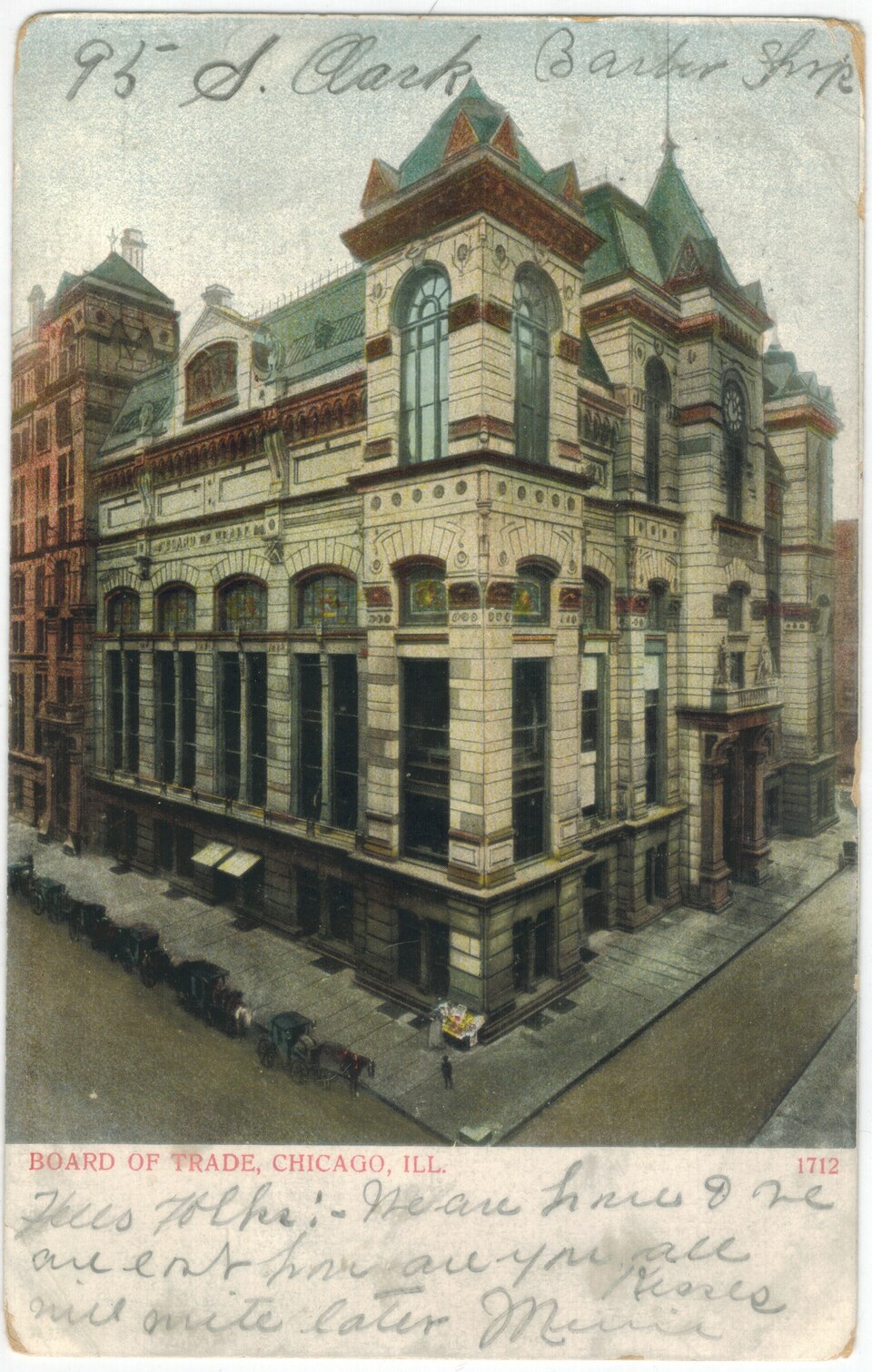
Postcard featuring the Board of Trade building, 1907