"Builders of the Cultural Present"

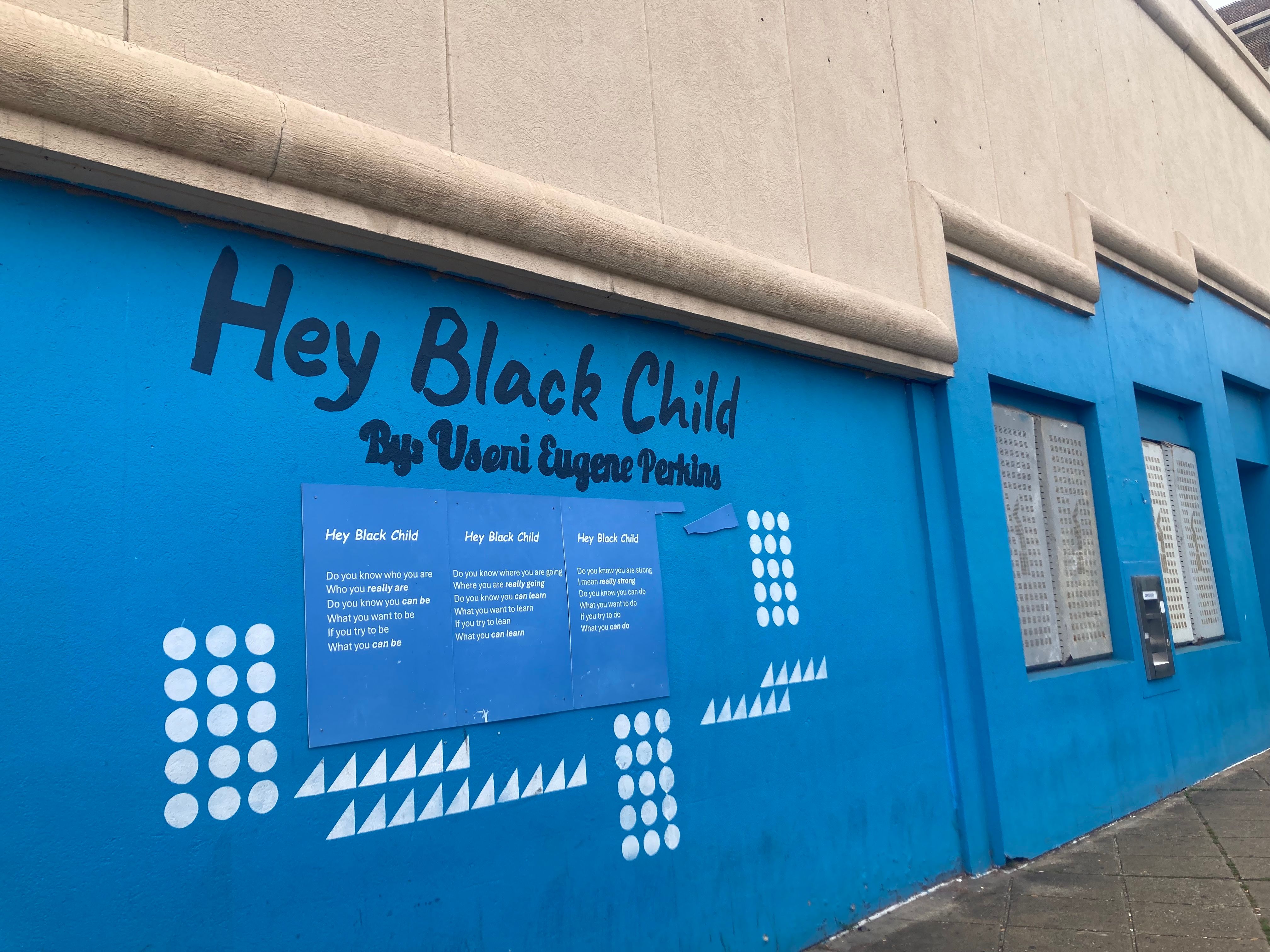
7100 S. Jeffrey Boulevard
Chicago, IL 60649
(South Shore)
Hey Black Child,
Do you know who you are?
Who you really are?
Do you know you can be
What you want to be
If you try to be
What you can be?
Hey Black Child,
Do you know where you are going?
Where you’re really going?
Do you know you can learn
What you want to learn?
If you try to learn
What you can learn?
Hey Black Child,
Do you know you are strong?
I mean really strong?
Do you know you can do
What you want to do?
If you try to do
What you can do?
Hey Black Child,
Be what you can be
Learn what you can learn
Do what you can do
And tomorrow, your nation
Will be what you want it to be.
Useni Eugene Perkins’s “Hey, Black Child”
Artists Mitchell Caton and Calvin Jones painted the mural, located on the northeast corner of 71st Street and Jeffery Boulevard, in 1981. According to Clare McCloskey, writing in the September 18 edition of South Side Weekly, “In the mural, contemporary and historic cultural and scientific leaders from the neighborhood and South Side, such as Gwendolyn Brooks, are depicted across three panels alongside traditional African symbols, such as the Ghanian Adinkra symbol gye nyame (‘fear none but God’) to show how a people shape and are shaped by their cultural heritage. The panels are diagonally slanted to the right, creating a sense of motion, as if the mural itself is continuing to shape and be shaped by its cultural heritage. Indicating the mural, and thereby the people it represents, cannot be contained by the confines of its construction.” The mural also includes Useni Eugene Perkins’s popular poem, “Hey Black Child.” Originally written as a song for his 1974 musical, The Black Fairy, the piece was later published as a standalone children’s book. The poem quickly became important and inspirational in the lives of many Black Chicago schoolchildren. Printed posters with the lyrics circulated throughout community spaces. In many schools, the poem became part of a daily affirmation routine in which lines were recited to set the tone. It became commonplace for children (in Chicago, especially, but across the country) to recite the poem as part of school programs, including graduation ceremonies. In some spaces, including churches, children (and adults) bellowed out the poem in call-and-response fashion. Perkins was a prolific and well-regarded poet and playwright, and in his life’s work as an artist and social worker he advocated for improved Black culture and experiences. He worked with Chicago’s Better Boys Foundation, Chicago Urban League, and DuSable Black History Museum, and served on the Chicago Board of Education’s Task Force on Gangs and the Illinois Governor’s Special Task Force on Troubled Youth. He was an early leader in the Organization of Black American Culture, as well as a co-founder of ETA Creative Arts Foundation. The mural also pays tribute to Useni’s father, the sculptor Marion Perkins. Useni passed away in 2023; Marion died in 1961.
Ghosts of literary past haunt this intersection.
At the end of Judgment Day, Studs Lonigan deboards the Illinois Central train at the Bryn Mawr station, staggers to his home on Jeffrey Boulevard, just south of 71st Street, collapses on his bed, and stays there until his death. In Bayo Ojikutu’s novel Free Burning, Tommie Simms hustles eastbound on 71st Street, just west of the Bryn Mawr platform, in pursuit of his mother. In “Waiting for Godot on Jeffrey Boulevard,” essayist Gayle Pemberton memorializes a 1980s walk along 71st, from the lakefront to Jeffrey, noticing the garbage-riddled streets, the lecherous men, the loiterers, and the closed shops.
The intersection is important to the memories of many South Shore residents, because at one time it was the hub of commercial activity and a gathering place. In a community dramatically divided by class, where the vast majority of residences are bungalows but where there are also more housing vouchers than anywhere else in the city, this intersection was a junction between South Shore tranquility and explosiveness.
The South Shore Bank was at the northwest corner—it closed in 2014. The Jeffrey Theater, on the north side of 71st Street and the west side of Jeffrey, was part of a larger building complex, and a cultural cornerstone first featuring vaudeville and silent films then as an 1,800-seat first-run movie palace—it closed in 1977. The Afro-American Patrolmen’s League was headquartered just a few doors north of the intersection—it moved out of there around 1980. There was a Walgreen’s, Wilson Brothers Hardware, Burny Brothers Bakery, a bowling alley, and much more—those are all gone, too.