Bessemer Park

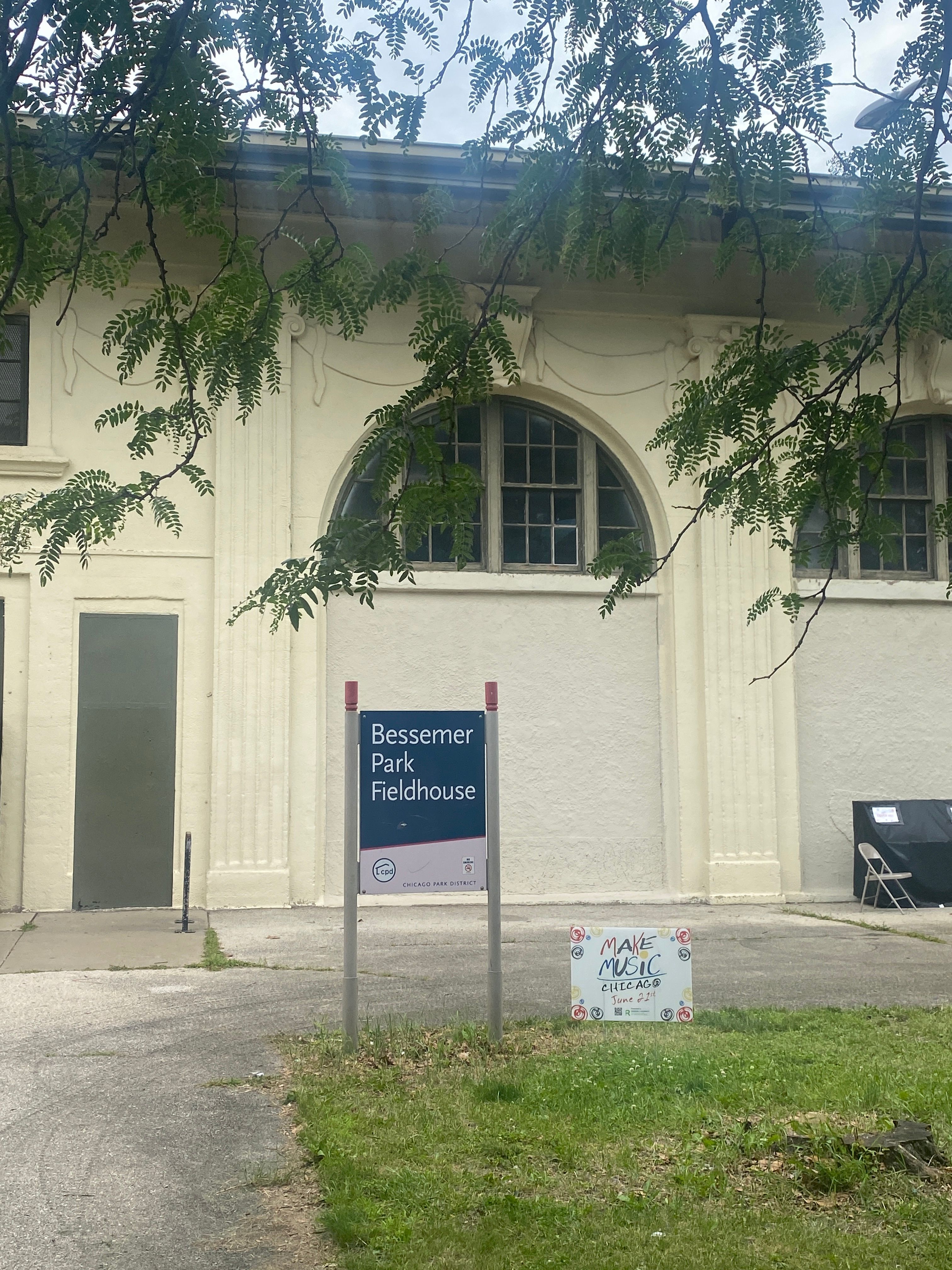
8930 S. Muskegon Avenue
8931 Chicago, IL 60617
(South Chicago)
I wanted to stand between the bully
and the frail kid.
Ready to take it. Ready to give it back.
I wanted to do the right things.
Pull the spit back into my mouth.
Scrape the gum-chewed secrets
off the bottoms of the chairs.
Drag the dumb, go-along laughs
out of the air.
excerpted from Marc Kelly Smith’s “I Wanted To Be”
Martinez-Serros’ “Distillation” follows an epic journey to the Chicago city dump from the family’s house in the Bush neighborhood via a wagon that the father pulls himself. The family’s southwesterly journey likely takes them past Bessemer (Henry) Park and architecturally distinctive James H. Bowen High School (2710 E. 89th Street). The narrator states, “At 89th Street my father followed a southwesterly course, going faster and faster, farther and farther from the steel mills, moving beyond the commercial area into a zone where the houses looked more and more expensive and the lawns grew thicker and greener.”
According to the Chicago Park District, the South Park Commission dedicated this park in 1905 as part of a neighborhood park system designed by landscape architects the Olmsted Brothers and architects Daniel H. Burnham & Co. In 1907 the park was named for Sir Henry Bessemer (1813 – 1898), known for developing the “Bessemer Process” – the first efficient means of mass-producing steel. The process involved injecting air into iron to remove impurities and thus make the metal more durable.
Nelson Algren used the Bessemer Process as a metaphor in City on the Make. The second-to-last section, “No More Giants” laments what Algren sees as the loss of Chicago’s greatness by 1951 as reflected by – among other things – its loss of writers. At the end of the section, Algren bemoans that Chicago is still home to dishonest hustlers: “a broker’s portage. And an old-time way station for pimps as well. Both professions requiring the same essential hope of something for nothing and a soft-as-goosefeathers way to go.”
However, Algren sees no room in Chicago for those who have true feeling and care for others: “Yet never a harvest in sight hereabouts for humanity’s spirit, uprooted over half the world and well deceived here at home. No room, no time, no breath for the Bessemer processes of the heart.” In Algren’s view, Chicago prioritizes the strength and purity of commodified steel, but not the strength and purity of human hearts. Instead, like the industrial buildings soon to be abandoned as Algren wrote in 1951, hearts in Chicago are left to “rust,” as reflected in the last lines of City on the Make:
“While we shall leave, for remembrance, one rusty iron heart.
The city’s rusty heart, that holds both the hustler and the square.
Takes them both and holds them there.
For keeps and a single day.”
Bowen High School has a dramatic setting that befits its distinguished architecture, its red and brown brick façade rising to the east behind the green landscape of Bessemer Park. Bowen’s current building (1910) was designed by Dwight H. Perkins, and in its design resembles Perkins’ more famous Carl Schurz High School (also 1910) located on the northwest side at the corner of Milwaukee Avenue and Irving Park Road.
Hugo Martinez-Serros graduated from Bowen in 1948.
Marc Kelly Smith, the creator of the Poetry Slam, graduated from Bowen in 1967. According to the Chicago Literary Hall of Fame’s description of Uptown’s Green Mill Tavern, Smith “is considered the founder of the Slam Poetry movement. Smith was a socialist construction worker and a poet who met with like-minded spoken word artists to perform outside the elitist world of literary poetry. In 1984, he started a kind of arts variety show called Monday Night Poetry Reading at the Get Me High Lounge in Bucktown. This event became the first slam in 1986, emphasizing poetry as performance of experience by and for ordinary people. The next year, 1987, the event migrated to the Green Mill, where the Uptown Poetry Slam has been ever since.”
Another famous Bowen alumnus is film director Andrew Davis. His 1978 film Stony Island stars the late Chicago saxophonist Gene Barge, a young Susanna Hoffs, and the director’s brother Richie (now a musician in the band the Chicago Catz) and depicts the creation of an integrated soul band. Stony Island was shot on location in Chicago and includes footage of the 1976 funeral of Mayor Richard J. Daley, whose death is incorporated into the plot of the film. Andrew Davis’ most famous film may be The Fugitive (1993), starring Chicago native Harrison Ford, which is also shot in Chicago and whose cast includes Barge, Chicago jazz musician John M. Watson, Sr., and Evergreen Park native Jane Lynch.
Jazz drummer Gene Krupa also graduated from Bowen.