American Writers Museum

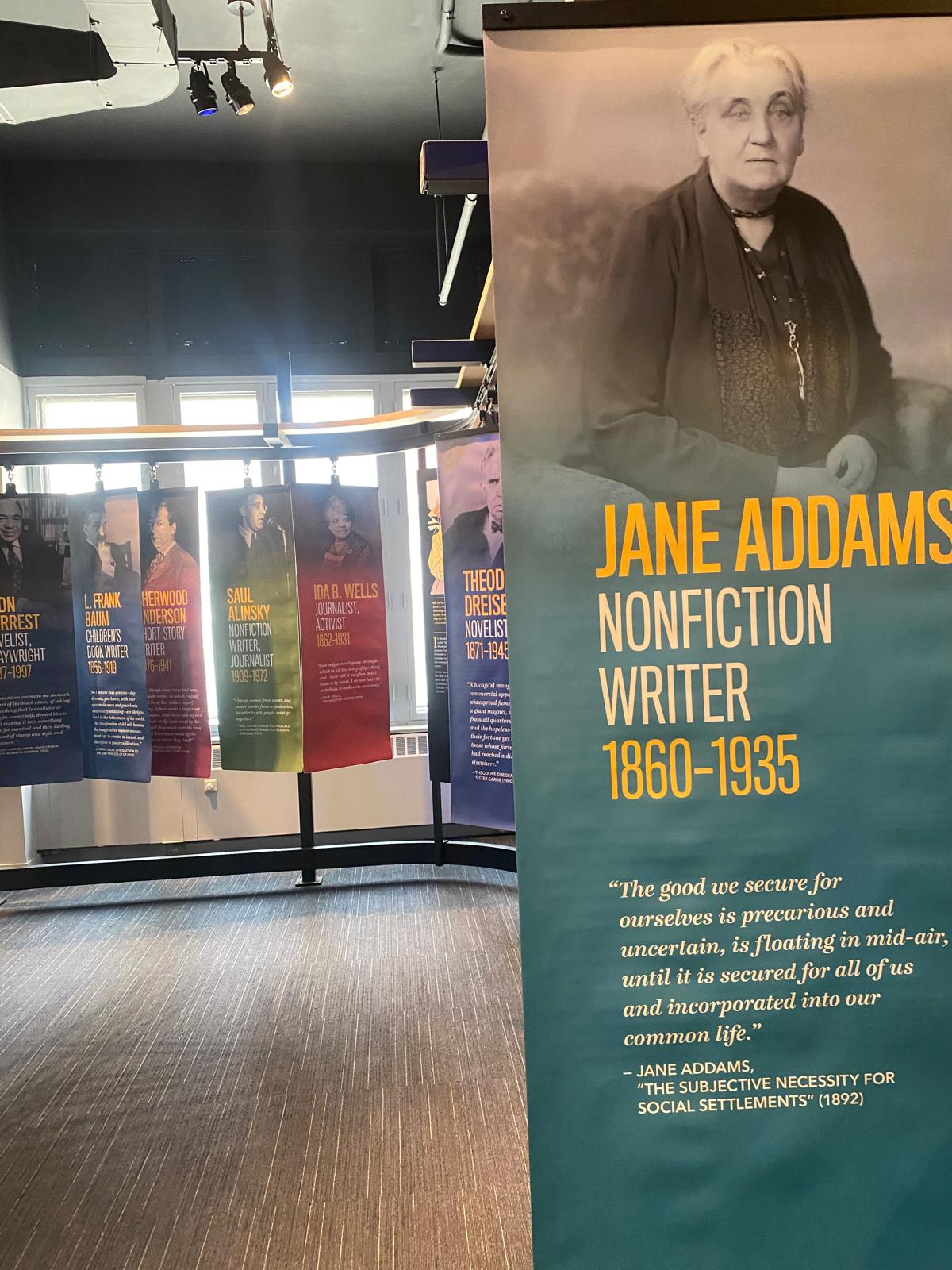
Chicago Gallery at the American Writers Museum. (Photo by Gus Boyer)
180 N. Michicagn Avenue
Chicago, IL 60603
I am an American, Chicago born – Chicago, that somber city – and go at things as I have taught myself, free-style, and will make the record in my own way: first to knock, first admitted; sometimes an innocent knock, sometimes a not so innocent. But a man's character is his fate, says Heraclitus, and in the end there isn't any way to disguise the nature of the knocks by acoustical work on the door or gloving the knuckles.
Saul Bellow's The Adventures of Augie March
In Chicago there is the mysterious something that makes for individuality, personality, charm;... Find a writer who is indubitably an American in every pulse-beat, snort, and adenoid, an American who has something new and peculiarly American to say and who says it in an unmistakable American way, and nine times out of ten you will find that he has some sort of connection with the gargantuan and inordinate abattoir by Lake Michigan.
H. L. Mencken's "The Literary Capital of the United States," The Nation
…once you've come to be part of this particular patch, you'll never love another. Like loving a woman with a broken nose, you may well find lovelier lovelies. But never a lovely so real.
Nelson Algren's Chicago: City on the Make
Opened in May 2017, the American Writers Museum in Chicago is the first and only museum in the United States devoted exclusively to honoring American writers, with exhibits that span centuries and genres. Its location is easy to overlook; it is housed on the second floor of a commercial office building at the southeast corner of Michigan Avenue and Lake Street, just one block north of Millennium Park.
The museum is the result of Malcolm O’Hagan’s vision. An Irish immigrant who came to the United States in the 1960s, O’Hagan conceived the idea in 2009 during a visit back to his homeland, where a stop at the Dublin Writers Museum left him wondering where a museum dedicated to American writers might be found. Upon returning to the United States, he was surprised to discover that no such space existed. Although several cities were considered, Chicago was ultimately chosen for its literary history, central location, strong cultural and tourist presence, and the support of local political leaders.
Unlike traditional literary museums that focus on artifacts and archives, the American Writers Museum emphasizes access and participation. Its exhibits are interactive and multisensory. Visitors can read, listen, and engage with writing directly through digital displays, audio recordings, and even manual typewriters. The permanent gallery Nation of Writers traces more than 400 years of American writing across genres, while rotating exhibits focus on specific writers, movements, and themes.
In the digital age, the museum treats literature as something active rather than fixed. Writing is presented not just as printed text but as an evolving practice that includes journalism, speeches, plays, poetry readings, songwriting, and live storytelling. The museum’s programming reflects this attitude, with events such as book launches, readings, and Get Lit--literary themed cocktail gatherings.
The Chicago Gallery (also called the Chicago Room) focuses on the city’s historic literary culture. The Chicago Literary Renaissance emerged in the late nineteenth century and continued through the 1950s, with its peak in the 1910s and 1920s. During this period, two small magazines founded by innovative women, Poetry (Harriet Monroe, 1912) and The Little Review (Margaret Anderson, 1914), played a central role in shaping the literary culture, publishing new work by Chicago and American writers and international modernists such as James Joyce, T. S. Eliot, and Ezra Pound.
Many Chicago writers began as journalists before turning to poetry, fiction, or drama. They wrote about the lives of ordinary people—workers, immigrants, families—living within unregulated and often harsh industrial conditions. Their writing reflects a strong working-class sensibility, grounded in daily reality in a city then better known for its commercial activity than cultural pursuits.
Carl Sandburg captures this identity in his description of Chicago as the “City of the Big Shoulders,” a place that is hardworking, cunning, and unrefined, with the reckless pride of “an ignorant fighter… who has never lost a battle.”
Gwendolyn Brooks, who spent much of her life writing about the people and places in Chicago’s South Side, described herself as an “organic Chicagoan,” shaped by the language, rhythms, and lives of the people around her.
Lorraine Hansberry focuses on systemic racism and the struggle to build a life with dignity in her groundbreaking 1959 play A Raisin in the Sun, set on Chicago’s South Side, and centered on a Black family confronting housing discrimination, economic limits, and unrealized ambitions.
Studs Terkel, whose oral histories record the voices of everyday people—workers, clerks, and others often left out of more formal accounts—describes the city with blunt critique and honest affection, calling it “not the most corrupt…just more theatrical.”
These writers reflect a shared commitment to the dignity of labor, social justice, and the lived experiences of ordinary people. Their work centers the individuals who build and sustain the city, insisting that those lives—and their stories—matter.
At the entrance to the Chicago Gallery, a large plaque titled “Visionaries + Troublemakers,” describes Chicago writers as “troublemakers…with a humanist bent,” who have “shone a light on injustice, questioned authority, and articulated bold new visions for a better world.” Nearby, five rotating panels entitled “Representing Workers,” “Fighting Discrimination,” “Advocating for Children,” “Confronting Power,” and “Embracing Difference,” each display photographs of Chicago writers, along with brief descriptions and quotations illustrating how they have addressed these concerns.
Around the gallery, double-sided banners mounted on wheeled metal frames glide along a ceiling track. Each introduces a major figure in Chicago writing, with biographical information and a selected quotation. While there is broad agreement on central Renaissance figures—Theodore Dreiser, Carl Sandburg, Sherwood Anderson, Ring Lardner, Ben Hecht, Edna Ferber, James T. Farrell, Richard Wright, Gwendolyn Brooks, Nelson Algren, Saul Bellow, and Lorraine Hansberry—the selection extends beyond these figures and beyond traditional literary genres.
Native American writers are represented by Simon Pokagon, an essayist and poet of the late nineteenth century, and by contemporary poet and playwright E. Donald Two Rivers. Journalists such as Finley Peter Dunne, writing at the turn of the twentieth century, appear alongside more recent figures, columnist Mike Royko and film critic Roger Ebert as well as oral historian Studs Terkel and longtime advice columnist Ann Landers. The gallery also includes writer-activists Jane Addams, Ida B. Wells, and Saul Alinsky, along with two key architects of Chicago’s improvisational theater movement, Viola Spolin and Del Close.
Behind the banners, individual plaques highlight notable literary characters--Maud Martha (Brooks), Sister Carrie (Dreiser), Mr. Dooley (Dunne), Walter Younger (Hansberry) and Benny Bearskin (Terkel). In another section of the gallery, an audio component invites visitors to pick up a phone and hear literary passages read aloud.
Chicago Literature is also presented on an interactive touchscreen organized by neighborhood, era, and theme, with maps, timelines, and sections such as “Up From the Ashes” (post-fire 1871-1900), “Chicago Renaissance” (1910s-1920s), “Transition” (1930s-1940s), “Turbulence” (1956-1983), and “Today” (1984-present).
The legacy displayed in the Chicago Gallery continues in the city today. Chicago remains a vibrant center for literary life; it is the birthplace of the Poetry Slam and home to major annual events such as the Chicago Humanities Festival and Printers Row Lit Fest as well as organizations such as the Poetry Foundation, Guild Literary Complex, The Newberry Library, The Poetry Center,Chicago Dramatists, Story Studio Chicago, and, of course, the Chicago Literary Hall of Fame. On any given night, a live lit event may be taking place between the shelves of an independent bookstore, in a pub, storefront, or any number of public spaces across the city.
Reading, Viewing and Listening List
Boss: Richard J. Daley of Chicago
A Dozen Cold Ones by Two Rivers: Native American Poetry in an Urban Setting