Stanley Elkin [May 11, 1930-May 31, 1995]
Saturday, July 25, 2026
By Barry Pearce
Stanley Elkin was a stylist of the highest rank, dazzling readers with highwire prose that kept them on the edge of their seats, white-knuckling books whose turns of phrase inspired thrills, chills, and deep unease. “Darkly comic” might be the most common label applied to his work and though he was the enemy of cliché, that description also goes to the core of his stories and novels.
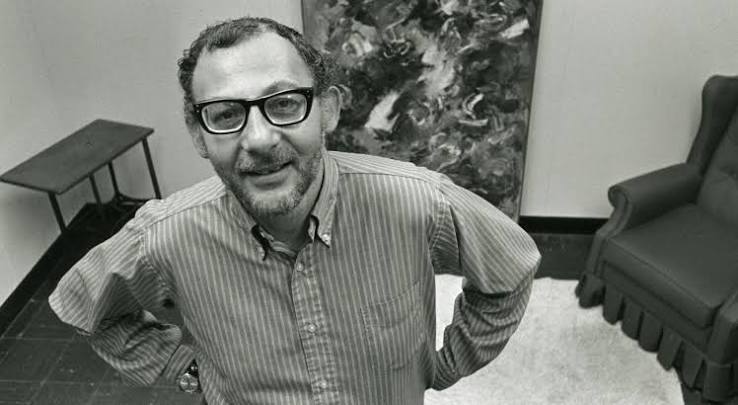 The author of nine novels and three story collections, as well as numerous novellas, essays, and plays, Elkin was a maximalist in the vein of Faulkner, an early hero and the subject of his PhD dissertation at the University of Illinois. Like Faulkner, he pushed the boundaries of what language could do and focused on the “the egocentric will pitted against something stronger than itself,” as Elkin wrote of his Southern forbear, later admitting the description applied as much or more to his own writing.
Elkin grew up in Chicago’s South Shore neighborhood, attended the University of Illinois, and remained a Midwesterner all his life, teaching nearby, at Washington University, in St. Louis. Chicago clearly affected his work, from his first published story, “A Sound of Distant Thunder” (based on a visit to the Maxwell Street Market) to the edgy urban scenes that arise in later work, though his grim city landscapes are often anonymous.
He was diagnosed in 1972 with multiple sclerosis. The slow progression of the disease eventually put him in a wheelchair and forced him to trade his pen for a computer. He wrote and spoke eloquently about disability, which heightened his reflection on suffering – a strain already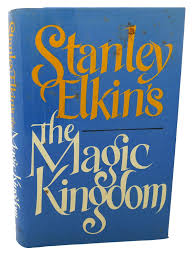 present throughout his work. His novel The Magic Kingdom, rereleased by Dalkey Archive Press in 1985, imagines a group of terminally ill children taken to Disneyland, replacing the sentimentality such stories are usually wrapped in with humor and vivid, honest description.
As Elkin’s style developed, a comic strain uniquely his delivered unflinching explorations of corners of humanity dark enough that even Faulkner might have cringed. His characters include bill collectors, conmen, shopkeepers, orphans, professional wrestlers, and pandering DJs. Through their lives, marked by loneliness and alienation, he returned again and again to critiques of American pop culture and our capitalist system.
In Elkin’s first novel, Boswell: A Modern Comedy (1964), Samuel Johnson’s famous biographer is transposed to a shabby American landscape, reimagined as a pro wrestler and con who cheats death by hunting celebrities in an edgy picaresque romp. The Living End, Elkin’ seventh novel, traces the lives and afterlives of victims in a liquor store holdup and includes Jesus, Mary, Joseph, and ultimately, God, as characters (“an expose of heaven, hell, and Minneapolis-St. Paul,” as John Irving wrote).
Elkin’ 1971 novel The Dick Gibson Show, also rereleased by Dalkey Archive, in 1998, is screamingly funny as well as deeply disturbing, often within the same paragraph. Critic Dwight Garner nicely summed up this dichotomy in a 2017 New York Times column, part of a series praising under-sung books of the previous 75 years.
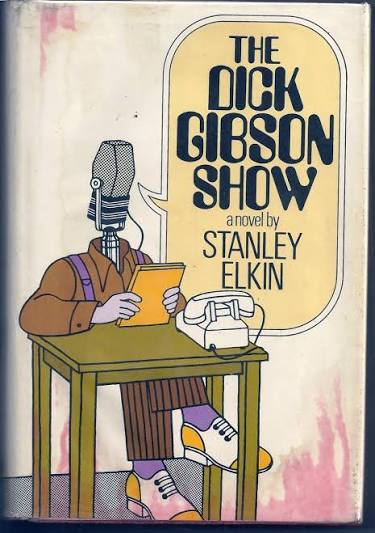 “Stanley Elkin’s third novel, The Dick Gibson Show (1971), is not improving to read. Its heart is not in the right place. It squeezes the blackheads behind the ears of your imagination; it’s a Diane Arbus walk on the unreconciled side. It’s among the most powerful and funny American novels I know.”
Elkin earned critical praise – he won two National Book Critics Circle Awards and was a finalist for PEN Faulkner and the National Book Award – but as Garner points out, even among the literati, the disquieting nature of his work kept him from the level of recognition he deserved. Novelist and critic William Gass, Elkin’s colleague at Washington University, where Elkin taught for 35 years, said of his fellow writer in a 1994 interview, “He's a very disturbing writer, but people by and large don't want to be disturbed.”
Elkin was the bard of America’s rootless, disconnected, and disillusioned, but not everyone wants to read about the country’s crawlspaces and the mean dust bunnies gathering there. “Thus, Mr. Elkin has Boswell tell us far more than we really want to know about life in the world's third‐rate hotels…” reviewer Charles Poore wrote of Boswell: A Modern Comedy, perhaps revealing more about his own appetites than about the book.
Poore and other critics also assailed Elkin’s novels for their lack of plot. There is a sense in his work that Elkin finds this element of fiction so thoroughly mined and so often contrived, he either wants it effaced or ramped-up to highlight the ridiculous. He’s much more concerned with the dark recesses of our psyches and culture, conveyed through riffs that demonstrate the virtuosity of the best bebop solos. He had to fight for that aesthetic, even with admiring editors.
“My editor at Random House, Joe Fox, used to tell me, ‘Stanley, less is more,’” Elkin said in a 1976 Paris Review interview. “He wanted to strike—oh, he had a marvelous eye for the ‘good’ stuff—and that’s what he wanted to strike. I had to fight him tooth and nail in the better restaurants to maintain excess because I don’t believe that less is more. I believe that more is more. I believe that less is less, fat fat, thin thin, and enough is enough.”
Barry Pearce is the author of The Plan of Chicago: A City in Stories (Cornerstone Press, 2025). a linked collection shortlisted for the 2026 William Saroyan International Prize for Writing and a finalist for the Foreword INDIES Book of the Year Award and a 2026 National Indies Excellence Award. Barry has won the Nelson Algren Award Grand Prize, a Chicago DCASE Independent Artists Program grant, an Illinois Arts Council Award, The Mercedes Delos Jacobs Book Prize, and the Keith Wilson / Joe Somoza Poetry Prize, and was recently awarded a Roosevelt University honorary degree for his service to literature.


 Back to Blog