Ronald L. Fair (1932–2018)
Friday, July 24, 2026
by Robert Loerzel
“I can’t breathe” became a slogan for the Black Lives Matter movement, as protesters repeated the final words of Eric Garner, an African American killed in 2014 after being put in a chokehold by a New York City police officer. Half a century earlier, Chicago author Ronald L. Fair toiled over the manuscript of an anguished, autobiographical novel about the plight of Black Americans. He called it We Can’t Breathe.
Fair, an African American writer born and raised in Chicago, is best known for his 1966 novel Hog Butcher, which sadly remains relevant in the 21st century. It tells the story of a Black youth killed by Chicago police when he’s mistaken for a burglary suspect. Booklist called it “a moving indictment of the hypocrisy and tragedy of segregation in a land professing a religious and democratic way of life … an effectively compact, vivid, troubling book.”
“Mr. Fair presented a new style of writing in Hog Butcher,” novelist and lecturer Cecil Brown wrote in an introduction to Northwestern University Press’s 2014 edition of Hog Butcher. “The story is told not in a traditional narrative mode, but in an impressionistic style that relies heavily on interior monologue. … Along with Richard Wright’s first novel, Land Today! (published posthumously in 1963), Hog Butcher can be seen as a milestone in the use of interior monologue to portray the consciousness of African American characters. … Offering readers access to the minds of African American characters was an act of liberation.”
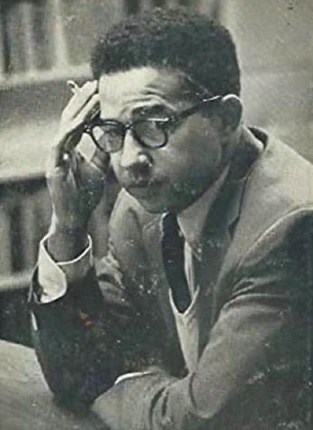 Fair was born on October 27, 1932, in Chicago. His parents, Herbert Fair and Beulah Hunt, had been farmworkers in Mississippi. He grew up near 65th Street and Langley Avenue in the Woodlawn neighborhood, at a time when the Black Belt was confined to the area west of Cottage Grove Avenue. “We never thought Negroes would live east of Cottage,” Fair recalled in a 1966 interview with the Chicago Daily News’s Panorama magazine. “It was a tough neighborhood. When we weren’t fighting each other, we’d cross Cottage and fight the white boys.”
Fair said he always knew, even when he was a young child, that life would be different for him because of his race. “I think it’s a feeling that a Negro child is born with. You always know it,” he said.
When Fair attended Calumet High School, “it wasn’t the white kids who were so bad,” he recalled. “You could fight them and it was over with. It was the teachers. I could always write a good sentence, and I’d get a paper back with three corrections and get an 85. The red-haired white girl next to me got 15 errors, and her score was 90. I always protested, and the teacher would tell me, ‘Don’t be so pushy … you’re lucky to be where you are.’ That’s why I quit school at 16, incidents like that.”
Fair found work as a court reporter. In the 1960s, he lived with his wife, Lucy Margaret, and their sons, Rodney and Glen, in Lake Meadows, a modern middle-class apartment complex in Bronzeville. Panorama magazine reported that they lived in a “modest apartment … among their books and paintings, their record collection and stereo equipment and Fair’s manuscripts.”
In 1963, Fair sent a letter to the Chicago Tribune, the Chicago Daily News, and the Chicago Sun-Times, decrying the way they were covering the Civil Rights Movement—or, as he called it, America’s “racial revolution.” Fair declared: “I am amazed that you would want the Negro not to demonstrate.” He insisted that Black Americans needed to protest. “The Negro is fighting for his share of this great country that he helped make. The Negro is at last out of patience and has decided to foreclose on the nation.” Fair’s letter concluded: “It is my hope that some day you gentlemen will come out of your world of hate and fear and ignorance and step in line with the many true Americans who live in a world of brotherhood and understanding.” Those newspapers did not apparently publish his letter, but the Chicago Defender did.
Fair’s first published novel, Many Thousand Gone: An American Fable, was released by Harcourt, Brace & World in 1965. The 114-page story imagines an isolated corner of rural Mississippi where slavery persisted in the 20th century, where any Black inhabitants trying to escape were hunted and killed—until one young boy is smuggled out and makes his way north, eventually becoming a writer in Chicago. “It is a story of brutality and horror and love and shrewdness, shaped in curves of mercy, pointed by a scratchy humor, rich with folk wisdom, shining with a stubborn will to live,” Lillian Smith wrote in her review for the Chicago Tribune.
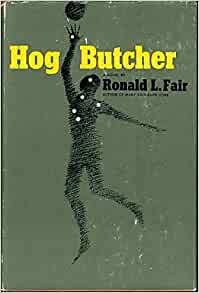 Next came Hog Butcher, released by Harcourt in 1966. The book was “A Triumph,” according to a Chicago Daily News headline. “Every character is drawn with aching fidelity,” the newspaper’s critic, Dayton Rommel, observed. “One of Mr. Fair’s greatest assets is his ability to invest his white characters with truth. … he has the honesty and courage to see his characters as they probably are, betrayed by their own good intentions, misunderstood.”
Fair’s real-life experience transcribing testimony at Cook County coroner’s inquests informed the climactic scene of Hog Butcher. In the months after the novel was published, Fair continued working as a court reporter, taking down the official transcripts of the inquest into the killing of U.S. Senator Charles Percy’s daughter, Valerie Percy. The coroner, Andrew Toman, was angered when Fair called the inquest a circus and a cruel ordeal. According to Fair, Toman called up Fair’s employer, Holleb Reporting Service, and tried to get Fair banned from the county morgue. The coroner denied doing this. “I like Ronnie Fair,” Toman told the Daily News.
In Panorama’s 1966 article, Fair said America’s racial injustices had forced him to become a writer. “I don’t want to fight this damned war every day of my life,” he said. “But I have to, we have to, or it will never end. And so, I have to keep writing, out of my guts, and it’s hell, it tears you to pieces while you’re doing it and it leaves you, afterward, with a drained, sapped, sour letdown feeling. But the Negro writer can’t just aim for what other writers try to achieve, a work of art. He must serve as the Negro’s voice.”
In the same article, Fair described Chicago as “the worst segregated city in the United States.” He continued: “It’s been perpetuated by the power structure. They give us these vertical dungeons on State Street, the public housing there, and Mayor [Richard J.] Daley may feel that he’s doing something for the Negro. All he’s done is make the ghetto perpendicular.”
Fair took direct aim at Daley in a play, The Emperor’s Parade or Our Boy Dick (A Farce), which was performed by the Chicago City Players in 1968. Daily News critic Richard Christiansen said Fair “laid on his satire with a trowel and pounded home his points with a sledgehammer.” But Christiansen also called it “the only strong, angry political comment now being performed in Chicago.” In comparison, he said, Second City’s political sketches were “merely playful.”
In 1970, Harper & Row published Fair’s World of Nothing: Two Novellas, which comprised the novellas “Jerome” and “World of Nothing.” In a New York Times review, Shane Stevens wrote: “Some writers can … take the horror of the everyday and temper it with passion and pain. Ronald Fair is one of these. Where most contemporary black writing is preoccupied with blackness, Fair’s work speaks to us from the depths of an involvement we all share. Yes, the scream is there—but the laughter of life is first. … In this day of self‐advertisements and racial nonbooks, truly fine writing seems almost a revolutionary act. In this sense, ‘World of Nothing’ is a revolution in itself.”
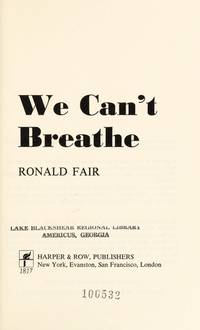 Fair’s next novel—the final one published during his lifetime—was We Can’t Breathe, released in 1972 by HarperCollins. But it was actually the first novel he’d ever written. He’d started working on it after he’d failed to find a job as a court reporter in New England and moved, along with his wife, into his parents’ home in Chicago. “I went down in the basement and rolled a sheet of paper in my typewriter and began my first novel, with the sentence, ‘I don’t remember a goddamned thing about my childhood,’” Fair told Panorama.
By 1966, Fair had rewritten the novel twice, and he didn’t want to try again. “That’s the most autobiographical of my books, and it tears me up to work on it,” he said. When We Can’t Breathe was finally published in 1972, it received less attention than his earlier books, receiving no review in The New York Times. In the Sun-Times, critic Shane Stevens gave it a mixed review, calling it too melodramatic.
“Fair describes his book as ‘the work of my lifetime, the book I’ve been trying to write for ten years,’” Stevens wrote. “I think not. ‘We Can’t Breathe’ is an interesting book by a writer of the highest talent. It is a book he had to write. We novelists have a compulsion to get at the mystery of own lives, to set things straight. We never do, of course. It is always simply a matter of degree of the failure for each of us. The work of one’s lifetime always lies ahead.”
But according to Cecil Brown, who talked with Fair in his later years, Fair grew discouraged that so few people were reading his books.
 Hog Butcher was adapted into the 1975 movie Cornbread, Earl and Me, starring Laurence Fishburne, who was just 14 years old at the time. The movie was not a hit, and it received mixed reviews. “Part of what made [Fair] lose his faith was the movie project that came out of Hog Butcher,” Brown wrote. “When the producer read his screenplay, he disliked it so much that he had a heart attack. Ron regaled me with that on the Skype call. Then, he wrote another draft, and the dude had a second heart attack! Then, the producer sold the project to somebody else. After the disaster with the screenplay, Ron told me on Skype, he decided to give up on America. He turned his talent to sculpture.”
Fair moved to Finland in 1977. He died there in 2018—a fact that went unnoticed and unreported. It doesn’t appear that any American newspapers published an obituary of Fair. The news of his death finally surfaced in a 2020 blog post by Brown. When Brown had tried to email Fair, he’d received a message from Fair’s sister, informing him of the novelist’s death two years earlier.
“I cried,” Brown wrote. “I should have worked harder. I should have called Henry Louis Gates Jr. again and again. I should have demanded that the English department teach a class on his work! I should have tried harder. But then, Ron, you were right! Black people do not read. But White people do not read either.”
As Ronald L. Fair died, his literary work was attracting some new attention, starting with that 2014 edition of Hog Butcher, which served as a reminder that police killings of young Black men were not a new phenomenon. Another Fair book reemerged in 2023, when Library of America published a paperback of Many Thousand Gone. Writing for the Tribune, Christopher Borrelli observed that Fair “reads now like a precursor to the fables of Percival Everett.” Borrelli called the book a “forgotten classic.”
Chicago nove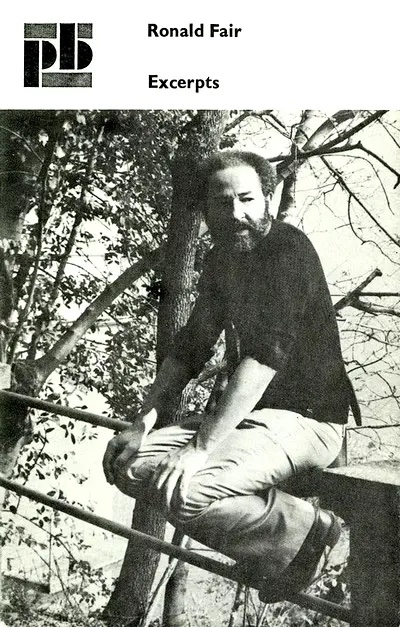 list Kathleen Rooney praised Hog Butcher in a 2022 blog post for the Chicago Literary Hall of Fame, writing: “It’s a concise, complex, and multi-faceted depiction of structural inequality and white supremacy and the costs they extract from both their victims and their perpetrators. I would like to nominate Fair’s novel to appear alongside To Kill a Mockingbird on syllabi everywhere because instead of exceptionalism and white saviors, Fair’s story depicts—with a cast of lovable, hateable, believable characters from the young man who gets murdered to the cops who murder him—how power’s highest aim is always to preserve itself and how collective action is the best hope anyone can have against systemic injustice. …
“More than any other book that would be captivating to audiences of virtually any age or ability level, Hog Butcher plumbs the depths of America’s racial wounds. With literary grace and zero sentimentality, Fair illustrates how little many of us have done to deal with these wounds honestly on a national level and with an eye toward restoration or healing.”
Back in 1966, Fair had been adamant that the world needed to hear the voices and stories of Black Americans, as he told Panorama magazine: “One day, the whites will begin listening to us and they will recognize that we’re just people, as they are. Then the trouble will end. That’s what I’m working for.”
Robert Loerzel is a freelance journalist and photographer. He cowrote two episodes of the documentary series Chicago Stories for WTTW and is the author of three nonfiction books, including his latest, The Uptown: Chicago’s Endangered Movie Palace, co-authored with James A. Pierce.


 Back to Blog