Nelson Algren’s South Side Roots
Tuesday, July 28, 2026
by John Lillig
Chicago author Nelson Algren (1909-1981) is usually associated with the north side neighborhoods of Bucktown and Wicker Park, where he lived during the mid-20th Century (first at 1523 W. Wabansia and later at 1958 W. Evergreen) and where much of his fiction is set. However, his Chicago roots are actually on the South Side.
The Chicago Literary Hall of Fame’s recent Far South Side Literary Bus Tour gave tour participants the opportunity to visit several sites important to Algren’s early life in the Park Manor neighborhood and nearby.
Algren’s First Chicago Home
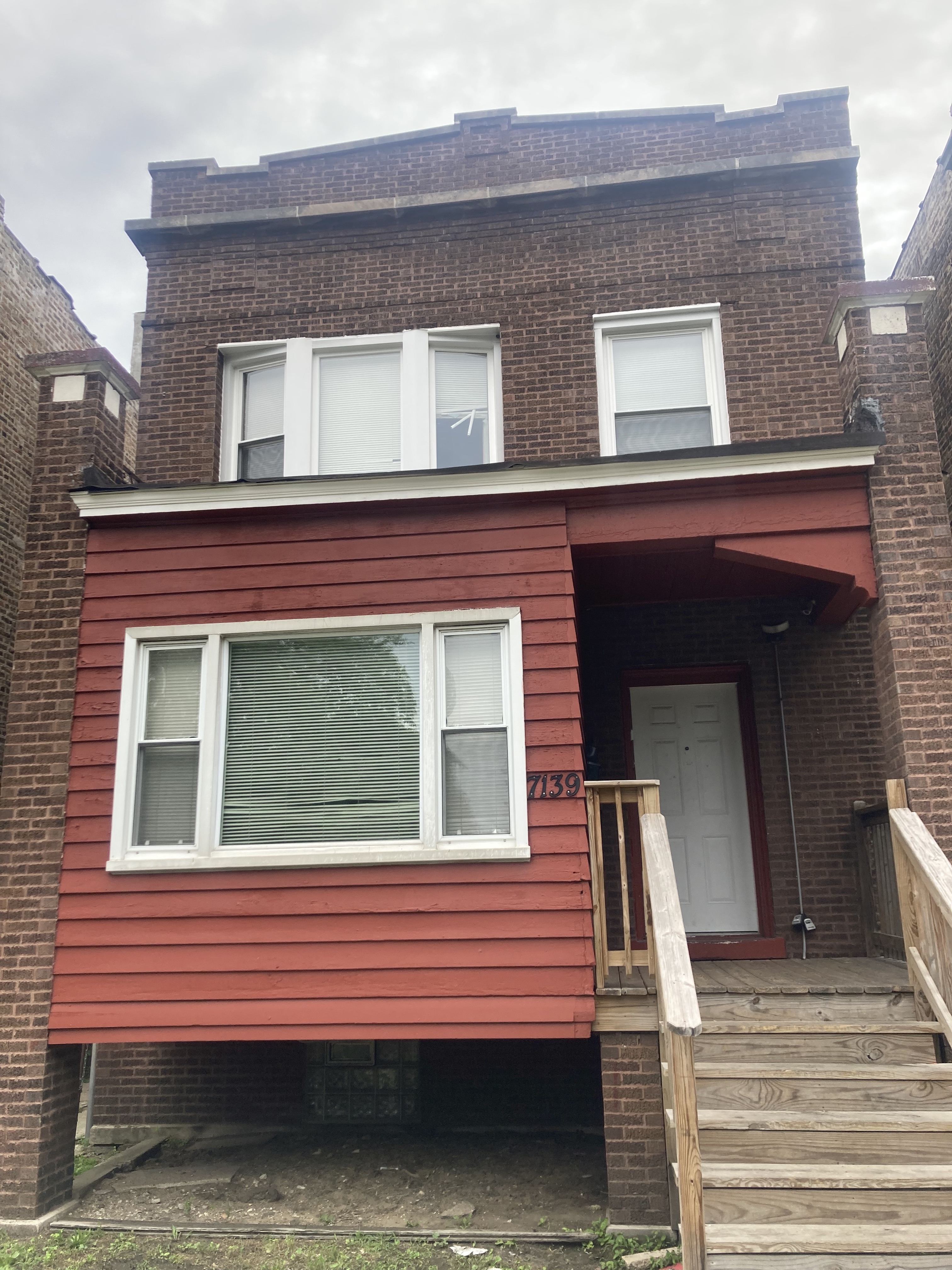 Algren lived at 7139 S. Dr. Martin Luther King Drive (then South Parkway) from 1913 to 1920. Algren depicted the Park Manor neighborhood around this house in his epic book-length prose poem Chicago: City on the Make (1951). Chicago writer Mary Wisniewski’s biography Algren: A Life (2016) describes Park Manor in 1913 as having “yards and open prairies for playing Run, Sheepy, Run, cowboys and Indians, or baseball.” According to Wisniewski, “The kids made bonfires in the vacant prairie lots on the chilly autumn evenings, and roasted potatoes, making them black on the outside, and soft and white within . . . People kept ducks and geese, and grew big vegetable gardens . . .”
There is some question as to whether the building that currently occupies the lot is the building in which Algren resided. In an interview with the Chicago Review Press Blog in 2016, Wisniewski described Algren’s house as “gone.” However, a Zillow listing for the property at 7139 S. King Drive contends that the current building was “Built in 1914,” which would have been a year after the Algren family moved to the address.
St. Columbanus Church
In City on the Make, Algren’s account of his childhood in Park Manor was punctuated by references to the local Catholic parish, the former St. Columbanus Church and School complex (now St. Moses the Black), at 331 E. 71st Street.
The current parish, St. Moses the Black, was formed in 2021 by a merger of the former St. Clotilde, St. Columbanus, and St. Dorothy parishes.
St. Moses the Black was a fourth-century Ethiopian monk who led a life of crime before repenting and joining a monastery at Scete, Egypt (now Wadi el Natrun) near Alexandria.
According to the parish website, the first St. Columbanus church and school building was built in 1909, with a convent following in 1917 and the current large church constructed in 1923, designed by architect James Burns. Later additions to the sprawling parish complex included additions to the school and rectory and the Glass House, which has served as a library, credit union, and meeting place.
The parish originally served an Irish congregation, according to the parish website, with rapid racial change occurring after 1948, as across much of the South Side, after racially restrictive real estate covenants were outlawed. Pastor John Ryan Gleason was appointed in 1952 and welcomed Black parishioners, resulting in a long-enduring, stable Black parish and school.
According to Wisniewski’s Algren: A Life, as the first St. Columbanus buildings arose near his South Parkway home, “Nelson grew up with this example of constant progress outside his window, of the city around him constantly expanding, with scaffolding and walls rising and the clanking noises of machinery.” Wisniewski reports that while his family was not Catholic, “Nelson was attracted by St. Columbanus and wanted desperately to attend” St. Columbanus church and school but instead attended the public Park Manor Elementary School (7037 S. Rhodes Avenue) and a Congregationalist Sunday School.
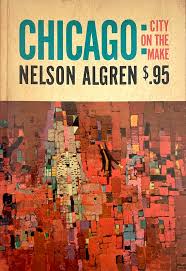
In City on the Make, St. Columbanus symbolizes Algren’s youth and innocence – the time before Algren’s family moved to 4834 N. Troy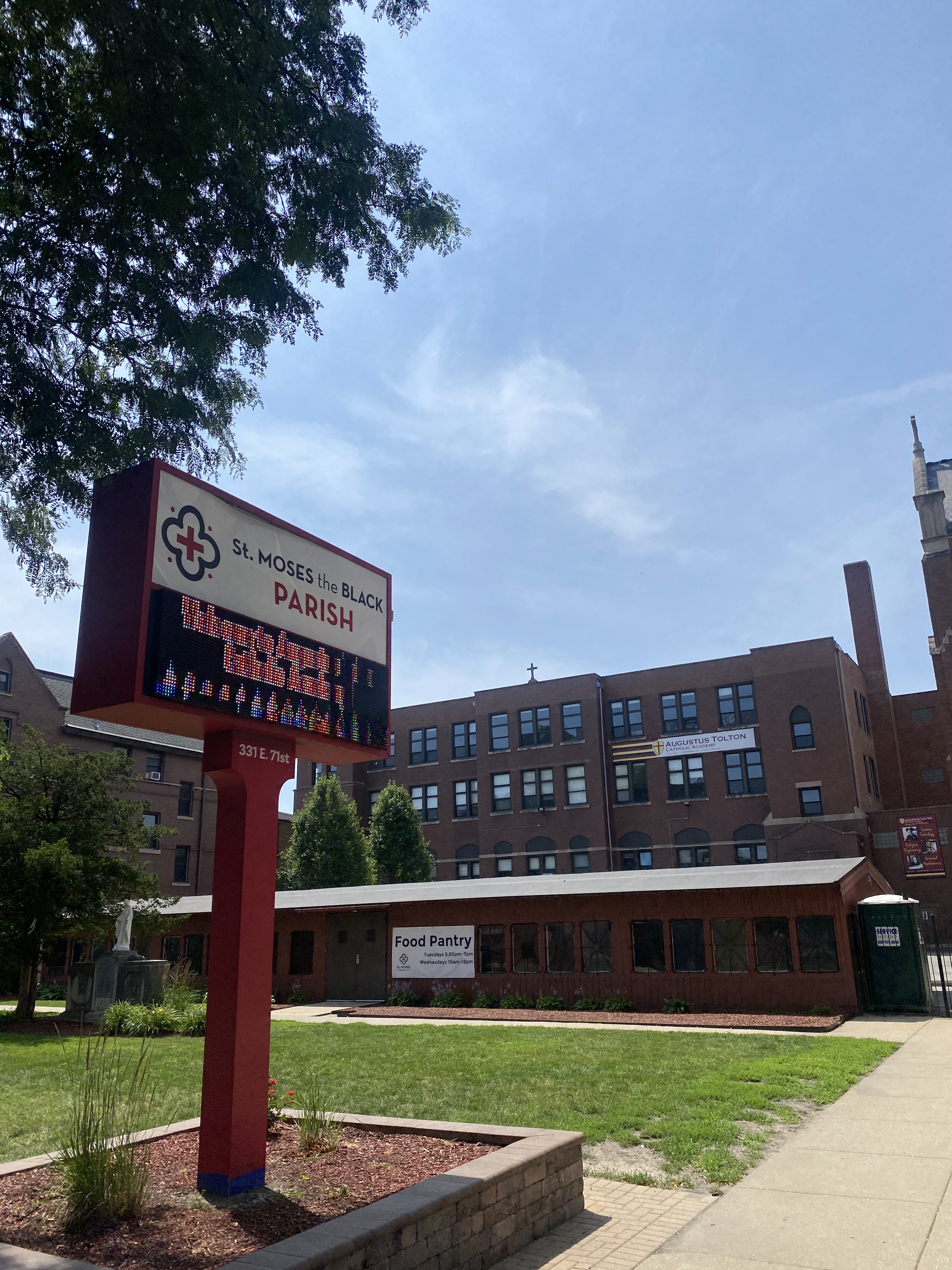 Street in Albany Park on the north side, and before the revelation that his beloved White Sox had thrown the 1919 World Series. Algren writes, “Yet on nights when, under all the arc-lamps, the little men of the rain come running, you’ll know at last that, long long ago, something went wrong between St. Columbanus and North Troy Street. And Chicago divided your heart.”
(Incidentally, the Algren family’s departure from Park Manor in 1920 meant that the young Nelson missed the chance to meet an infamous neighbor who moved in three years later. Al Capone’s home at 7244 S. Prairie Avenue is just one block south and one block west of Algren’s. According to a 2019 Chicago Tribune article reporting the sale of this home, writer Bob Goldsborough noted that “Capone moved into [this] two-flat with his mother and sister in 1923 after moving to Chicago from New York. Although Capone's name was never actually on the purchase deed, his mother's and wife’s names were on it, and the family owned the two-flat until the 1950s, when [Capone’s] mother died. After Capone got out of prison in 1939, he lived in Florida until his death in 1947. Built about 1909, the two-flat, which sits on an extra-wide lot, has had several owners since the Capones, and in 1989, the Commission on Chicago Landmarks and the Illinois Historic Sites Advisory Council both rejected bids to make the house an official landmark.”)
The Cottage Grove / South Chicago / 71st Street Intersection
The six-way intersection of 71st Street, Cottage Grove Avenue, and South Chicago Avenue, four blocks east of his childhood home on King Drive, is central to Algren’s childhood memories of the neighborhood, as recounted in City on the Make. In “The Silver-Colored Yesterday,” the most autobiographical section of the book, Algren describes several features of the intersection, including the “wrought-iron gate” of the cemetery, a tavern, and a place where he sold newspapers. None of these features are extant. A modern concrete wall now stands in place of the cemetery gate. The cemetery’s only extant gate is at 67th Street and Greenwood Avenue.
Oak Woods Cemetery was established in 1853. According to the Hyde Park Historical Society’s online Oak Woods Cemetery Project, “The cemetery has been the final resting place for a vast array of individuals who have shaped the history of the City of Chicago, and even the world. Five Chicago Mayors, including the 1st and 2nd Black Mayors, as well as 2 Nobel Prize winners, and a gold medal Olympian are among those buried at Oak Woods.” Notably, the cemetery includes “The Confederate Mound,” a memorial to more than 4,000 Confederate soldiers who died at Camp Douglass, the Civil War prison camp located in what is now the Bronzeville neighborhood. In the 20th Century, Oak Woods was largely segregated, refusing to bury Black people with few exceptions until yielding to protests in 1963.
In City on the Make, Algren recounts that in 1919, during the White Sox World Series season, “every Saturday evening the kid called Nephew and I hauled a little red wagon load of something called the Saturday Evening Blade, a rag if there ever was one, down Cottage Grove to the wrought-iron Oakwoods Cemetery gate. There to hawk it past the long-moldering graves of Confederate prisoners who had died at Camp Douglas in some long-ago wrought-iron war.” Afterwards, “[w]hen we sold out we’d just hang around the gate waiting for Nephew’s Uncle Johnson to break out of the saloon directly across the way.” In the concluding section of City on the Make, “Nobody Knows Where O’Connor Went,” Algren references Oak Woods and the Confederate Mound again, referring to the former Illinois Central Railroad tracks that form part of the cemetery’s eastern boundary: “The cemetery that yet keeps the Confederate dead is bounded by the same tracks that run past Stephen A. Douglas’ remains.”
 Algren does not identify the “saloon” he mentions, but he could be referring to the Terminal Inn, which stood “directly across the way” from the former Oak Woods gate somewhat later, about 1939 – at roughly 7100 S. South Chicago Avenue, about where a J&J Fish & Chicken fast food restaurant parking lot is located today.
In “The Silver-Colored Yesterday,” Algren describes an August sunset looking west from the six-way-intersection: “All that long-ago August day the sun lay like shellac on the streets, but toward evening a weary small breeze wandered out of some saloon or other, toured Cottage Grove idly awhile, then turned, aimlessly as ever, west down Seventy-First.”
But the intersection is symbolically important to Algren in “The Silver-Colored Yesterday” because it is here – even before his move north, even before the revelation that his White Sox had thrown the Series – that he witnessed what he seems to regard as his first loss of innocence. In Algren’s telling, after Nephew’s uncle emerged from the tavern, he was invariably goaded to drunkenly “fight” another patron who inevitably beat him senseless and humiliated him in the process: “I remember that poor hatless holy Johnson yet, lurching upon some unsaved little tough with a face shadowed by a cap and a lit cigarette on his lip—the cigarette bobbles and Uncle reels back, blood from his nose coming into his mouth. . . . Uncle had never learned to fall down. He’d reel, lurch, bleed, bellow and bawl until the bartender would break the thing up at last, wiping Uncle’s ashen face with a bar towel in the arc-lamp’s ashen light. Till the others came crowding with congratulations right out of the bottle, pouring both into Uncle right there on the street.”
The young Algren “used to hang open-mouthed around that sort of thing, coming away at last feeling nothing save some sort of city-wide sorrow. Like something had finally gone terribly wrong between the cross atop St. Columbanus and that wrought-iron gate, out of an old wrought-iron war, forever guarding the doubly-dead behind us.”
Algren’s mapping of the poles between which “something” went “terribly wrong” are his place of innocence – the St. Columbanus cross near his childhood home – and this busy crossroads of three intersecting city streets, where iron gates held back the dead and where he saw the drunken Uncle Johnson beaten and humiliated. Algren would have walked this four-block route along 71st Street – the same route Algren’s sunset follows in reverse – to get to the Oak Woods gate to sell his newspapers.
Algren would go on to dedicate his career to depicting the lives of people like Uncle Johnson – the marginalized, the losers, the alcoholics, the down-and-out. In his work, readers see the dignity and humanity of these characters, even as others – like Uncle Johnson’s tormentors – attempt to deny them the same.
Bessemer Park
Two miles to the southeast of Oak Woods, along South Chicago Avenue, is the Chicago Park District’s Bessemer Park. It is unclear whether Algren ever went to the park as a child, although its proximity and the direct route between the park and his home suggests that it would have been a relatively easy journey by streetcar or even on foot. According to the Chicago Park District, the South Park Commission dedicated Bessemer Park at 8930 S. Muskegon Avenue in 1905, a few years before Algren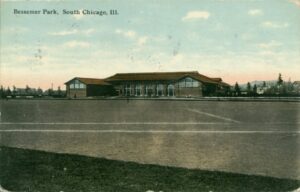 moved to the area, as part of a neighborhood park system designed by landscape architects the Olmsted Brothers and architects Daniel H. Burnham & Co. In 1907 the park was named for Sir Henry Bessemer (1813 – 1898), known for developing the “Bessemer Process” – the first efficient means of mass-producing steel. The process involved injecting air into iron to remove impurities and thus make the metal more durable.
Bessemer Park was aptly named, as the U.S. Steel South Works dominated the area to the east of the park, and steelmaking was the economic lifeblood of those neighborhoods and those who lived there.
Algren used the park’s namesake Bessemer Process as a metaphor in City on the Make. The second-to-last section, “No More Giants” laments what Algren sees as the loss of Chicago’s greatness by 1951 as reflected by – among other things – its loss of writers. At the end of the section, Algren bemoans that Chicago is still home to dishonest hustlers: “a broker’s portage. And an old-time way station for pimps as well. Both professions requiring the same essential hope of something for nothing and a soft-as-goosefeathers way to go.”
However, Algren sees no room in Chicago for those who have true feeling and care for others: “Yet never a harvest in sight hereabouts for humanity’s spirit, uprooted over half the world and well deceived here at home. No room, no time, no breath for the Bessemer processes of the heart.” In Algren’s view, Chicago prioritizes the strength and purity of commodified steel, but not the strength and purity of human hearts. Instead, like the industrial buildings soon to be abandoned as Algren wrote in 1951, hearts in Chicago are left to “rust,” as reflected in the last lines of City on the Make:
“While we shall leave, for remembrance, one rusty iron heart.
The city’s rusty heart, that holds both the hustler and the square.
Takes them both and holds them there.
For keeps and a single day.”
Nelson Algren’s early life on the south side of Chicago afforded him important early experiences that seem to have formed and influenced his life and work as an adult. Far from the north side neighborhoods with which he is most often linked, Bessemer Park, Algren’s childhood home on King Drive, and the still-busy intersection of South Chicago Avenue, Cottage Grove Avenue, and 71st Street all hold significance to Algren and his writing.
John Lillig is an English teacher at Loyola Academy in Wilmette, Illinois and a member of the Advisory Board of the Chicago Literary Hall of Fame. He has taught Chicago Literature courses at both the college and high school level. He was previously an attorney in private practice whose clients included writers, artists, and nonprofit organizations.


 Back to Blog