“I use this sighting all the time”: Preparing to Read Ed Roberson
Friday, June 12, 2026
By Barbara Egel
 There has been so much written about this poet: the forms, the subjects, the place in cultural history and the response to the culture that came before him, the politics, the song, the sweet, and the sly—and with good reason, because there is no reaching the edge of his world, no being finished and moving on. His friend, the scholar Andrew Welch, says of Roberson’s work that “it may be some time before its tapestry is completely unfolded, but that is happy work to anticipate.” Ed Roberson’s poems require a lifetime of meeting the poem naked on the page, then reading the book to find where the tissues between poems have adhered to one another. Then reading all the books in order and out of order to find where he has buried the wormholes that bind them to each other, to begin the necessary exegesis, to find the intertexts. Then to learn the language of his signs and symbols and all the polysemous conversation that happens among them, within them, like seeing lightning confined in a cloud. As the poet himself says,
Timed-out,
it’s neither
possible nor done
The problem with an essay like this, a general one for new and familiar readers, is that Roberson’s vast worldview resists categories. He brings everything he knows and everything he is into every poem all at once, and to comb out the strands into neat flowcharts of literary analysis is to distort the work. The options are either a close reading of one poem that will continue to resonate and grow more associations and connections or the creation of a sort of field guide to start you off on your travels. Let’s start the field guide with seeing and trekking.
Seeing
To set off on a trek through Roberson’s world, first you must become accustomed to disorientation and reorientation. You must strive to see as Roberson sees, telescopically, kaleidoscopically, and above all, fearlessly. Seeing is the First Principle in this poetic universe from which all other fundamental aspects spring. In a 2011 interview with Lynn Keller and Steel Wagstaff, Roberson talks about the fearlessness he tries to instill in his students to “... really look at things; if something scares you, then look at it. If something hits you as pretty, don’t just take the pretty, figure out how it does that to you, then what’s way behind all that, too.” Reading the poems, it becomes clear that seeing, sensing, is as essential as breathing. In “Violent Suicide,” a short poem in The New Wing of the Labyrinth, the act of noticing saves a life:
I was so surprised, I froze. I stopped
to watch it. so, it didn’t happen, so, I lived.
Observation was my practice so I lived. (49)
The automatic human impulse is usually to see and to judge, or at least to evaluate, arrive at a conclusion, and then over time,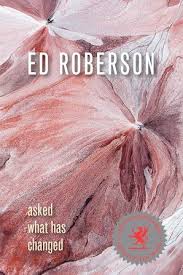 not see the thing anymore because the judgement has taken the place of what is to be seen. In “Eye Ear Nose and Throat” from Asked What Has Changed, people started speaking and “they stopped hearing at a distance with their eyes” and later, “They are beyond what is animal says / to them” (44). Roberson does not allow such diminishment of the senses, in part because with every re-vision, new associations and resonances appear alongside or connected with the thing we see.
Not just the what-is needs to be seen but also the what-isn’t, the spaces between things that define those things as much as their heft and outlines do, the switching from foreground to background and back again. The needs-to- be-seen in Roberson’s poetry is sometimes a literal invisibility, as in “About the trees bending as a seeing / of the wind:” from To See the Earth Before the End of the World, and often, it is about seeing the history in the geography, how a moment of seeing Nature (I’ll capitalize it, as Roberson does) parallels a moment of violence in the history of Black America. A short poem from Roberson’s second book, Etai-eken, accomplishes both.
how many ever
heads at one
time you see their two
colors
the jaguars and the sun
and trees are brothers
passing through each other
in their coats
walls and the spots
bleeding down the plaster and the night
they were shot are panthers
passing through their brothers
in the skin (32)
First, we are seeing the trickster magic of Nature’s camouflage, then the mythmaking of the brotherhood of jaguar and sun, and finally the murder of Fred Hampton as he passes through his Panther brothers, completing the myth with bloody reality. This connection mirrors biblical prefiguration and fulfilment, the model in the Old Testament finding its mirror in the new, like Ahitophel and Judas. Throughout Roberson’s work, the prefiguration of a state of being in nature finds its human anti-fulfillment in the 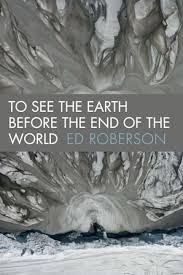 treatment of enslaved Africans from the time of the Middle Passage to the present. Nature is inescapable. As Roberson says in his introduction to the ecopoetry anthology, Black Nature (Camille Dungy, ed.), “There is, however, no humanly containable limit to living Nature; there is no outside of Nature.” With that vastness—“the epochal / heartbeat of larger elements, the seas, / the air” (Asked What Has Changed, 1)—with that inevitability, the treatment of Africans and African Americans still shows on Nature’s face, like seeing a wildfire on Earth from high in space. In Roberson’s work, to deny that burn scar is to deny Nature as surely as clearcutting a forest.
It is a strange direction for poetry: rather than working up from the human to the cosmic, Roberson begins in the sky and works his way to the dust, to the ship hold, to the lunch counter in Alabama. The effect of this is to change your way of thinking, of seeing. After taking this journey with him many times, often in poems where you least expect to end where you do, you begin to anticipate the connection, and even, as he intends, create it for yourself. “(Architectural Drawing),” also from To See the Earth begins in some capital city with weathervaned domes that curve in all directions. The next, human scale is the arch of the foot with the same geometries as the domes. But “geometries have narrative,” and the dome of heaven is invoked next, but turned upside-down to contain the oceans, which in turn contain the feet “cupped into a ship’s / hold carrying each step’s ground / gained by trampling another’s.”
Geography
Once you start seeing, you must venture out. There are maps mentioned in Roberson’s work, particularly in MPH, but neither the natural nor the human world is best learned from a piece of paper. To travel in these poems and experience the world through them is, paradoxically, to give up on direction until you can learn it right. Having learned to see—or at least have learned
by example what it must feel like to see with such microscopic/macroscopic apertures for eyes—you must trust and treasure where you see, even if it defies the compass. First, surrender any vertigo, because you will be swooping in and out of scale. As he says in the Keller/Wagstaff interview, “the second section [of To See the Earth Before the End of the World] turns the microscope into a telescope directed upwards to the other end of that core, looking up this big bore into the ends and beginnings and talking about those galaxies up there.” This is the way of seeing that takes in one glance jaguars and Fred Hampton, or sees in the reverse-image light and dark of the sun on the water in “Taking the Print” how the water also hid people fleeing slavery, “our crossing guided by the internal sight / on our darkness.” Prepare to be jolted, and don’t look away.
Roberson’s work shows the toolmarks of deliberate systems. Science fiction and videogames call this “worldbuilding,” where a coherent, consistent fictional universe is created in all its details. But Roberson is writing about our world, one that already exists, for now, and we have rationalized away most of its inconsistencies by either not seeing them (the homeless man freezing in the alley) or stopping at awe without an effort to understand. (As I might have done had I not read Aquarium Works, in which the fish he cared for in one of his many and wildly varied jobs become colleagues and treasured family, although like family, they can be sneaky and dangerous.) Roberson’s systems are fully realized from the beginning. What this means for the geography of the work is that, as noted, up is where you start, and you work your way down to the self or to history or to the vacant lot razed for something that doesn’t come—start huge and get human. In a pair of poems on facing pages in To See The Earth, “The World, Then” and “Facing up to,” we get a glimpse into the worldbuilding and the thought behind it.
The world then
was made up of the same
pieces that turned
into what we have now.
pieces the same nowhere took
any of what then
I thought was the world and world to come
that came (26)
Opposite that on the next page, we begin to fall up, a direction Roberson will take in many poems, including and especially in The Aerialist Narratives.
Facing up to
the night sky is way off
is a vertigo of falling up off the face of
not so much the earth’s off into space as off
any hold that was ourselves together
in what balance lasting in the stars. (27)
There is so much more to say about this, but we must move on. City Eclogue seems to make space more familiar by pinning us to a human-sized space. We foolishly imagine that this change in scale will give our unmuscled eyes a rest. Instead, the poems take us as far into the geography of a city as other books did into glaciers and galaxies. “Sit In What City We’re In” measures “how many steps we took / to cross one of our streets” and seems to lay out the hexagonal grid of the city. But in the next stanza, that street is home to a lunch counter where an endlessly regressing mirror on the wall records the abuse heaped on Black protestors in the South, and another mirror makes a breathtaking connection:
The oceans, themselves one, catch their image
hosed by riot cops down the gutter into
The sphere surface
river
looked into reflects
one face. (26)
Every city tells the story of all cities somewhere in their mosaicked mirrors.
The mirror is metaphorized into repetition, into what is called, among people who make things, “generational loss,” where a copy of a copy of a copy loses clarity and sharpness and may pick up unwanted artifacts of the duplication process. Our increasing distance from Nature and from the honest geography of where we are mirrors generational loss. The powerhouse poem, “I Remember Form” from Atmosphere Conditions has an added bit, “The Osiris Addendum,” on the end that looks like a lagniappe and has the force of a lodestone. Read “Sit In What City We’re In,” and then go back to the older poem’s coda
I remember the shock
of remembering
that I am
still that who
rememberings
re-remember (67)
I wonder whether Roberson, through this constant reflection and dilation, is holding open the portal of memory for generations who know Medgar Evers or the four little girls killed in a Birmingham church only from a paragraph in a textbook. Whatever his intent, they can’t stay unseen.
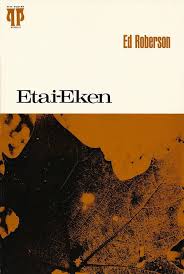 Even when the poet is moved by age and illness into a smaller geography, the view from his high rise in Bronzeville provides opportunity for yet another geography of scale in Asked What Has Changed. The view is pinned on the horizon between Lake Michigan and the sky, and the odd corners seen from that window activate the geography of small places. We have seen him focus on interiors before, notably in a pair of facing poems in Lucid Interval as Integral Music, where he moves from speculating on why white poets’ homes become talismanic museums, to thinking about those objects that should be venerated by and for the Black poet, handed through generations, “But we are sold / goods apart from each other.” In Asked What Has Changed, he sees from an interior vantage point, and the poet’s own human interiority is much more clearly on display than in previous collections:
But back to horizons. Just as Etai-eken shows us how to see the Magic Eye photo in the untangle-able knot of nature/culture/history that we cannot tease apart but only learn to focus our eyes on, the horizon is a defining ley line.
In the Keller/Wagstaff interview, Roberson tags what is important about his Chicago apartment, “For one thing, the lake gives me a horizon. I don’t feel comfortable unless I have a horizon. Even if it’s the next mountain, I have to have a horizon.” The horizon is the measuring stick for the shadows of “the skyscrapers lying out / into the lake” and his high aerie in a geographically flat city is “a paradise / we look down on from.”
The Rest
I could have written a messy, missionizing, half-coherent book based on the manic scribblings brought on by total immersion in Roberson’s work. I haven’t even shared poems from all of the books. I will briefly summarize the other things you should know: The geography of the poems is as built and meaningful as the geography in the poems—his spacing and lineation and the matrices he makes on the page; the “lena” form, named for his daughter, begs for close analysis; enjambment rearranges your certainty about meaning; and there are enough sonnets sitting in his books to make their own collection. The importance of lines—broken and reconnected, fading and fast—hums under everything as parts of poems, as geographical markers, and as historical and familial connections. The music and the oratory that elevate and teach. There is so much myth as intertext, both Roberson-made myth and myth from cultures as far apart in time and space as Egyptian mythology and Native American rituals. The list of echoes from other poets runs a gamut that includes Donne, Blake, Eliot, Hughes, Dylan Thomas, Louis MacNeice (the drunkenness in Asked What Has Changed!), Gwendolyn Brooks, and Amiri Baraka. Whether I am right or not about all these poets being overt influences, the fact that I heard them in his work shows how connected he is with us as a species (oh the word “specie”—note it when you see it.)
Most of all, the thing you should know is that Roberson’s poems connect across the books, drawing the work together like a string bag, like a gris-gris herb bag. This connecting is why Roberson is never done, why, as Welch says, the tapestry has not fully unfolded. The connections I still haven’t made await me in future readings, and I am eager to draw the threads together and pull them apart again to see what new geographies await me. Read and reread these poems, take the journey, be changed.
Barbara Egel is a Chicago poet and critic. She is the co-director of the program in Design Thinking and Communication at Northwestern. Her most recent work appeared in Ploughshares, Spring 2026.


 Back to Blog