Ed Roberson: Lake Poet
Thursday, June 18, 2026
by Andrew Peart
Chicago was destined to be Ed Roberson’s “second chance.”
 That’s what a parking attendant told him at the Congress Plaza Hotel in 2004. Roberson had received an invitation from poet David Trinidad to serve that spring as a visiting artist at Columbia College Chicago, and he was here to check out the city. Roberson, having recently retired from an administrative career at Rutgers University, having recently come through surgery for prostate cancer, felt in between one life and the next—in the “bardo,” as he puts it. Chicago offered the possibility of a new beginning.
Roberson was serious enough about that offer to be already apartment hunting. He got a little help in his search from that parking attendant at the Congress. But the man’s insight was not merely practical. “When I was packing up the car to leave, he said that a couple of times in his life he had been gifted with being a seer. And he said that he could see that I was being given a second chance at life and that I had come to Chicago to take it up. Shocked the shit out of me,” says Roberson. “I hadn’t told him anything about the prostate cancer or coming here because of David. I hadn’t said any of that to him. But he said that I was here to make a second run at life and he saw that I was going to be all right. I was surprised because that was so accurate.”
Roberson’s decision? “OK, I’m going to try this.” It was time to journey forth into a new life, and not a time to delay. “Couple of months later, I stepped out of the bardo. ‘Oh, shit. Fasten your seatbelt.’”
And what a journey it’s been. Chicago is the place of Roberson’s rebirth. What started as a one-semester gig turned into a full-blown second career, first with a couple years’ renewal at Columbia College and then with teaching posts at Northwestern University and the University of Chicago. Roberson’s “second run at life” in Chicago is now more than two decades long and going strong. He might be retired from teaching, but his presence in the literary life of the city is vibrant and abiding. Just ask anyone who attends the city’s myriad poetry reading series, or follows what the small presses and literary journals are doing. Publisher and author Peter O’Leary calls Roberson “the essential Chicago poet” of the past 20-plus years.
For Roberson, it’s still somewhat surprising that he came here at all. “This is a place I had so denied,” maintaining that he would never live here. Roberson has memories of visiting Chicago as far back as the early 1960s, and they’re not pretty. In fact, he came to associate the city with downright ugly racial attitudes. “It just built up that kind of a history. Every time I’d come here for something, some award, some shit would come up. And you’d heard the story of how bad Chicago was, and then every time I’d come here, there it was.” He tells me the story of a dinner at the Drake Hotel, decades ago, when he and his group witnessed a manager verbally abuse a young Black staff member for talking to a white girl in front of the clientele. “And I’m one of the clientele!” says Roberson, still perturbed all these years later. “As Black as I am, he had to see me.”
Eventually Roberson gained a different perspective on Chicago. A few years before he moved to the city, Roberson was in town again, this time to join several other poets in readings and talks. Afterward, he met up with fashion designer Tereneh Idia, the daughter of late sculptor and dear Roberson friend Thaddeus Mosley. Roberson told Tereneh of his Chicago apprehensions. Tereneh made him see that plenty of welcome was to be found in Chicago— but with a caveat. “She said, ‘You have to know which Chicago.’ You know, you had to be careful which Chicago you were in.”
Roberson remembered this sage advice when he got the invitation to come teach in Chicago, and when he needed to find a spot to live. Staying at the Congress that time, he heard a lot of chatter that he should look only north. But he thought of Tereneh and wanted to explore. And he had wheels to get himself down to the South Side. “I saw that Bronzeville was right down the street. I hopped in the car and drove down Michigan Avenue. Got down as far as 31st Street, recognized these buildings, came over here, rode around, and, when I asked about the rental, everybody was so nice that I said, ‘Well, I like this place. I’m going to take this place.’ At that time there were all these Black folks here, and there were families and kids. It was like, ‘Hi, how you doing? Where you from?’ It was so homey that there was just no need to look anywhere else. I signed up right on the spot. It was so perfect.”
Roberson tells me this story as we sit in the living room of his eighthfloor apartment in Lake Meadows, right on the edge of the Bronzeville neighborhood. Perfect the fit must have been; he’s lived in building number nine of this midcentury modern high-rise complex ever since he’s been in Chicago. When he says he recognized these buildings on that momentous day in 2004, he means from his passionate study of architecture as an undergraduate. Once a college kid writing about the modernism of Skidmore, Owings & Merrill, Roberson must have been awestruck when he unexpectedly pulled up on the SOM-designed Lake Meadows for the first time. He was shown apartments throughout this whole building, and he originally took one up on the 15th floor. “It was so pretty. It had that beautiful view.” About a decade ago he moved downstairs for a corner unit and more space. He also got arguably an even better view. On this warm spring day Lake Michigan spreads its turquoise waters as far as we can see across the horizon.
Roberson’s Chicago is the Great Lakes metropolis. His poetry since the mid-2000s is deeply intertwined with his apartment’s perch above Lake Michigan, its view of the Chicago skyline, and its permeability to street sounds exiting off Lake Shore Drive. There’s a breadth of vision that many admirers note in Roberson’s poetry, and it comes not just from the lake itself but also from the way he views it with the eyes of a newcomer, no matter how long he’s lived here. He’s not a native of the city by the lake; he hails from the city of three rivers, with many travels in between.
Born in Pittsburgh in 1939, Roberson spent the first three decades of his life there. The oldest of five brothers, he graduated from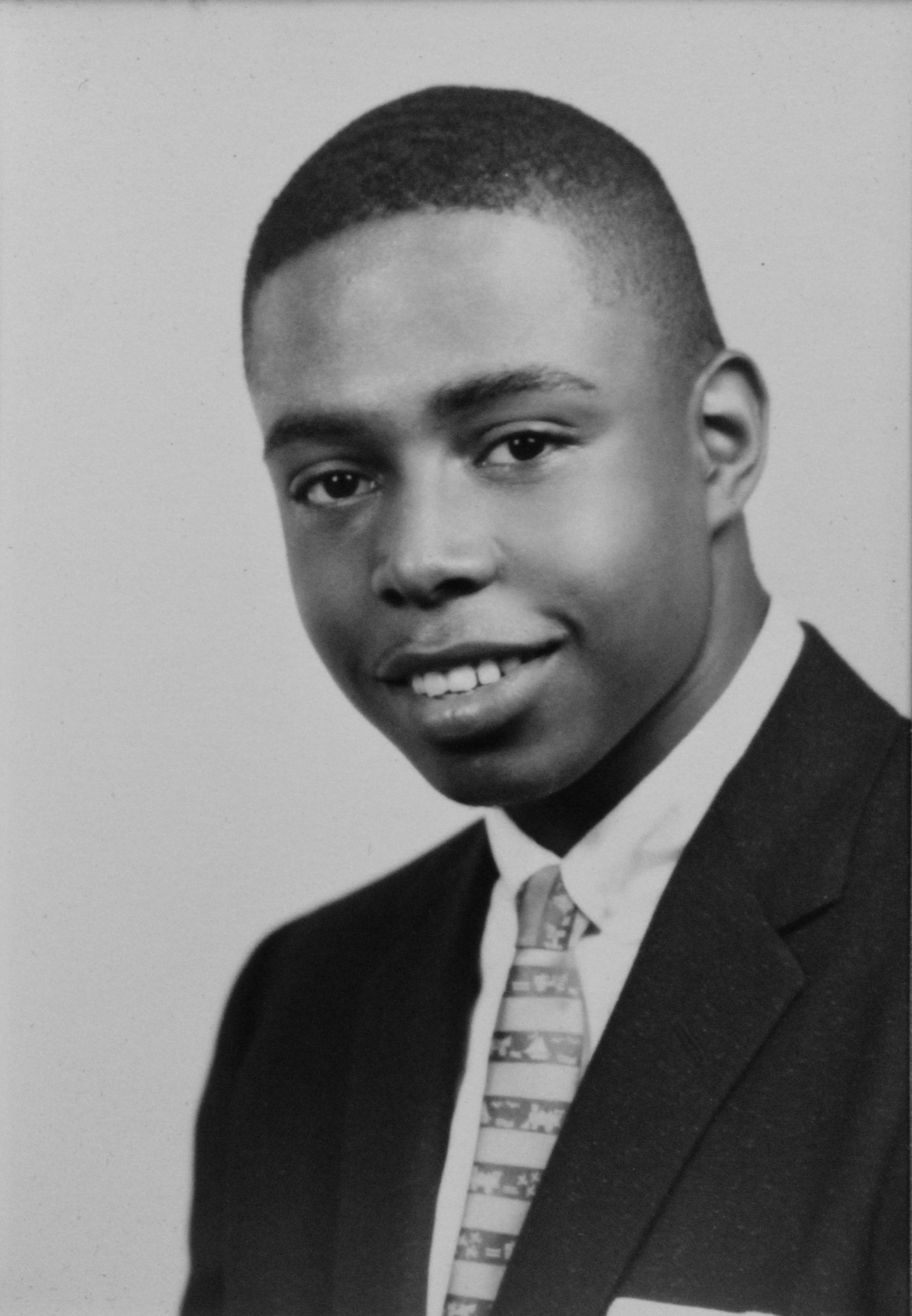 storied Westinghouse High School, whose other notable alumni include jazz greats Mary Lou Williams, Billy Strayhorn, and Erroll Garner. Roberson went on to the University of Pittsburgh, studying chemistry before switching to English literature. His undergraduate work in the sciences and humanities shaped his outlook. As a research assistant in limnology with Pitt’s Richard C. Dugdale, Roberson undertook extensive travels, including to fieldwork sites in Alaska and Bermuda. Reading the Metaphysicals and the modernists with English professor Charles R. Crow, Roberson expanded his own horizons in a different way. Professor Crow too had traveled widely, and he taught Roberson to look for the deep cultural matrix beneath whatever he was reading. “What was so impressive about Crow is that the stories he could tell and the places he had been were learning,” Roberson says. “So, when he talked about what could be learned from study, you could tell that he had been there. Those notes I take on the road,” Roberson stresses, “I treat those with the same kind of seriousness Crow taught with his historical references.”
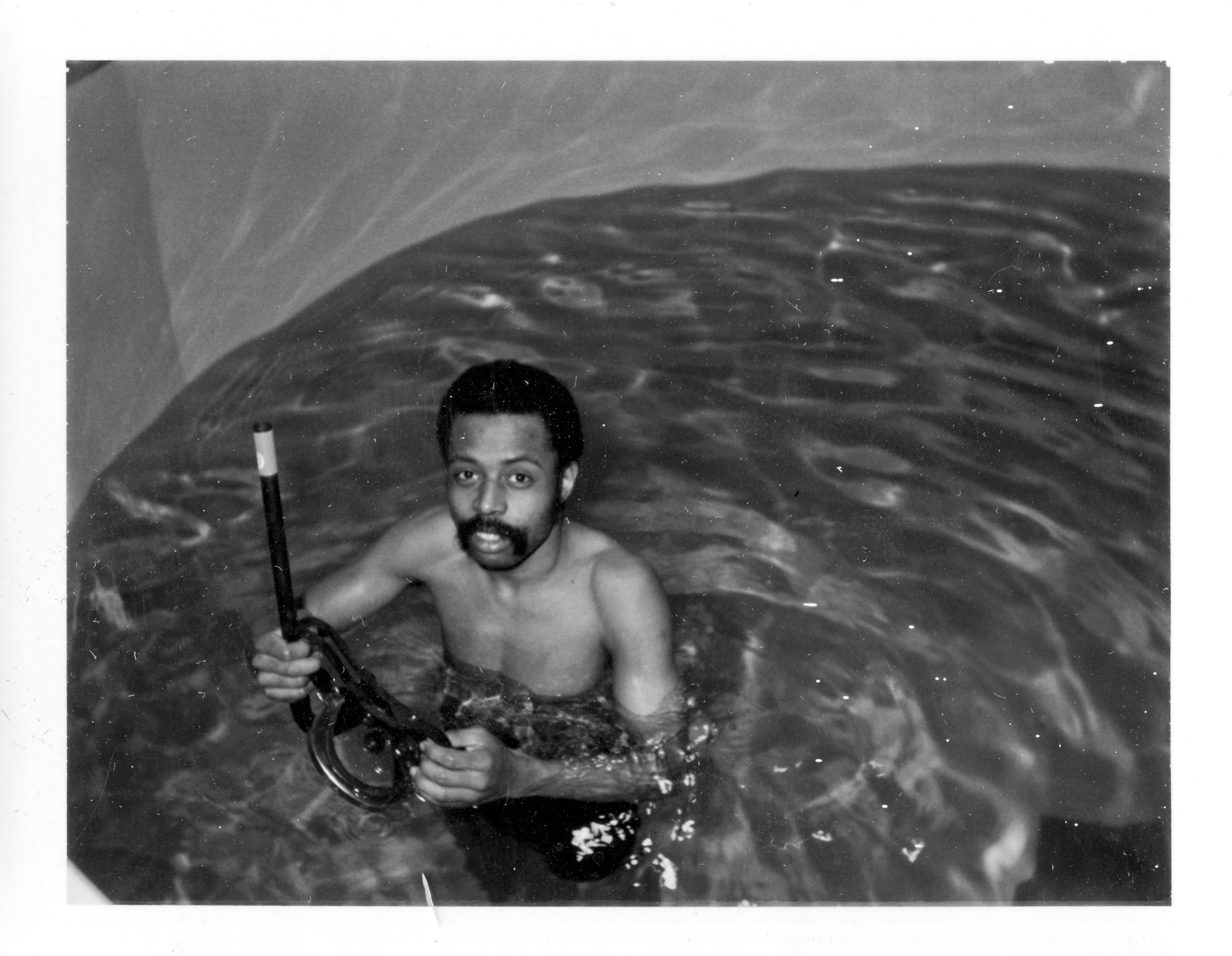
Roberson’s not speaking figuratively when he talks about being on the road. His Pitt days also involved an important extracurricular education. A member of the Explorers Club of Pittsburgh, he joined expeditions to Ecuador and Peru, scaling peaks in the Andes when mountain climbing was the no-frills business of the Army Navy Surplus racks. Travel and adventure informed Roberson’s poetry from the beginning, and still do today. His 1970 crosscountry motorcycle trip from Pittsburgh to San Francisco, undertaken the same year he graduated from Pitt, became a lifelong saga. It produced a manuscript, long thought lost but recovered a decade ago, reworked, and published in MPH and Other Road Poems (Verge Books, 2021). Roberson, a student of the well traveled, learned the value of circling back. He’d return to South America as a young professor himself later in the 1970s, the continent forever animating his poetic imagination, even now. “The South American memories are like mythology,” Roberson tells me. Each image in the memory bank is bedrock. “It doesn’t have a time.”
After stints teaching literature at Pitt and the Community College of Allegheny County, Roberson headed to Rutgers University in 1973 to continue his teaching. He’d spend the next three decades in New Brunswick, NJ, switching in the early 1980s from teaching to administration. He retired from Rutgers as assistant director of special programs on the school’s Cook College campus in 2003.
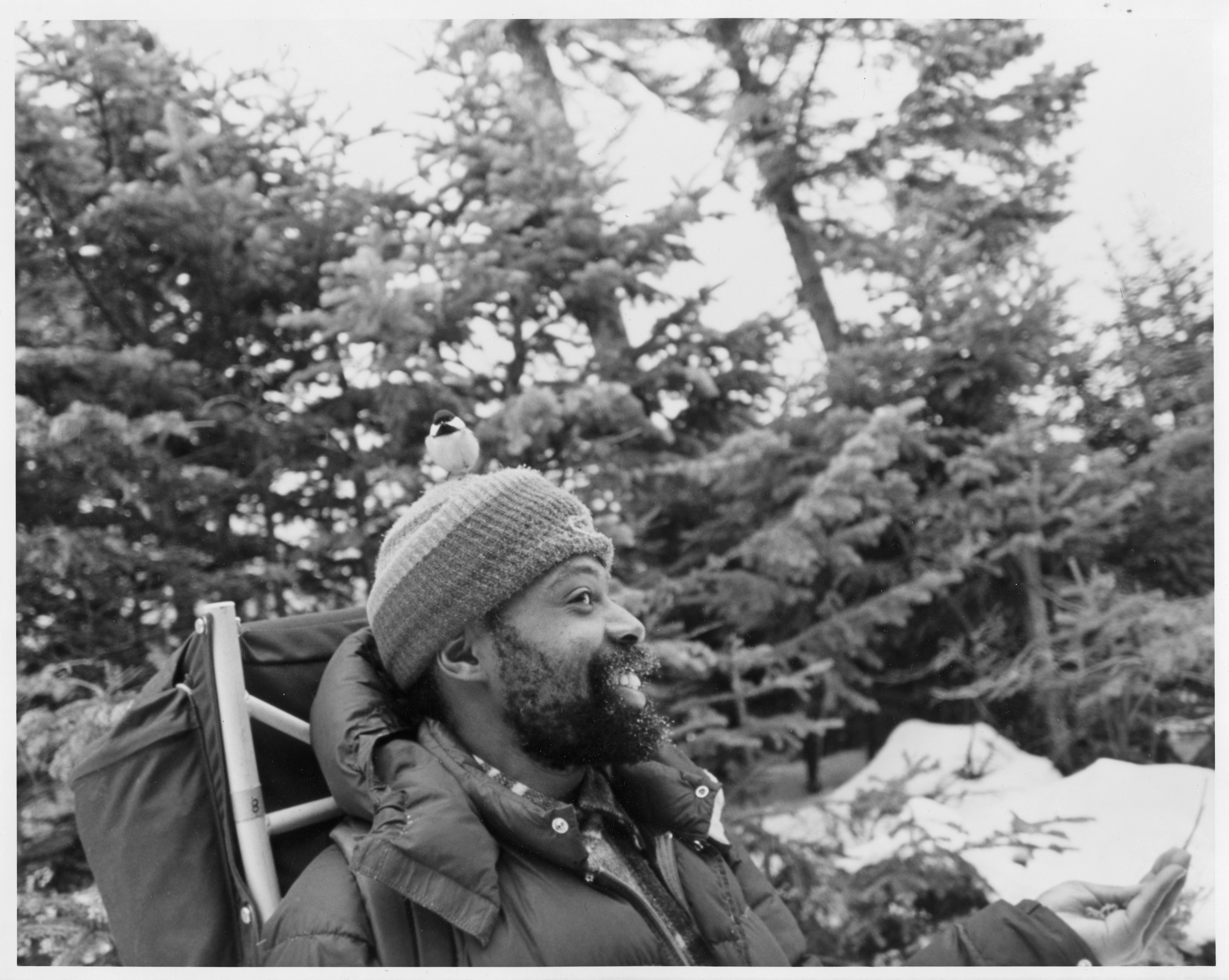
Arriving in Chicago, Roberson brought with him a naturalist’s eye for the local environment and an anthropologist’s sense for the locals’ behavior, honed over years of exploring far-off places and distant cultures. The city gave him plenty of raw material to work with, and now it’s hard to imagine him apart from the wide vantage Chicago provides. Former colleague and fellow poet Srikanth “Chicu” Reddy underlines that affinity. “This is the city that got Ed to stay still.”
“It was completely gifted to me,” Roberson says of the string of teaching invitations that launched his personal literary renaissance in Chicago. “I would just join up with folks. That’s what was so nice. It was like home.”
Trinidad, who offered the first of those invitations to Roberson, does think “it was his destiny” to find a new home in Chicago. Fresh off retirement from an admin career, Roberson came to Chicago and restarted teaching at age 65; he retired again after turning 80. Such a “second run,” especially with such longevity, is certainly rare, something Roberson understandably regards as a gift. I asked Trinidad about the thinking behind his decision to offer Roberson one.
Trinidad thinks Roberson, no matter his age, was perfectly suited to the role of inspiring young writers. “I knew he was a good person and a good poet,” says Trinidad, who was a creative writing adjunct at Rutgers when he first met Roberson. The elder poet reached out to the younger Trinidad and invited him to coffee, which left a deep impression. “He’s a quiet guy. He’s very modest, and I’ve always liked that about him.” At Columbia College, the understated and reserved intelligence that Trinidad witnessed back east showed up again in the classroom. “I do remember how the students really liked him. He made his important points in a soft-spoken way that you would just respect and listen to. He generated a kind of respect in me and his students too.”
Roberson landed in the right place at the right time. Trinidad, along with colleague Tony Trigilio, was steering Columbia College’s undergraduate poetry program and standing up a new MFA program. Teaching needs turned a one-semester post for Roberson into a longer engagement. But was it really just a job that got Roberson to stay in Chicago? Why has he so fully adopted the city as his home?
 One reason is precisely that view from Lake Meadows he takes in every day. When I ask Roberson what the essential ingredients are that make Chicago his city, he points at the nearest living-room window. As a poet of the natural world, and of urban nature in particular, Roberson gathers images from the daily dramas that unfold on the lake, in the sky, and against the backdrop of the city skyline. He lists a few of them for me. For one, Roberson delights in watching as rainbows arch from skyscraper to sky. For another, he loves the optical trick that happens, eight stories up, when birds and jets suddenly occupy the same visual plane. And, in an eerie twist, he’s awestruck by the city’s disappearing act whenever fog makes the ground invisible.
Another reason is Chicago folks. Their speech and their patterns of living have given new music to Roberson’s poetry. Vernacular language and snatches of recorded speech take prominence in Roberson’s voluminous Chicago-era poetry. For instance, “Aunt Haint,” published in Poetry magazine in 2015, is an ornate verbal artifact that spins on the pedestal of a monologue delivered in Black vernacular and overheard by a speaker unseen and unknown but occupying the same public space. In a 2019 interview with the poet Joseph Donahue, Roberson tells a story about witnessing a lover’s quarrel on the Chicago Transit Authority’s #3 bus, his regular line. And he tells it to illustrate something that endears Chicago to him. “I remember being on the bus soon after moving here,” Roberson tells Donahue, “and being at a bus stop. There was an argument going on between an elegant couple on the corner. And, you know, she is pretty pissed about whatever it was. And then she hauled off and punched him.” The scene would be different back east, in New Jersey or New York. “Somehow or another, the way New York is set up,” Roberson suggests, “you’d sort of make sure that you didn’t see it. Here it was like, ‘Oh, man! She punched him!’ And everybody on the bus saw it. So there’s enough room for that, for people to have a reaction, and say, ‘Wonder what he did?’”
Roberson’s bottom line about Chicago folks? “I feel people here more than I do other places.”
Yet another reason for Roberson’s Chicago affinity is the spectacular architecture. “Architecture and music, those are the modernist modes for which the city is most well known. And they’re everywhere in Ed’s work,” says Liesl Olson, author of Chicago Renaissance: Literature and Art in the Midwest Metropolis (Yale University Press, 2017). Chicago folks and their vernacular speech give Roberson a musical grounding, and the city’s urban design gives him an architectural one. Roberson’s longstanding interest in architecture, in the design of built environments, is actually an interest in what he calls “civilizations,” or the overall planned construction of the physical world humans live in. Buildings don’t just have stories; they are stories, with their passageways and portals. For Roberson, if you can understand the way a city organizes its spaces, then you can understand the stories its citizens organize their lives by.
Roberson’s imagination ignites when viewing human life at this scale. “I like looking down Lake Street, which goes from one side of Chicago to the other,” Roberson remarks in his interview with Donahue. “I can just stand there and gawk across the whole town.” Architecturally speaking, Chicago’s stories are an open book to Roberson. No wonder he’s written poems about many of the city’s signature architectural achievements, including the Rookery Building, Robie House, and the now-demolished Mecca Flats. Roberson’s meditations on Chicago architecture take him back to mythology, to archetypes, to the structures that organize time but have no time themselves. Like his South American memories, they give him access to a kind of eternal poetic source.
Finally, there’s the literary community, academic and otherwise. The kind of work Chicago offered Roberson was so much more than routine classroom work. Teaching poetry in Chicago opened up for Roberson a new world of peers, admirers, champions, and disciples. I wanted to get a sense of what Roberson was like as a teacher early on in Chicago. I asked Trigilio, given his role alongside Trinidad in developing the Columbia College MFA program. Trigilio talked first about the program’s aims. “The ethos we were building at Columbia is the ethos of community,” says Trigilio, and Roberson “is that kind of collaborative person.” Trigilio, Trinidad, and their colleagues wanted a school that reached out into the city, and Ed fit right into that collegial esprit de corps. “He carried himself like his poems: a real spaciousness and authority,” Trigilio remembers. “I felt as welcome in his presence as a person as I did in his poems.” That feeling extended to students. Roberson was “never the older person lecturing the younger person” but instead taught “always with a sense of wonder,” reflects Trigilio, who found a lasting lesson in Roberson’s approach. “This is how to age into your art form.”
Roberson has fully embraced Chicago. You could say he did so the moment he signed on the dotted line at Lake Meadows back in 2004. He’s made good on the “second chance” he got in the city, publishing more than half of his life’s work to date in just a quarter of his life’s time, if you count by number of books and chapbooks. That prolific streak started in 2006 with City Eclogue (Atelos), a book that cemented Roberson’s reputation as a premier ecopoet with a singular vision of cities as ecological spaces. “That’s really a Chicago book,” Roberson says of City Eclogue. “A lot of East Coast memories, but it’s a Chicago book.”
In turn, Chicago has fully embraced Roberson. There’s no shortage of proof, but the Chicago-based Poetry Foundation’s Ruth Lilly Poetry Prize, bestowed on him in 2016, brought hometown cred and hometown laurels. I have seen Roberson break into tears talking about the deep sense of belonging he thrives on from Chicago’s literary community, as he did one night at the Hungry Brain Sunday Reading Series in January 2023. The mutual affection is strong; the feelings are real. Why has Chicago so fully adopted Roberson as its poet?
The answer, just like Roberson’s new life in Chicago, starts in the classroom. But it doesn’t end there. Roberson brings real magic to the seminar and the workshop, as his students in Chicago attest. But they’ll also tell you that he transforms their lives by showing up for them in other venues: their readings, their small-group sessions, their hangouts. “When you come here and participate in community here, you belong to us,” says Marguerite L. Harrold, who worked with Roberson extensively both during and after her MFA program at Columbia College. The city knows one of its own.
Roberson has a reputation for treating students like colleagues and colleagues like family, and for eliminating the usual pretenses that keep a teacher at an elevated remove from everyone else in the room. Poet Jacob Saenz, then a Columbia College undergrad, petitioned Roberson for an extra spot in the visiting artist’s fully enrolled class. Roberson was willing “to open the door for me,” Saenz says, and “because of that moment,” he adds, “we were able to develop a relationship that lasted two decades. I’m very grateful to have Ed Roberson in my life as a teacher, as a mentor, just as a person.”
Roberson did more than open the door. He opened up himself to his students. Saenz recalls that Roberson taught the writing of serial poems and used as a model his own 1995 collection Voices Cast Out to Talk Us In (University of Iowa Press), part of which addresses his father’s death. “I remember one particular class where he was reading some of those poems and talking about the process of those poems, and he broke down in class. It was just this moment that none of us had experienced before with any professors and we were all, of course, touched and crying ourselves, some of us. And he ended up calling the class early,” says Saenz. “It was just such a heartfelt moment for him to become so vulnerable to us, sharing that poem, sharing the history of that poem, and how those feelings were still there, just below the surface.”
It’s Roberson’s candor and vulnerability that won over his students. Perhaps it’s the same qualities that won the whole city over to him. “Keep up the struggle. Be honest. Best of luck.” Those are the words Roberson inscribed in Saenz’s copy of Voices Cast Out to Talk Us In. Chicago likes a truth teller. Saenz describes Roberson as someone who “has never put on a facade,” who, inside and outside the classroom, “was always just who he was, which is an awesome poet and a great human being, somebody who is down to earth and able to speak to you at your own level, never someone who is speaking down upon you.” I wanted Saenz’s opinion on why Chicago so fully adopted Roberson. His response was quick and decisive. “Chicago has a love for realness, and Ed is a real one.”
Saenz mentioned another facet of Roberson’s teaching that struck me as emblematic of his open-door policy. “We had a workshop outside of the workshop,” Saenz says of himself and his fellow students. Roberson heard about it and decided that he was going to host the group at his place—quite a generous act for a poet of his age and stature. I talked to another Columbia College student who was part of that extracurricular poetry workshop. Poet Daniel Suárez agrees that Roberson the teacher was “someone who would crack open the door” and let other voices fill the room. In Suárez’s experience, that tendency took Roberson’s relationships with emerging writers beyond that of teacher-student. For Suárez, there was a deep “connectedness” between the two based on “mutual curiosity.”
The so-called “workshop outside of the workshop” was a venue for Roberson to show Chicago’s young poets what kind of role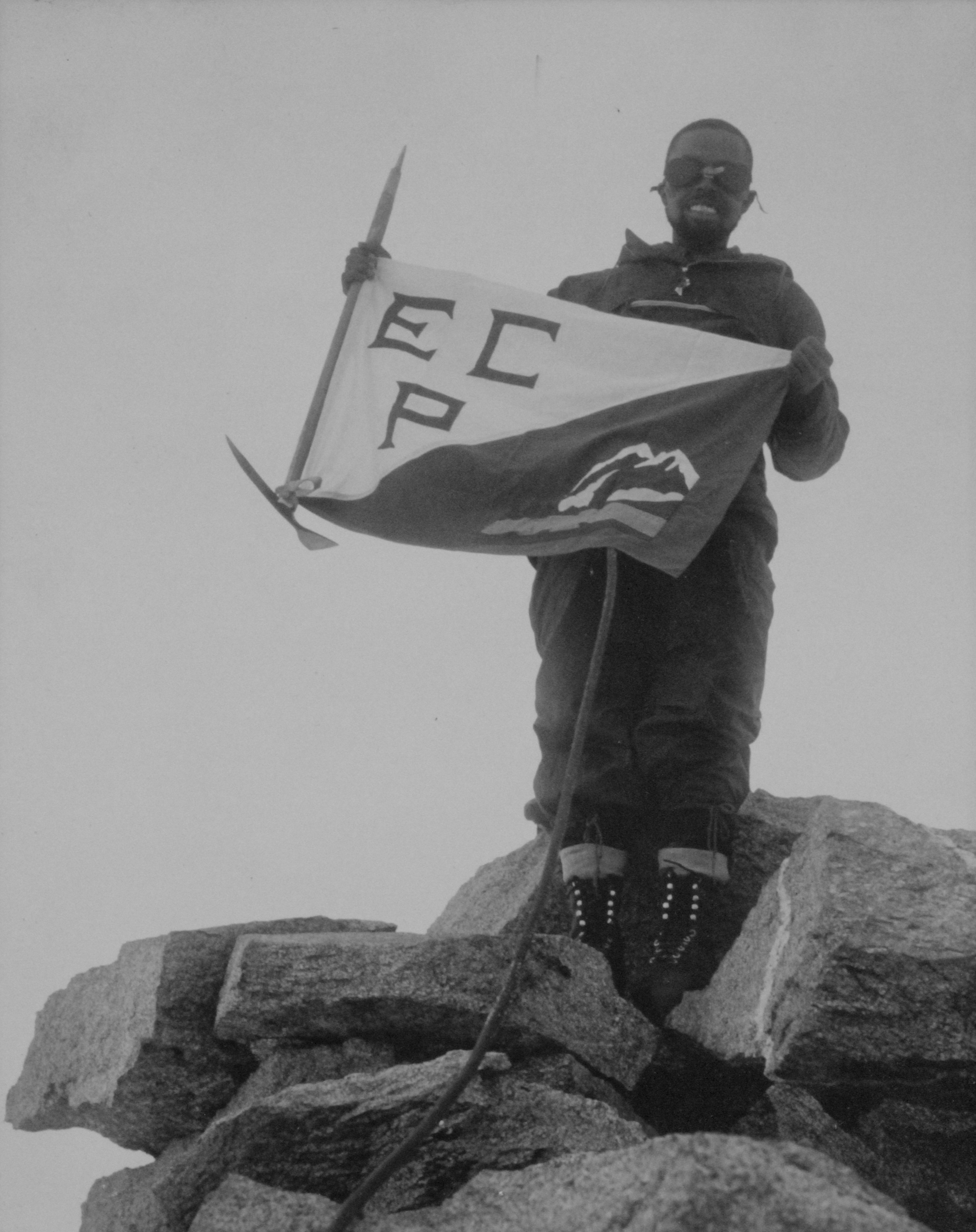 model and pillar of community he could be. What impressed Suárez about Roberson’s presence in those extracurricular sessions? “He’s bringing his own work to the table” and shedding any remnant of the instructor persona for a different role. Roberson’s attitude was never “Here I am, the elder,” according to Suárez, but rather “I’m an equal. We’re writers.” Roberson made the effort to meet the younger poet where he was and elevate him, Suárez says.
As for Chicago’s embrace of Roberson, Suárez thinks the early dedication to students was paramount. “Interacting with the students,” says Suárez, “made him feel comfortable and welcome here.” The warm feelings spread to the writing community and the arts community more broadly. “The people just off the bat seemed to welcome him. It wasn’t a forced welcoming. You would be around people he had known a bit, and they were excited to see him,” says Suárez. “He would meet new people, and they would take a liking to him.” And that rapport might have warmed Roberson up to seeing Chicago’s fraught social history, part of his own past, in a different light. “The history of Chicago, whether it was good or bad,” Suárez thinks, turned into a source of inspiration. “All of that brought something new to him.” Like the drama and beauty of Lake Michigan, it became something to write about.
For the young writers in Chicago who embraced him, Roberson the teaching poet consistently gave them something to talk about. Trigilio tells me that he always knew when a group of students filing into his class had just been in Roberson’s. Those students would be absolutely abuzz, carrying on a conversation that could not be limited to the time and space of just one classroom session.
Roberson had shown them that the knowledge contained in poetry could be large. You just needed a large enough table and a wide-open invitation for what each writer was welcome to bring.
It was a favor Chicago had paid him. In his early Chicago years, Roberson received an invitation to a kind of reception party, hosted in his honor, by Northwestern University’s Reginald Gibbons. Now a close friend and longtime colleague, Gibbons had assembled a large group of Chicago writers to meet the new poet in town. These were the people whom Roberson needed to know, and who needed to know Roberson; they included the likes of Angela Jackson, Sterling Plumpp, Christina Pugh, Mike Puican, and Anne Winters. Roberson remembers the event as a turning point, and an invitation to community much more welcoming than any he’d ever received back east. “That was a big introduction,” Roberson says. “I knew where to go. And I got invitations from there.” I mention the trendy word networking, but Roberson is quick to emphasize that his connections came to him as a kind of grace. “I just fell in with folks. Kept doing the work.” Recognition, reception, and appreciation followed. “That was always what was going on.”
Chicago may be the second city in many respects, but not in putting ambitious work above ambition as such. And that has made Roberson and the city a great fit for one another. “In Chicago,” Roberson says, “everybody’s in here doing it together. The bigness is what we have. It’s not an imagined thing. The bigness is what you do. It’s real.”
Excellent writing and mutual support are the cardinal points in Chicago. With everybody working toward the same goal, and everyone invited to bring their best to the table, the city has made Roberson feel like family. But it’s a different feeling than when he sensed his only community was his actual family. Back east, it often seemed to Roberson that his “tribe,” he tells me, was simply his mother and his brothers and a tight-knit circle of friends. It’s in Chicago that Roberson realizes “there are other tribes I do business with.” And that, for Roberson, is precisely what the bigness of Chicago is about. “The world has gotten much larger.”
Roberson’s personal storyline routed him to Chicago. His legacy as an author will be mapped onto the city too.
I asked Roberson how he felt about being a writer identified with a particular city, the city of Chicago. “I’m proud of that,” he said. I also wanted to know how he identified with Chicago, and how Chicago would identify with him. Roberson says that he appreciates, even loves, the stories of Chicago natives like Angela Jackson, Carolyn Rodgers, and Stuart Dybek. But his story is different because his attachment to Chicago is different. Roberson the Chicagoan, as he sees it, “is someone who came here as an immigrant,” and that image, he thinks, casts him in the light of the regular folks he so admires and their down-to-earth wisdom: ”that anybody would have enough sense to come here.” That’s Roberson’s Chicago way. “It’s not the same as being born here,” he acknowledges, but to be “someone who’s associated as an immigrant here just says, if the natives accept me, then I’m a native. I’m an immigrantnative. And I’m fine with that.”
I point out that the immigrant story is a central storyline of Chicago. Roberson’s “quite proud” of that too, he tells me.
How Roberson would fit into the big storyline of Chicago literature is a question I put to the University of Chicago’s Reddy. He agrees that Roberson’s story of coming to the city is essential Chicago stuff “because Chicago is a place that people arrive at.” Reddy, who’s known Roberson since 2005, remembers that even then Roberson described coming to Chicago as a homecoming. “For somebody who’s lived so many different places and lived so many different lives in one,” says Reddy, “he is a Chicago poet.” Reddy goes even further. “It’s hard to imagine Chicago poetry without thinking of Ed Roberson.”
But Reddy also thinks Roberson is more than just another new arrival making his home in Chicago. Roberson enriches the city’s literary scene by bringing to it a range of cross-cultural influences, won through his labors and adventures in Alaska, Bermuda, South America, and Africa. Those influences are never too distant from his poetic imagination, as firmly situated as it is in Chicago. “That’s the thing about Ed. He thinks on multiple scales simultaneously, always. He’s thinking about the city. He’s thinking about the architecture of the city. He’s thinking about the urban topography and urban politics of the city. But he’s also at the same time thinking about glaciers and shamanism and indigeneity.”
Roberson’s place in the Chicago literature storyline? “He makes Chicago poetry more cosmopolitan,” says Reddy. “I think of Ed in some ways as a world poet.”
I put the same question to Olson, who also sees Roberson as a global writer glad to have found a home big enough for himself in Chicago. “He came to Chicago after so many travels,” notes Olson. “Wherever he is, he’s clearly really there.” Roberson’s commitment to Chicago has meant showing up for poets, for poetry lovers, and for even just the poetry curious. “Not everybody’s here for poetry,” says Olson, but Roberson’s poems “really are here for everyone.” And that might be the most Chicago thing about Roberson. If we try to place Roberson in a Chicago literary tradition, Olson tells me, we’re going to struggle to find one dominant mode, style, or aesthetic that stands for the city or for the poet. But we might find a signature ethos: a pluralistic commitment to different audiences, regardless of class.
In viewing Roberson alongside great Chicago poets of the past, Olson says, “What I find more of a through-line is not necessarily the aesthetics of the work but a kind of attention to communities of readers: that dynamic between a work of art and who’s absorbing it, consuming it, reading it, responding to it.” And on that score Roberson stands tall among the greats, whether it’s Gwendolyn Brooks, Margaret Danner, or Carolyn Rodgers. “He’s as heterogeneous as the city itself.”
Olson recalls the motto that once appeared in every issue of Poetry magazine: “To have great poets, there must be great audiences too.” And if Roberson has a motto, it could be Olson’s gloss on his willingness to cultivate the art form’s various audiences. “‘If it’s for poetry,’” she imagines Roberson saying, “‘I’m in.’”
 Roberson came to Chicago as the consummate experimentalist. He was someone who could offer students and other young writers, as Trinidad puts it, “a different kind of perspective on how to make poems and what a poem can be.” Ongoing and evolving relationships with major institutions of higher learning here—Columbia College, Northwestern University, and the University of Chicago—gave him plentiful opportunities to burnish that reputation. Now, in something of a plot twist in his Chicago storyline, the experimentalist has become the classroom poet par excellence, even as he plays to audiences all across the city.
Nowadays, even when he’s not in the classroom himself, Roberson is continuing to guide young writers and readers with his poetry. Curious about how Roberson’s work comes across in the classroom two decades after he came to Chicago, I asked poet Richie Hofmann, a lecturer at the University of Chicago. What students find so engaging about Roberson’s poems, Hofmann told me by email, are “their elastic forms, their hinged lines and multiple meanings, and their undaunted leaps from observations of the world around them to the imagination.” The poetry has amplitude. “You sense a lifetime of study and practice and experience, whole traditions coursing through it, even as the poems keep surprising you.” For students under the spell of Roberson’s poetry, as he himself might say, the world has gotten much larger.
Chicago literature has also become much larger, thanks to the presence of Roberson the “world poet.” For his part, Roberson feels that Chicago chose him. Perhaps the city, for its part, feels so warmly to him because, in reality, he chose us. He could have gone anywhere for his “second run at life.” He came here. It’s been a second run, a second act, dedicated to poetry—to teaching it, to writing it, to championing it. He’s living it fully. The city, and the world, have noticed.
Andrew Peart is a writer and editor based in Chicago. Since 2016 he has served as Ed Roberson’s literary assistant. He works with authors and artists to organize and place their archives, including the Ed Roberson papers.


 Back to Blog