Cyrus Colter’s The Beach Umbrella
Wednesday, October 7, 2026
by Michael Antman
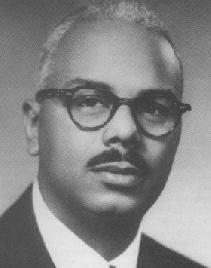 Cyrus Colter was a Chicago novelist and short story writer, now grievously overlooked, who had something vital in common with fellow writers T.S. Eliot, Franz Kafka, Wallace Stevens and Anton Chekhov. All abjured academia and the publishing racket, making their livelihoods in non-literary pursuits. Eliot was a banker, at least early on; Kafka was a clerk at an insurance firm; Stevens also worked in insurance, though at a higher level than the beleaguered functionary Kafka; and Chekhov was a dedicated physician and medical researcher.
Colter, who was born in 1910, was an attorney — his law school education, in the depths of the Depression, financed in part by janitorial work — who spent many years as a member of the Illinois Commerce Commission, eventually becoming its senior member. He also served as an IRS tax collector and a Captain in the U.S. Army during the Second World War, taking part in the liberation of Italy. He was on the Board of Directors of many Chicago cultural institutions, including the Chicago Symphony Orchestra. He didn’t write his first short stories until he was 50 years old, and didn’t begin publishing his work until he was 60.
While spending one’s career in writing workshops and academic and publishing circles doesn’t automatically enforce either stylistic or ideological conformity, it certainly does tend to bend many writers in that direction. Be that as it may, it seems highly likely that Colter would not have become the great writer he was had he not spent so many years of his life engaged in endeavors that were about something other than getting his writing published.
Colter has something else in common with Anton Chekhov. Colter’s collection of short stories, The Beach Umbrella (originally published in 1970 by The University of Iowa Press, and still available in various used editions) is Chekhovian both in the narrowness, and in the impressive scope, of its ambitions. Which is to say that Colter, like his famous predecessor, focuses closely on the ironclad traditions and prejudices, social expectations, and tightly knit communities that circumscribe the lives of ordinary people, while at the same time exploring with tender sympathy and tremendous subtlety their motivations, miseries, and endless and generally hopeless quests for something better in their lives.
Colter’s version of the Russian provinces and resorts where Chekhov set his stories is the South Side of Chicago, and his subjects were the Black bourgeoisie, working class, and struggling underclass of the 1960s. Colter, whose own family migrated from North Carolina to Indiana in search of freedom in the 1830s, took as his subject every social class in the variegated Black communities of mid-century Chicago. This is of note because (while my own knowledge of Black literature is hardly exhaustive) the predominant emphasis of American literary writers over the years, Black or otherwise, who chronicled the Black experience seems to have been on the Black underclass, usually viewed through a political, economic or sociological lens. Colter was different. The social and political factors are placed firmly in the background, and taken as just a fact of life; what he’s interested in is the psychology of his fictional subjects as they seek out the small joys and struggle against the disappointments, large and small, that define their lives.
His fiction, though the recipient of a good number of awards including the Iowa Short Fiction Award (the judge was Kurt Vonnegut, and the prize led to the initial publication of The Beach Umbrella) was also subject to criticism at the time that it wasn’t radical enough or political enough, and that it strove for timelessness rather than timeliness, a critique that Colter likely accepted as a compliment. Though precise sales figures are no longer available, it is highly likely that all his books sold modestly, like other university press and small press collections then and now.
The title story of The Beach Umbrella is a deeply touching example of Colter’s methodology. A middle-aged man, Elijah, escapes from his oppressive family, nagging wife, and humdrum warehouse job by basking alone in the sun at the Thirty First Street beach, every Saturday, all summer long. The beach had “fastened upon him a curious charm, a hex,” and he spends the day drinking lemonade, eating Eskimo Pies, and ogling the pretty girls in their bikinis. He is almost childlike in his pleasures, especially when he becomes infatuated by the colorful beach umbrellas everyone else seems to have. Short on cash and swallowing his pride, Elijah borrows $15 from his son and buys an umbrella of his own, though he must hide it from his wife as if it were a mistress.
But he is beside himself with excitement as he opens the trunk of his car where he has hidden it, and muses, “Ah, there it lay — encased in a long, slim package trussed with heavy twine, and barely fitting athwart the spare tire. He felt prickles of excitement as he look the knife from the tool bag, cut the twine, and pulled the wrapping paper away. Red and white stripes sprang at him. It was even more gorgeous than when it had first seduced him in the store. The white fringe gave it style; the wide red fillets were cardinal and stark, and the white stripes glared. Now he opened it over his head for the full thrill of its colors, and looked around to see if anyone else agreed.”
But like a guilt-ridden little boy whose stolen Snickers bar turns to clay in his mouth, Elijah soon realizes that he lacks the means to repay his son, and must sell his precious umbrella after only a single day of drunken fun at the beach. So he trudges up and down the darkening sand, looking for someone to buy it from him, and naturally no one is interested; a glowering lifeguard says, “The cops just now cruised by up on the Drive. I'd have turned you in so quick it'd made your head swim. Now you get the hell outa here." Then he calls him a “thievin’ bastard.” But, Elijah thinks as he drives home with the umbrella still hidden in his trunk, “it was great while it lasted…great.”
 Self-imposed guilt is a recurring theme in these stories. In “Overnight Trip,” a married man reflects on his much-younger wife and their “inept” sexual encounters once every two weeks: “To him she was inviolate. And more extraordinary still — and quite beyond his comprehension — was his dark intuition that she was inviolate even against himself. Whose fortnightly transgressions, he so regarded them, dismayed and saddened him — made him feel a ravisher.”
Another beautifully poignant story centers on a middle-aged woman who has fallen far behind in the social order; her former friends have ostracized her, among them “a cruel, vicious coterie of social brigands (who) boasted northern university degrees and light skins.” They have all married well-off men while her own husband has “plateaued” and is “content to go to the football games in the fall, and for the rest of the year to have in a few cronies periodically for poker in front of his tidy bar. Lately, to her secret disgust, he had been watching the late TV movies. He had long ago left the supervision of the two boys completely to her and sometimes she found she had three boys on her hands instead.” She reflects bitterly, “husbands were the key to everything.”
The woman accidentally learns of an elegant, catered bridge luncheon hosted by these former friends to which she has not been invited. And so, in the cold and the blowing snow, she sits slumped in her car observing the guests as they arrive, evaluating the fine wardrobes and jewelry of the “vain, lucky women” who have left her behind. She knows that if she were to be observed spying on them from her car, it would be a “fateful admission,” for she has “made a quietly desperate effort at indifference.” Yet she cannot bring herself to drive away and cease tormenting herself with envy.
White people barely figure into these stories at all. Neither does political or sociological “context-setting.” Colter is focused on his characters above all else as human beings — individuals with wants and needs, subject to envy and lust and ambition and loneliness and self-abnegation. Colter once said, “when blacks solve their immediate problem, which is ridding the country of the denial of opportunity based on race … then they will find themselves on the threshold of other monumental problems of the human condition.” It is clear that, in these stories at least, it was the latter challenge that transfixed Colter.
And yet, there is virtually no character in any of these stories who isn’t described by Colter in terms of the color or shade of their skin. No doubt this is a manifestation of the racism that Colter witnessed and likely experienced, but it also is made clear in these stories that “colorism” — as in the reference to the “vain, lucky women” with light skins — is rampant within the Black community itself. It’s just something that all of these characters have been marinated in, and is treated by Colter as such — a simple reality, like the economy, or politics — that is beyond their control and hardly bears discussing in an overt manner.
Colter uses setting just as effectively as he does psychology. In the story “Black for Dinner,” he describes the home of a self-absorbed “well-off housewife” who is too focused on the dinner party she’s hosting to notice that her husband is slowly dying of heart disease. Colter sets the scene and the mood like this:
“Friday evening arrived cold and rainy in early darkness. From outer Lake Michigan a wet November wind drove the slanting rain inland, dousing streets, parked cars, and the huge, swirling trees around Anita's big house, which from basement to attic was a schooner of blazing lights wallowing in the gale; and, inside, a wild fire leapt up the blackened cave of the fireplace, casting great, weird, frolicking shadows up against the paintings on the far wall.”
Not every critic and reader at the time was enamored of Colter’s determinedly character-driven, anti-didactic and non-ideological approach to fiction — nor of his willingness to explore the psychology of Black people who lived in grand, schooner-like homes, and not just in tenements. Reginald Gibbons, looking back at Colter’s critical reception in the Chicago Review in 2020, provides probably the best insight into Colter’s contemporary critical reception that would be available to anyone other than a professional traveling scholar, since hardly any contemporary reviews have survived outside of specialized collections.
Gibbons said, “The reception of Cyrus Colter’s work has been very disappointing to anyone who sees the scope, richness, and accomplishment of his work, and the lived experience that it represented. Most of the review comment on his work was by white writers. Far too much of it lacked understanding of his materials, and thus of what he was doing with them. There was to my mind often something repellently condescending in such comment.
“Like many American writers whose purposes, goals, and ambitions are artistically serious and full of emotional and intellectual risk, Cyrus was mostly overlooked by the critical establishment of America, and was also caught in the conflicts of politicized culture, even within the Black community. Yet these obstacles and this loneliness of the long-distance writer seemed only to strengthen his will to write utterly and completely as himself.”
Or, as Colter said himself on many occasions, in Gibbons’ accounting, “You have to write out of your own chemistry as a human being! You have to be yourself!”
In making comparisons to Chekhov, I am hardly exaggerating. Besides The Beach Umbrella, I have read only one other book by Colter, the controversial (for its sexual content) novel The Hippodrome, though he published five novels in all, in addition to his many short stories. His 1988 novel A Chocolate Soldier, widely considered at the time of its publication as his masterpiece, is out of print, but is available in used editions. I have ordered it from Amazon.
Later in life, he joined the faculty of Northwestern University and eventually held an endowed chair in the Department of African-American studies, but not before he’d lived a full and productive life and observed countless others. Cyrus Colter, who died in 2002, is a writer who deserves to be read and remembered. If some enterprising publisher is in search of a semi-forgotten fiction writer to bring back into print, Colter would be an excellent candidate.
Michael Antman is the author of the novels Cherry Whip and Everything Solid Has a Shadow. He is a longtime book and theatre critic and was a two-time finalist for the National Book Critics Circle’s Nona Balakian Award for Excellence in Reviewing.


 Back to Blog