An Interview with Author Patrick T. Reardon
Sunday, November 15, 2026
by Donald G. Evans
Patrick T. Reardon knows Chicago. He grew up in the West Side’s Austin neighborhood, at 135 N. Leamington, near St. Martin de Pores, then called St.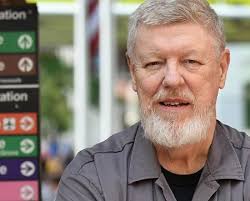 Thomas Aquinas. Then Patrick’s family moved to 79th and California during his college years; he later lived for a time in South Chicago, around 92nd Street and Commercial. He floated to various spots in Lincoln Park, before settling near Loyola University, near Devon Avenue and Clark Street. For three decades, the Chicago Tribune paid Patrick to write about the city and suburbs. His 2020 book, The Loop: The “L” That Shaped and Saved Chicago, stands as a near-definitive account of our city’s downtown transportation hub. Through that portal, Pat examines the evolution of Chicago as a city, including its character and identity and resilience. The Loop is an enormously entertaining history lesson, in which you learn so much along the way, about urban planning, construction, politics, diversity, architecture, culture, even literature. Pat’s gift to us is that he uses his considerable talent as an historian and journalist to research the subject, down to the minutia, and in that minutia lies joyous discoveries about Chicago and Chicago life. Pat also makes the connections that shows our future being shaped in ways we never anticipated or realized in the moment. The Loop is one of his eight nonfiction books, in addition to his eight published poetry collections.
DGE: The Loop. What does that mean, technically?
PR: There's three different answers to that. One is The Loop itself, the stuff inside the rectangular EL tracks structure. So that is “The Loop.”
However, there is The Loop community area. Chicago is divided into 77 community areas, and the community area for The Loop is not just the stuff inside the Elevated Loop, but it's all the stuff, it basically goes from the river to Roosevelt Road and from Halsted to the lake. Wikipedia has a whole a page for each one of these 77 community areas. So that's the second definition.
The third definition, though, is people will say, “I'm going to The Loop,” but they mean they're going to Michigan Avenue, or they mean they're going to the Art Institute. So The Loop is partly a very specific thing, but hardly anybody really uses it that specifically. They're much more loose in how they talk about it. It's sort of a synonym for Downtown. “I'm going Downtown.” Well, if you're going Downtown, you may be going to the Water Tower, and so it's vague, to that extent. The way the downtown got its name “The Loop” was because of the Elevated Loop, and it was a progression of the way people talked about it and thought about it that gave its name to the land inside. When you look at where you're at, if you're actually outside the Elevated Loop structure--north, west, east, or south--you're not technically in The Loop, but then you're in these other things called The Loop.
DGE: What qualities define Chicago?
PR: When you talk about the city, to my mind, the street grid is a really important thing in determining what it's like to live in Chicago. Leamington is 5100 west and Washington's just 100 north. You can go there. You don't need any lady in your car telling you which way to turn. Essentially, it's just all rectangles, [except] a few angled streets. The street grid is really important. The river is important, especially at the beginning of the growth of the city. Today, there’s a strong difference of opinion among Chicagoans between the Cubs and the White Sox, the North Side-South Side kind of division, which then gets real racial. That goes back to when the important part of the city was south of the river, and east of the river. So it's south of the main branch and east of the south branch, and then once you built bridges over the river, then it connected. The Elevated Loop had a similarly big impact in connecting the three sections of the city — the South Side, West Side and North Side.
DGE: Chicago brims with landmarks that give it definition, as well.
PR: I think for what it's worth, I would lean toward the Picasso sculpture as an image of Chicago more than the Bean, or a lot of other things, because it's so ambiguous and so strange. The Bean is just kind of warm and cuddly, which is why everybody loves it. And you can see yourself in it, and you can reflect from it. So that's a lot of stuff, but it's only touching the surface.
 DGE: Chicago embeds itself in the fabric of your work, not just the journalism but the poetry, as well.
PR: The street grid pops up all the time in my poems, partly because it really grounds the poem. I have a poem that I was working on in the last day or two, and I talked about one of the characters climbing the spire of a church at 71st and Vincennes. What I actually did then was look up [whether] there is a church there. There isn't, so I moved it to another place where there is a church. I like to talk about viaducts. I like to talk about the sidewalks. So the physical thing of the city helps ground the poetry, the emotions, and the ideas of the poetry. The EL pops up. I have a poem that mentions the El going through the night with the wheels, kind of like a prayer wheel. And bricks. I'm looking out my window at the brick two-flat next door, and bricks come in all the time, because it's so Chicago, but it's also so grounding. I can't write about flowers because I don't know anything about flowers. I can describe a flower as colorful or whatever, but flowers don't do much for me when I'm talking about the city. The city is Western Avenue. Driving Western Avenue from one end to the other gives a sense of the breadth of Chicago. You're starting at Evanston and you're ending up at 123rd or something, you've gone 20 miles just in a straight line through neighborhood after neighborhood after neighborhood. So neighborhoods: the feel of neighborhoods is a big deal.
DGE: These literary tours we've been doing—some of them we do on a bus. I never really appreciated how many viaducts there are in Chicago until we had to start driving the route to determine if the bus could clear each viaduct. Viaduct after viaduct, especially when we were on the Far South Side.
PRL Viaducts on the South Side, especially those viaducts just to the east of Western Avenue, it's the railroad line. That was such a dividing line, a racial dividing line, for a long time, particularly in that area. So it becomes this thing, this physical thing, which stops you from going through if you're too tall, but also it becomes this thing you can't cross. Chicago's full of lines that you can't cross, but the viaducts were a physical thing that really you knew. In fact, Stuart Dybek writes about a viaduct near 26 and California near the jail in his second book of stories, and it's just a wonderful evocation of how the viaducts were a great place to hang out, but you might not want to be there if somebody else was hanging out there.
DGE: Joe Meno also writes about Western Avenue as a dividing line. He grew up in Evergreen Park, but his stories are set on the Southwest Side. He went to school in Chicago at Brother Rice, and in his novels, there's a kind of fluidity between the suburbs and the city. Western Avenue was the dividing line between Blacks and whites, basically.
PR: Right. When my family moved to 79th and California, the dividing line was more Ashland, and then there was this movement. It was a much slower movement than the movement that had taken place on the West Side. When we moved out in '69, there were only a few white families left in Austin, and it had all happened in two years. There had been this migration across the West Side, and it was real fast because it was being fed by panic peddlers and by fears and by racial antipathy, but it was also fed by the fact that because of The Depression in World War II, nothing had changed in these neighborhoods for 20 years, and then suddenly it changed, and it just changed in a huge way. Part of that too was people were not moving back into the neighborhood; they were moving to the suburbs because it was cheaper.
DGE: Your book is called The Loop: The “L” That Shaped and Saved Chicago. It's meant to be, and I think it is, the definitive history of the El. But of course to get to that definitive history, you give credit to a lot of the historians that came before you, and you seem genuine and effusive in your praise for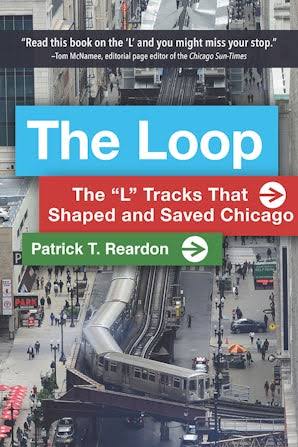 some of the work that they've done, and that you used as building blocks for your own research. What was it about the previous histories that needed updating, or was it that you wanted to center the discussion a little bit differently than it had been done in the past?
PR: I was one of the really smart ones that published my book on Thanksgiving Day in the middle of COVID, the first year of COVID. Nobody was seeing anybody, so I ended up doing 20, 30, Zoom or Zoom-type presentations, which are fine except you don't sell any books. It’s not like you can have a book table. People would ask a question about the gauge of the tracks and stuff like that. I said, “I don't know any of that. I'm not a transportation expert.” My book is focused on The Loop. The rest of the El, it obviously ties in. But I wasn't trying to write the definitive El thing. That had been done. Bruce Moffat wrote this really big transportation-ish thing that touches on everything. I use that as the Bible for technical stuff. And it also turned out the guy I'd been playing basketball with for 20 years was the chief engineer at the CTA; I didn't know that until I started writing work on the book. The genesis of the book was…I had been gathering information, research, for a different book on Chicago, where I was going to look at different individuals to go through a progression of the city's chronology. At some point I realized I had to be able to say where the name “The Loop” came from. This had come up when I was at the Tribune, and I had written about it and quoted Bruce Moffat and some other people saying it was because of the elevated structure. The problem was, for 50 years, historians in a knee-jerk way had been just saying that the name The Loop came from the cable car loops, the first one of which was built in 1882, I believe. So they said, "Oh, The Loop meant the cable car loop,” as if it was one cable car loop. In fact, there were six cable car loops, and each one was a tiny one. So Bruce said he'd never run into the downtown [being] called The Loop until after the Elevated Loop was built, and so, I'm a reporter, I knew how to do these things and I knew how much work it was going to be, but I thought, “Alright.” So I started looking, and I used The Tribune database, The Tribune files that the public library has, and starting from before the cable car loop was put in. I started tracking the use of the word “loop,” and, to make a long, long story short, I looked at thousands of Tribune articles. The word “loop,” as a transportation thing, was used in The Tribune to talk about the cable car loops, but it was never used to talk about the downtown. I tracked it all the way to when the Elevated Loop was built. For 50 years, historians had been writing that it was from the cable car loops; after the first few, the ones who came after would often not even source it. They would just put it in because it was common knowledge among historians. “Well, those Chicagoans they think it was from the Elevated Loop, but they're wrong, it's from the cable car loop.”
I get to the point where I can prove to myself that the word “loop” was not used because of the cable car loops. In addition to that, I was looking at the memoirs of Clarence Darrow and Edgar Lee Masters, who were of all things law partners, and they each wrote memoirs and talked about and used the words, something like this, “Where we were walking later became called The Loop.” That was like 1893, 1894, so if it wasn't called The Loop when they're walking there. There were lots of other things that I touched on, lots of other books, novels about Chicago that I looked at. At that point, in 1897, in October, when the elevated loop is finished, I know that it didn't come from the cable car. At that point, the downtown isn't being called The Loop yet, so I tracked it some more and tracked it all the way to basically to New Year's Eve of 1911; this is almost 15 years afterwards. What had happened in those 15 years was there was this evolution of the way people talked about The Loop elevated structure and its relationship to Downtown.
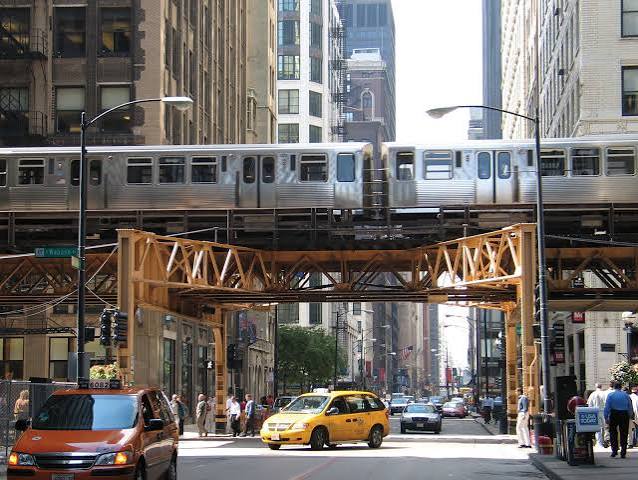 You’ve got to remember, these EL tracks are two stories above your head, and they're making all this noise and there's dirt and it just looks really kind of rusty. Algren called it “the rusty heart of the city.” As a physical thing, it's imposing. Also, even before it was finished, all the businesspeople knew the land inside The Loop was worth a lot more than the land outside. The reason for that was people would use the elevated trains to come downtown, and they would go to shop. Well, so they got off and moved toward the area within the tracks, because that's where all the stores were. They didn't move to the outside, they moved inside. Over the years, real estate writers in The Tribune, [would propose expansion] south from Harrison to, say, Roosevelt, to make more room. In fact, this was one of the big fights that almost blocked the elevated loop from being finished. Levi Leiter, who had property outside of the Loop footprint and wanted to make sure his property was inside, was trying to block it. So the first evolution was, people talked about the land inside The Loop structure. By 1911, The Tribune had a New Year's Eve story, and in every reference to the downtown, it called it The Loop. So, the downtown became called The Loop because of the way people talked about it. The same way that the Bean got the name the Bean because people called it The Bean.
This was the way you could get to any part of Chicago by the Elevated trains, any section, any area. You could come in from the West Side and change trains and go to the North Side or go to the South Side. It was really important in knitting the city together, and it created an area that belonged to all of Chicagoans. Everyone felt comfortable in their own neighborhood, but they felt uncomfortable everywhere else, except The Loop. The Loop became this common place for all Chicagoans. All of that was very important, and I thought, “Well, all right, nobody's told that,” and then I realized that over the next 50 years, when throughout the country the pattern after World War II was to move out to the suburbs, and this suburbanization undercut cities all over the place and destroyed many downtowns, Chicago was able to hold it off because this very tight area held together all this wealth, and the people that owned the wealth couldn't walk away from it, the way they could in a Cleveland or an Akron, where the downtown was much less dense and much less cohesive. Once I realized how important this was, I needed to tell people that. That’s how that's how the book came to be.
DGE: I found it fascinating, this idea that even before the trains were built, before the El was built, that there were going to be winners and losers. If you're inside The Loop, you’re a winner; if you're outside, you're a loser. That was back in the late 19th century when it was being built, 1897. As we were doing our downtown literary walk, we came through the financial district canyon, and then down Van Buren. As we walked east on Van Buren, which is of course the southern portion of the line, we neared the Harold Washington Library, around Federal, I guess. Just to the south, just outside of The Loop. there's an SRO, and a dive liquor store. There's a pawn shop. Amidst all this affluence in 2026, it's still a clear demarcation between being inside and being outside.
PR: There were a lot more of those SROs along that southern border until some of these new buildings were built; not only the southern border, but also the east and the west. The north, for that matter. If you remember, the North Loop had had a bunch of strip clubs right at the north end of Dearborn. All the way around the southern border, there used to be mob-owned adult video shows.
DGE: You knew this book was going to be a gargantuan task, and what impressed me as I went through the pages was the vast array of intellectual areas that underpin the story: architecture, engineering, transportation, politics, labor, so forth, so on. You had to understand Chicago's geography, its social nuances, its sensibility, and so much more to even make a framework for this narrative. Did that excite you or daunt you, or both? When did you say, “I'm willing to make this investment, knowing how huge of a task this is?”
PR: Like I said, I started on a different book, and so a lot of that, the early research, I was able to incorporate in some way. But it took 11 years of research and writing, and it was exciting. First of all, I see this as a biography of the Elevated structure and the downtown, but also a biography of the city. I hope when you read the book, you get a sense of Chicago in a very integrated sense. It's about how the neighborhoods and the downtown weave together. It's about how engineering can affect the everyday lives of people. A physical structure can reshape the way people go about their days.
We know that when you put in the Dan Ryan Expressway, suddenly that became a dividing line. But this Elevated Loop, I argue in the introduction, this is the most important structure in the city's history because it did so much to knit the city together and to protect the downtown, and to create and protect the downtown, which in the long run protected the rest of the city. So this was an exciting thing, and I was constantly on the search for people and for stories, because I'm writing about wood and steel and girders and there's no personality there.
DGE: You wanted to show how human beings interact with the physical world?
PR: The [Harold M.] Mayer and [Richard C.] Wade book, City of the Century, had a mention in there of a Japanese tourist who looked at the Elevated train going by and said it was like being in hell--or something like that--and they didn't identify who the tourist was. I started searching around, and he's quoted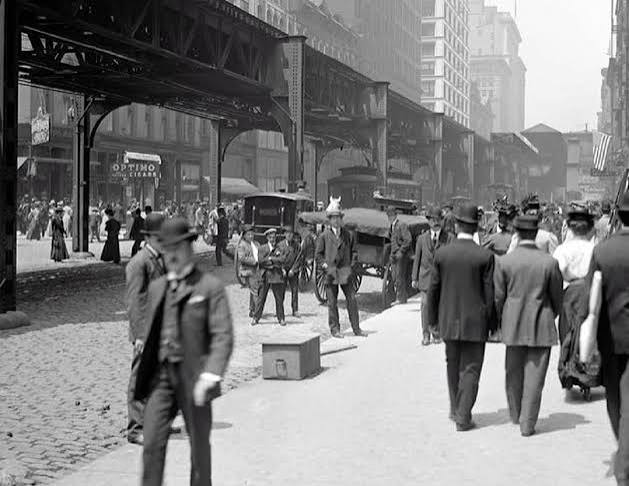 by other people. I'm not sure who was the first one to quote him, but they were all quoting the same sentence. I wanted to get the whole thing, so I tracked down who this guy was, and found his book. His references to Chicago were just spectacularly evocative and interesting, and so I was able to weave him into the story at various points. Wherever I could find people--whether it's in a Tribune story or whether it's in a book or whether it’s a magazine piece—talking about what the city looked and felt like, that's what I was trying to get to take this skeleton of a story and put meat on it.
DGE: For our literary tour, we chose the old Randolph Wabash stop, which has been raised and moved down the block a little bit, but we chose that one mostly because there's a scene from the Bellows novel, The Dangling Man, set there. It was a nice place to stop and tell a little bit about the E and the CTA and its relationship to literature. The downtown transportation system finds its way into a fair amount of Chicago literature, doesn't it?
PR: I came across a file folder that I still have even though I've given most of my files to the archives at Northwestern [University], but this was a file folder for a story I wrote about [on September 2, 1999] literature and the EL. In Jane Hamilton’s A Short History of a Prince, it's these three kids who are going downtown to [ballet] school, and two of them, Susan and Mitch, are in love with each other, and so on the EL down and back, they're necking the whole time, and their friend Walter, who is just realizing he's gay, is like a third wheel, and at one point he's saying to himself. “What happens to love if it isn't collected?” He wanted to know. He might ask this question out loud. He might stand and go from commuter to commuter down the aisle, asking each one what he thought about the old unsolved problem that science and mathematics had never tackled, and literature and opera only fleetingly illuminated. “Where,” he'd ask, “Does love go?’” This was written in [1998]. So Jane Hamilton writes about it. Carl Sandburg wrote poems about people in and around The Loop, and of course, City on the Make deals with the whole EL system, as with his “the rusty heart of the city,” which was the downtown Elevated Loop. What I found when I did this story essentially was when writers wanted to give a real sense of the grittiness of Chicago, they put their characters on the EL because there's nothing quite as gritty or as separate as the EL. If you're riding the EL, it's different from the subway; on the subway, you don't see anything. But if you're riding the EL, you see the whole city. You're seeing all the church spires and all the tall buildings, and you are kind of out of yourself. You're out of ground-level life, and you're in this two-story-up life. Bill Brashler had one of his characters doing this, and there are others. It just is a very gritty way for characters to interact with Chicago and to be interacted with.
DGE: It was the Bill Brasher novel City Dogs. Was that the one?
PR: Yes.
DGE: You write in your book about how the EL is part of the fabric of Downtown and really the fabric of Chicago. You said it's one of the most identifiable structures in the city. I think that is part of why it's now almost a film cliché to use the EL as an establishing shot for Chicago. But it works, just like a Cubs hat or the lions in front of the Art Institute, in placing the story. As soon as you see the EL, you know where you are. I think of it that way in terms of the way it's used in literature. It's in and of itself an adventure. It has tension. It holds potential conflict. And as you mentioned, you're looking at the church steeples. You're looking at tall buildings. You're also looking below, and at times you're almost kissing the six flats. In terms of a literary device, it gives an author endless possibilities, one way or another.
PR: It says travel, you know. It’s like all those railroad novels, or novels where railroads show up, or now airplanes. It’s travel, but it's also being combined with other people who you don't know. It's all those disaster movies from the '80s where people would be in tall buildings, and they get stuck in an elevator. With people. It’s this edge of danger. My brother used to look out the window when we'd go around the corner into The Loop, and he'd say, "We're going to fall. We’d all laugh, because, well, you're not going to fall and because it does this all the time…except then one time it did fall because it got hit from behind. So there is this this edge of danger to it. There's this mixing of races, mixing of cultures, and if you ride the Red Line from Howard, the closer you get to Downtown, more and more African Americans start to get on, and then once it goes into the subway and then comes out, by the time you come out around Roosevelt, it's mainly African Americans, and so this it is a visual lesson in what the city's race relations are--racism is too blunt a term; it's a very complex thing.
The guy who designed the The Loop was a guy who designed bridges. So when you think of the Elevated Loop Downtown as a kind of bridge, it becomes this other thing. It’s not just travel, it's also connections.
DGE: It’s such an interesting and important book and there are lots of different threads that I found compelling. One of them, it's a story you hear in different ways in Chicago as well as every other city, it’s the path not taken. I think of the story of Montgomery Ward helping to fight off developers and city officials from wrecking the whole lakefront. It would have been an irreversible moment; Chicago would have been a completely different city. In your book, the discussion is about all the people that just hated The El. It was dirty. They thought it was dangerous. They thought it was too noisy. Their opinion was that we need to get rid of it and do something better, and this persisted for…
PR: Eighty years.
DGE: Eighty years, okay. Tell me a bit about that story and how The EL survived. How did we manage to keep it from being torn down?
PR: Even before it was finished, people were suggesting it should be torn down. Every five, six years, somebody would say, “We got to get rid of it.” Mayors would say, “We got to get rid of it.” Reports would say, “It has to be taken out.” Dick Daley said when he was first elected, “We're going to get rid of The Loop.” This whole movement to get rid of The Loop was a signal to me of how much people did not understand how important it was. How important it was to contain this downtown in a way that that kept all the money together. There’s a class thing going on here, because the people who are saying, “It's ugly” are the people who have fancy buildings Downtown and the architectural fans. The people who ride the EL, they're not complaining. So many people rode the EL that you couldn't get rid of it. You had to put up with it. But then there was this hope that federal money would come to create two new subways that would then permit the elimination of the EL, and so in 1978 there was this big fight; Daly was on the verge of tearing down two of the sections of the four-section EL. But a Tribune reporter, Paul Gapp, who was a great reporter and also the architecture critic, contacted people and found out that Daley was going to tear this down. He wrote a story and said, "This is what Daley's going to do.” Daley stopped because what he wanted to do was tear it down the way his son messed up Meigs Field, a done deal by the time anybody knew about it. Dick Daley could not pursue it at that point because Paul Gapp blocked him. There was this year-long fight or argument over whether it should be taken out, and the city thought if we just tear it  down, tear down part of it, then the federal government will be forced to send us money. Well, that wasn't going to work. Harry Weese, who was an architect and really liked sticking it to Daley, was spearheading the fight to keep The EL. And among the people who were for tearing down The EL was what's called Landmarks Illinois now. They wanted to get rid of it because if you got rid of it, then you could see the pretty buildings better. It was right on the edge of being torn down, in one way or another, and then it snowed a lot, and Mike Bilandic lost the election to Jane Byrne. Jane Byrne came in, and she decided not to tear it down, to save it and fix some of the stations and to transfer money from the crosstown expressway that was never built to fix up the The Loop.
So Jane Byrne came out of nowhere to save it, and then at that point, that was the dividing line between the period where everybody thought the Elevated Loop looked ugly, to the beginning of the understanding that the Elevated Loop gave Chicago character.
DGE: You've done so much in your career, Pat; you're going to leave a very rich and important legacy. This book is going to be a big part of it. What do you want the legacy of this book to be? What’s your ideal vision of what the book will have accomplished?
PR: I hope that it filters down to the decision makers to understand that physical things, structures, have these huge social implications. The story of The Loop, to my mind, tells us that when we build something or take something away, there are ramifications, and a lot of it is ramifications we don't expect, or ramifications we don't even realize until 80 years later. I hope the legacy is that the people who set policies will recognize that there are things that can be done that bring people together, and there can be physical things that drive them apart. I think the book [shows] that [The Loop] tied the city together in lots of ways, and that's what I hope people remember.
DGE: We could go on, but that’s a good place to stop. Thanks, Pat.
PR: Thanks so much for all your work here.
Donald G. Evans is the author of a novel and story collection, as well as the editor of two anthologies of Chicago literature, most recently Wherever I’m At: An Anthology of Chicago Poetry. He is the Founding Executive Director of the Chicago Literary Hall of Fame.


 Back to Blog